September 25, 2026
Ikebana Vessels for Beginners | Placed, Hung or Suspended — How the Vase Shapes the Flowers
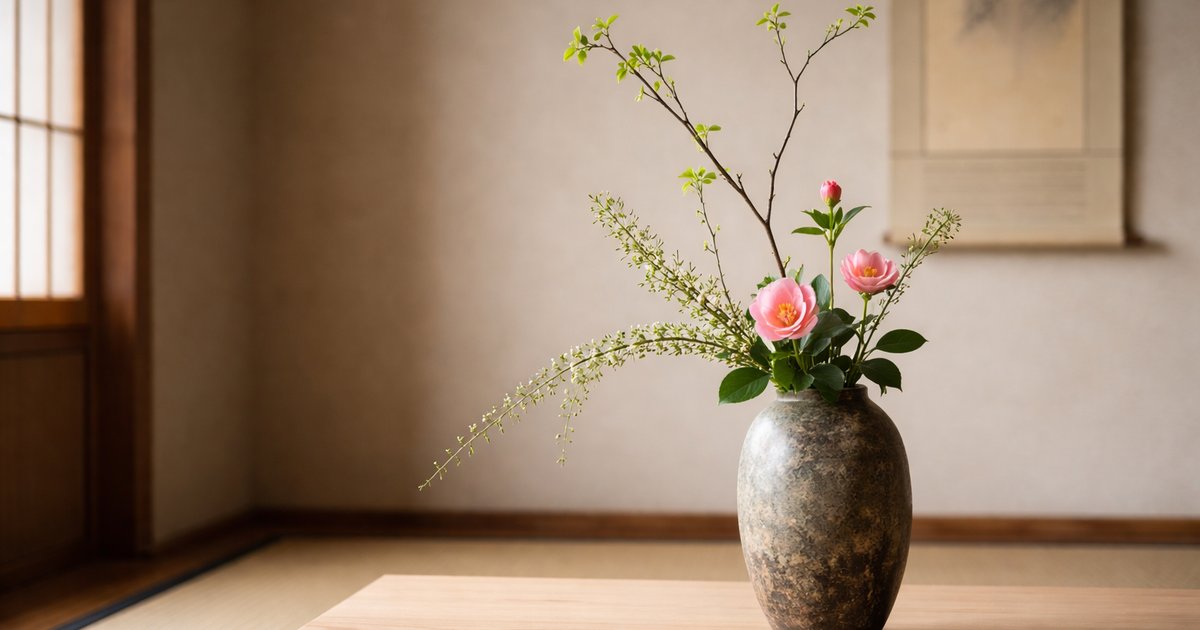
When we think of ikebana, our eyes go straight to the flowers.
But what quietly decides where a flower stands, and in what posture, is the vessel. In ikebana, the container you arrange in is called a kaki (花器), literally a “flower vessel.”
Ikenobo’s official site calls vessels the most varied of all ikebana tools. There are countless shapes and materials. Yet if you’re just starting out, one idea will change how you see them: a flower vessel can be placed, hung, or suspended.
What this article covers
- The basic shapes and materials of ikebana vessels
- Placed, hung and suspended — and the scene each one creates
- Boat-shaped vessels, and the “departing” and “arriving” boat
- Rikyū’s cracked bamboo vase, and “the leak is its life”
- Choosing a vessel at home
Four shapes, many materials
Ikenobo groups vessel shapes into four broad families: tubes, jars, suiban and deep bowls. A suiban is a wide, shallow basin, almost like a plate of water.
Materials range from earthenware and porcelain to glass, bamboo, bronze and iron. Pottery from famous kilns such as Kiyomizu or Shigaraki comes in especially rich colours and forms. Glass shows the stems under the water, so a clean, simple arrangement suits it. Bamboo deepens with use — a vessel you “grow.” Bronze is the weighty, traditional choice that has served classical ikebana for a very long time.
At Ikenobo, the style of arrangement also decides the vessel:
- Rikka (the grand, formal style): deep bowls, or shimokabura vessels that swell out near the base
- Shōka (the simpler classical style): tubes, suiban, and vessels hung on a wall
- Jiyūka (free style): no fixed rule — choose whatever fits your image
We introduced the main schools in our guide to ikebana schools.
Placed — the most familiar vessel
These sit in an alcove, on a shelf or on a table. Basins, jars and tubes — most of the vases you see every day belong here.
Among bamboo vessels, the simplest is the zundō. Nihon Kadōsha, Ikenobo’s publisher, puts it plainly: bamboo becomes a fine flower vessel just by being cut. A zundō is a thick stalk sawn straight across, about 30 centimetres tall. It’s hard to imagine a humbler tool.
For how flowers are held upright in a shallow basin, see our article on kenzan and other flower holders.
Hung — flowers floating on the wall
These are small vessels hung on a pillar or wall. Nihon Kadōsha describes the result as flowers that seem to float in mid-air.
Take the bamboo ichijūgiri: a length of bamboo with its nodes kept, and a single window cut across one side. A thick one is set down; a slender one is hung. Same shape — completely different feeling.
The tea room makes the same distinction between placed, hung and suspended flower containers. You can read more in our article on chabana, the flowers of the tea room.
Suspended — the boat vessel
The third kind hangs from the ceiling, and its best-known form is the boat. A boat hung on a chain is a tsuribune; one set down is an okibune.
Here’s the lovely part: the direction of the boat means something. According to Nihon Kadōsha, in Ikenobo shōka, if the bow points to the viewer’s left and the stern to the right, it’s a defune, a departing boat; the opposite is an irifune, a boat coming home. The departing boat is an arrangement for celebrations — a ship leaving harbour, like someone setting out on a new path.
Even the flowers take nautical names: parts of the arrangement are called the sail (ho) and the oar (ro). One vessel turns an alcove into a small seascape.
These boat conventions differ from school to school. A column from a Mishō-ryū ikebana teacher, for example, explains that hanging the boat higher or lower turns it into a ship out at sea or one close to the shore.
A cracked bamboo vase: “The leak is its life”
One last vessel.
The Tokyo National Museum holds a bamboo vase named Onjōji. According to Japan’s Cultural Heritage Online, it is one of three bamboo vases said to have been made by the tea master Sen no Rikyū in 1590, from bamboo cut at Nirayama in Izu, while he accompanied the warlord Toyotomi Hideyoshi on his siege of Odawara.
A long crack runs down its front. The vase is said to have been named after the bell of Onjōji temple (also called Mii-dera), which legend says cracked when the warrior-monk Benkei dragged it away.
The Omotesenke school of tea tells a story about it. Water leaked from the crack. When a guest pointed this out while Rikyū was using it, he is said to have replied: “The leak is this vase’s very life.”
We can’t know how much of that really happened — even Rikyū’s authorship is “traditionally attributed.” But someone kept a split piece of bamboo, made it into a vase, and gave the crack a name. That alone shows how the vessel, just like the flower, was valued for exactly what it was.
Trying it at home
- Start with what you have. Ikenobo suggests small bottles and mini vases for tight spaces. A drinking glass or an empty jar is a perfectly good “placed” vessel.
- Think about where it will stand. A shallow shelf suits a tube better than a wide basin, and whether you’ll see it sitting or standing changes the right height.
- Own one white or black vessel. Ikenobo notes that monotone vessels go with flowers of any colour.
In closing
Next time you bring flowers home, look at the vessel for a moment before you begin.
Placed, hung, or suspended? A tall tube, or a shallow dish? Once the vessel is chosen, the way the flowers stand — and the whole scene in the room — begins to follow. Maybe ikebana starts a little before your hands ever touch a flower.
Sources
- Ikenobo official lesson site, “What kinds of vessels are used in ikebana?” (materials, colours, shapes; tube, jar, suiban, deep bowl; rikka = deep bowl / shimokabura, shōka = tube / suiban / wall-hung, jiyūka = no rule; vessels are the most varied tool; small bottles and monotone vessels) (Japanese)
https://lesson.ikenobo.jp/ikenobomedia/kaki/ - Nihon Kadōsha, Hanaraku flower shop, “Bamboo vessels” feature (zundō about 30 cm; ichijūgiri placed if thick, hung if slender; hung vessels “float in mid-air”; boats: defune = bow left, stern right, irifune the reverse; sail and oar; defune is for celebrations) (Japanese)
https://www.kadosha.co.jp/view/page/bamboo.html - Nihon Kadōsha, Hanaraku flower shop, “Tsuribune” (a hanging boat-shaped vessel; defune and irifune by the direction of the opening) (Japanese)
https://www.kadosha.co.jp/view/item/000000000246 - Mishō-ryū Azuma Jūho ikebana school, “Handling the boat” (tsuribune and okibune; hanging height suggests open sea or shoreline) (Japanese)
https://www.misho-azuma.info/post/2016/08/06/船の取り扱い - Cultural Heritage Online, “Bamboo single-window flower vase, named Onjōji” (attributed to Sen no Rikyū; said to be made from Nirayama bamboo during the 1590 Odawara campaign; given to Sen Shōan; named after the cracked bell of Onjōji; formerly owned by Matsudaira Fumai) (Japanese)
https://bunka.nii.ac.jp/heritages/detail/540901 - Omotesenke Fushin’an, “Rikyū’s flower vases” (water leaked from the crack; Rikyū is said to have answered that the leak was the vase’s life) (Japanese)
https://www.omotesenke.jp/chanoyu/7_6_20a.html
Names, categories and boat conventions differ between ikebana schools; this article mainly follows Ikenobo (Nihon Kadōsha). The making of the Onjōji vase and Rikyū’s words about the leak are both traditional accounts. Whether the vase is on display varies over time.