September 24, 2026
Bakōhan: The Tea Bowl Called “the Origin of Kintsugi” Was Mended With Iron Staples, Not Gold
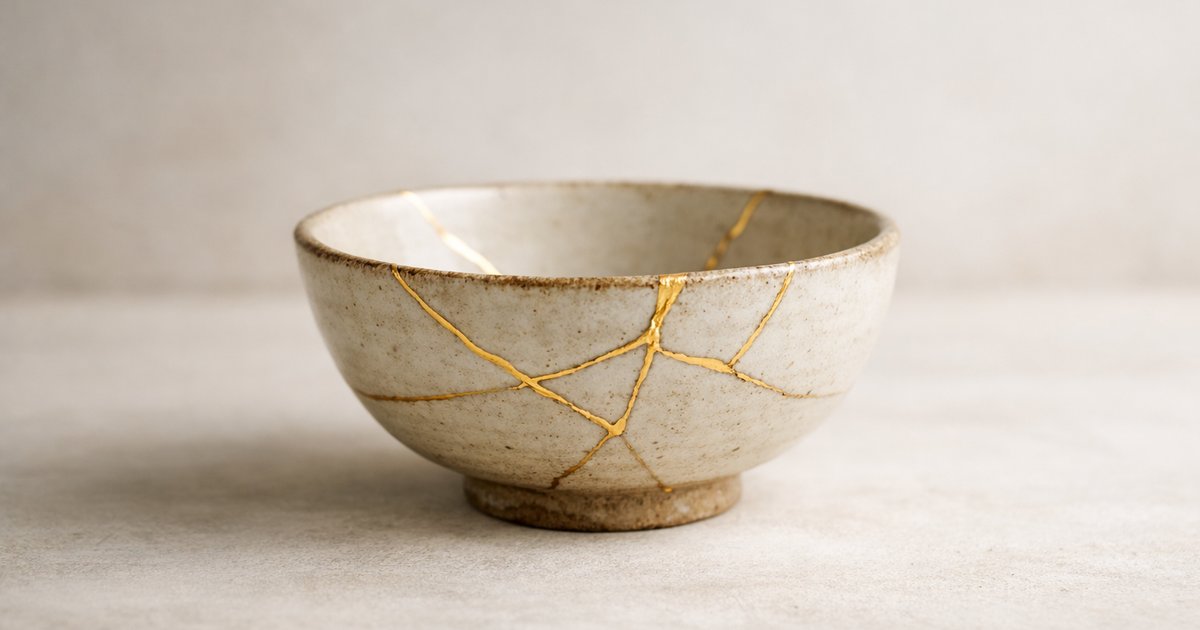
If you read about kintsugi for long enough, you’ll probably meet this story.
In the fifteenth century, the shogun Ashikaga Yoshimasa sent a cracked Chinese tea bowl back to China. It came home repaired with crude metal staples. Unimpressed, Japanese craftsmen set out to find a more beautiful way to mend — and that, the story goes, is how kintsugi began.
The bowl in that story is real. It sits in the Tokyo National Museum as an Important Cultural Property: a celadon tea bowl named Bakōhan (馬蝗絆).
And when you actually look at it, you notice something surprising. There isn’t a speck of gold on it.
What this article covers
- What kind of bowl Bakōhan is
- Staple repair (kasugai), a different way of mending
- Where the name comes from — and what “bakō” might mean
- How much of the story we can actually trust
- Its real relationship to kintsugi
A blue-green bowl from thirteenth-century China
Bakōhan was made in the Longquan kilns of what is now Zhejiang Province, China, during the Southern Song dynasty (13th century). It’s celadon — stoneware or porcelain covered in an iron-bearing glaze that fires to a soft blue-green.
Japan’s National Institutes for Cultural Heritage describe it as especially beautiful in form and glaze among the celadon tea bowls that reached Japan. Its rim is notched in six places, so the bowl opens like a flower.
A crack runs from the rim down around the base, and that crack is held shut with iron staples, called kasugai (鎹) in Japanese.
Mending with staples
A kasugai is a small U-shaped metal clamp — think of the kind used to join two pieces of timber.
To mend a pot this way, a repairer drills tiny holes on either side of the crack, sets the clamp across it, and pulls the two sides together, a little like stapling paper. It doesn’t hide the break, and it doesn’t decorate it. It simply holds it together.
That’s a completely different idea from kintsugi, which glues the break with urushi lacquer and finishes the seam in gold. We walked through the kintsugi process step by step in our article on how kintsugi is done.
Sent back cracked, returned with staples
The bowl’s story comes from a short text called Bakōhan Saōki (Record of the Bakōhan Tea Bowl), written in 1727 by the Edo-period Confucian scholar Itō Tōgai. The text is still kept at the Tokyo National Museum along with the bowl.
Following the National Institutes for Cultural Heritage summary, it goes like this:
- In the Muromachi period, the bowl came into the hands of the shogun Ashikaga Yoshimasa
- It had a crack in the base, so he sent it to China and asked for a replacement
- But China at that time (the Ming dynasty) no longer had a celadon bowl this fine
- So the crack was fastened with staples and the bowl was sent back to Japan
- The staples looked like big locusts — and instead of spoiling the bowl, they raised its reputation. It was named Bakōhan.
The last character, han (絆), means “to tie” or “to bind.” So Bakōhan is, quite literally, a name that means “the bakō-shaped fastener.”
The mark of the repair became the bowl’s name. That’s the most wonderful part of this story.
A locust — or something else?
As for what bakō (馬蝗) actually refers to, there’s more than one reading.
In Japan it’s usually explained as a locust, as in the National Institutes for Cultural Heritage description. But in Chinese, mahuang (馬蝗 / 螞蟥) normally means a leech, and some scholars suggest the staples were likened to leeches clinging tightly to the crack. Other research points out that in the Edo period, “bakōhan” was also used simply as a word for the staple itself.
No one reading is settled. But locust or leech, the image is the same: a little creature perched on the crack, holding on.
How much of this is true?
Here it’s worth slowing down.
Tōgai’s record was written roughly three hundred years after Yoshimasa’s time — and it’s considered the oldest surviving document to mention this bowl at all.
In an interview with the Japanese magazine Waraku, Tokyo National Museum researcher Keiko Mikasa gave several reasons for doubt: the bowl doesn’t appear in the Muromachi shogunate’s records; there’s no trace of it in the tea-gathering diaries of the following centuries; and the story may have been created later to raise the standing of the family that owned it.
The National Institutes for Cultural Heritage also say one part of the legend — that the bowl once belonged to Taira no Shigemori, a warrior of the late 12th century — is “difficult to accept as historical fact,” since the bowl itself dates from the Southern Song. At the same time, because the bowl was handed down for generations in the Suminokura, a wealthy Kyoto merchant family, they judge the tradition to be credible, and note that it comes in a special Chinese-made lacquer case — so it certainly came from China for some special reason.
Put simply:
- It was clearly a treasured bowl brought over from China
- The part about Yoshimasa sending it back hasn’t been confirmed
So is it where kintsugi began?
The final step — “and so Japanese craftsmen invented kintsugi” — is even harder to pin down. The English Wikipedia article on kintsugi itself introduces it as just “one theory.” The honest answer is that no one knows exactly when or how kintsugi began.
But what this bowl has to teach us isn’t really about origins.
Bakōhan isn’t decorated with gold. It simply has iron staples lined up along its crack — six of them, according to Tōgai’s record. And yet — or perhaps because of that — it was given a name and cherished for centuries.
The feeling of loving something together with its repairs doesn’t need gold. It’s right here. If you already love kintsugi, this rough little bowl may move you more than you expect.
If you’d like to see it
- It’s in the Tokyo National Museum’s collection. It isn’t always on display, so check the museum’s exhibition information before you go.
- You can see it online any time. The National Institutes for Cultural Heritage’s “e-Kokuhō” database has large images where you can see the staples clearly.
- Keep an eye out closer to home, too. In antique shops and exhibitions of old ceramics, you’ll sometimes spot pieces with tiny metal clamps across a crack. That’s staple repair.
In closing
When something breaks, you mend it. When the mend shows, you accept it as part of the piece.
We can’t know how much of Bakōhan’s story is true. But a bowl with six iron staples on it has been treasured, name and all, for nearly three hundred years at least — and that part is sitting right in front of us.
The next time you come across kintsugi, spare a gentle thought for this plainer way of mending that sits right beside it.
Sources
- National Institutes for Cultural Heritage, e-Kokuhō, “Celadon Tea Bowl, known as Bakōhan” (Japanese) (Longquan ware, Southern Song, 13th century, Tokyo National Museum / Itō Tōgai’s Bakōhan Saōki, 1727 / Yoshimasa sought a replacement in China because of a crack; it was returned fastened with staples / named after staples resembling locusts / Taira no Shigemori’s ownership difficult to accept as fact, but the tradition is credible given its transmission in the Suminokura family / its Chinese-made case shows it certainly came from China for some special reason)
https://emuseum.nich.go.jp/detail?content_base_id=100886&content_part_id=001&langId=ja - Waraku web, “The legend of Yoshimasa’s famous tea bowl Bakōhan… isn’t true? We asked a researcher” (Japanese) (interview with Keiko Mikasa, Tokyo National Museum: absence from shogunate records and tea diaries; possible later creation to raise a family’s status)
https://intojapanwaraku.com/rock/culture-rock/245410/ - Cultural Heritage Online, “Celadon Tea Bowl with Foliated Rim, known as Bakōhan” (Japanese) (Important Cultural Property)
https://bunka.nii.ac.jp/heritages/detail/479058 - Wikipedia (Japanese), “馬蝗絆” (six-lobed rim; six iron staples; donated to the Tokyo National Museum in 1970 by a couple of the Mitsui family / “six iron nails” in Bakōhan Saōki / that text is the oldest document to mention the bowl / readings of “bakō” as locust, as leech (螞蟥), and Takahashi Tadahiko’s view that it was a Ming-era word for a staple)
https://ja.wikipedia.org/wiki/馬蝗絆 - Wikipedia, “Kintsugi” (Yoshimasa’s bowl as the origin of kintsugi is presented as “one theory”)
https://en.wikipedia.org/wiki/Kintsugi
The account in Bakōhan Saōki (that Yoshimasa sent the bowl to China and it came back stapled) was written about three hundred years after Yoshimasa’s time and has not been confirmed by contemporary records. The idea that this bowl led to kintsugi also lacks firm evidence. Interpretations of “bakō” vary. Whether the bowl is on display depends on the season.