September 6, 2026
How Kintsugi Actually Works | The Gold Is Not the Glue — and Yobitsugi, Where the Missing Piece Comes from Another Bowl
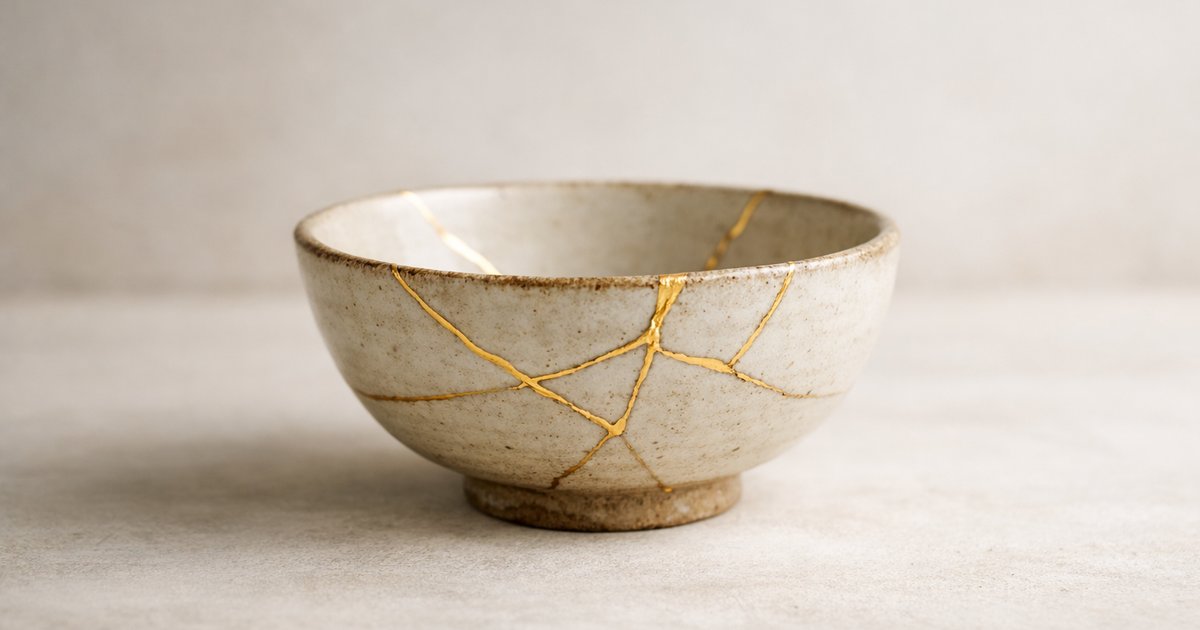
You have probably met kintsugi as a metaphor first. A broken bowl, a seam of gold, a caption about how the damage is the beautiful part.
This article is about what actually happens to the bowl.
Start with a correction that changes everything: the gold is not holding the bowl together. The adhesive is lacquer — urushi, the sap of a tree. Gold arrives at the very end, as the thinnest possible layer, in a step that takes minutes out of a process that takes months.
So what happens in all the time before that? This is where kintsugi gets genuinely interesting. In Japanese, a broken pot has different names depending on how it broke — and each name calls for a different treatment. And when a fragment is simply gone, it can be replaced with a piece of a completely different bowl.
Here is the route a broken bowl travels, explained for beginners.
What you’ll find here
- Why the way a piece broke decides how it gets repaired
- How one material — lacquer — becomes glue, filler and primer
- Why the gold is the thinnest and last thing that happens
- Yobitsugi: filling a gap with a shard from another vessel entirely
- Why real-lacquer kintsugi takes months, and cannot be hurried
- The one thing to check before eating off a repaired bowl
First, the damage has a name
Every kintsugi conversation starts with the same question: how is it broken? Japanese ceramics has a vocabulary for this.
- Kake — a chip; a piece of the rim or foot is missing
- Hotsu — a very small chip, a few millimetres, that appeared after firing
- Nyū — a crack that goes past the glaze and into the clay body. You can see it from both the inside and the outside
- Soge — a shaving, where the surface of the rim or foot has peeled away on one side
- Ware — a break; the vessel has come apart into pieces
One term is worth separating out, because beginners often mistake it for damage: kannyū, the fine net of hairline cracks running across a glazed surface. Those form as the piece cools in the kiln. Nothing has gone wrong. They are considered part of the view.
Different damage needs different work. If a break has all its fragments, they can be rejoined. If a chip has lost its fragment, the missing volume has to be built before anything can be joined at all. That is why kintsugi is not one procedure.
Lacquer plays three roles
Almost everything used in kintsugi is lacquer. What changes is what you mix into it — and the same sap becomes glue, putty or primer depending on the answer.
Mugi-urushi — lacquer as glue
Wheat flour and water kneaded together, then mixed with raw lacquer (ki-urushi, the sap as it comes from the tree). This is the adhesive. Broken fragments are joined with it.
Kokuso-urushi — lacquer as putty
Mugi-urushi with wood powder and fibre worked into it. This fills deep chips and the empty space where a fragment used to be. Think of it as putty made entirely from natural materials.
Sabi-urushi — lacquer as primer
Finely ground stone powder (tonoko) mixed with water, then combined with raw lacquer. Once the coarse filling is done, this refines the surface. Apply, let it harden, sand it back, apply again — until the repaired area meets the original glaze as one continuous surface.
Which of the three you need, and how many times, depends entirely on the piece. A tiny chip may need only sabi-urushi. A large loss starts with kokuso. There is no single correct sequence — you select the steps the damage actually calls for. That is why the work feels less like repair and more like treatment.
The gold is the last and thinnest layer
Once the surface is true, lacquer is built up in coats. Harden, sand, coat again. Then, immediately before the gold, comes a coat of red lacquer — lacquer tinted with iron oxide, which serves as the bed for the metal.
While that red coat is still tacky, the gold powder is sown onto it, placed a little at a time with a brush or a wad of cotton. The powder sinks into the lacquer and sets. A final thin wash of raw lacquer locks the powder in place, and the seam is polished.
So the gold is not glued on. It has settled onto lacquer that had not finished hardening. The bright line you see is only the topmost skin of many layers underneath.
Change the metal and the name changes with it: silver powder gives gintsugi, and tin or brass have their own names again. The word “kintsugi” comes from that final step alone. If you want the lacquer itself, we wrote a whole article about urushi here.
Yobitsugi — calling in a shard from somewhere else
Everything above assumes you still have all the pieces.
Often you don’t. A fragment went out with the sweepings, or skittered under something, or the piece shattered too finely to recover. That particular shard is not coming back.
The answer is yobitsugi. A shard from an entirely different vessel is shaped down to fit the gap and joined in with lacquer. The name is built on the verb “to call” — you call a piece in from elsewhere.
It is difficult. Thickness, curvature, colour, pattern — a lot has to agree before a fragment will sit, so the work often means waiting until the right piece turns up. Joining fragments of the same vessel back together has its own name in contrast: tomotsugi.
The best-known example sits in the Eisei Bunko museum in Tokyo: a Seto cylindrical tea bowl repaired by yobitsugi, dated to the Muromachi period, sixteenth century. Two fragments of blue-and-white porcelain are joined into its broken rim with black lacquer. Thick stoneware against thin porcelain; a Japanese vessel against a Chinese one. A combination that should not work, holding tea.
The bowl is said to have been repaired by Oda Urakusai — younger brother of the warlord Oda Nobunaga, and a tea practitioner himself — and to have been treasured under the name “Yobitsugi.” That account is handed down rather than documented; we could not verify it in a primary source. When the technique itself began is equally loose: around the Muromachi period is as precise as the record gets.
What the bowl demonstrates, though, does not depend on any of that. The repaired vessel did not return to what it was. It became something else. And somebody looked at that something else and decided it was good. That, more than the gold, is the aesthetic heart of kintsugi.
Why it takes months
Real-lacquer kintsugi is slow. Studios and schools generally quote two months and up, and a difficult piece can run to half a year.
The reason is how lacquer dries. It does not dry by losing water. It hardens by taking moisture in from the air. To cure, it needs damp conditions — around 80% humidity and about 25°C. That is what the muro is for: a cabinet kept deliberately humid, where pieces sit between steps.
And every stage needs its wait. A day to a fortnight before the next coat can go on. No amount of skill shortens this. The schedule belongs to the lacquer, not to the person.
You cannot fix it the day you break it. Hurrying does not help. By the time the bowl comes home, you have usually stopped thinking about the afternoon you dropped it — and that length of time is part of the technique too.
One thing to check before you eat off it
Kits exist for simplified kintsugi, using synthetic resin adhesives and a coating sold in Japan as shin-urushi — “new urushi,” which despite the name is a synthetic paint, not tree sap. These finish in hours rather than months, and they are a genuinely good way to learn the shape of the process with your hands.
But if you intend to put the repaired piece to your mouth, check the materials first.
In June 2020 Japan introduced a positive list system for the synthetic resins used in food-contact utensils and packaging: only substances that have been assessed and listed may be used. The five-year transition period ended on 31 May 2025, and the system came into full force on 1 June 2025.
That regulation is aimed at businesses, and no law stops you repairing your own bowl and drinking from it. But it tells you how carefully food-contact materials are now scrutinised — which is why most teachers and studios say the same thing: use real lacquer for anything that touches your lips, and keep kit repairs for ornaments, trays and vessels that hold objects rather than food. Whether a given kit is rated for tableware is a question for the manufacturer’s own labelling.
One more practical note. Raw lacquer can cause an allergic skin reaction until it has fully hardened, and how strongly varies from person to person. Wear gloves your first few times. We cover the rash in the urushi article.
How to touch kintsugi today
The quickest way in is a one-day workshop. They run in Japan’s lacquerware regions and in ordinary city studios. A single day cannot contain the full lacquer process, so most of them use a simplified method or walk you through one stage of the real one. Either way, you leave knowing what lacquer feels like when it turns into glue.
If you want the whole thing, look for a course that runs over several months. Because of the waiting, these usually meet once or twice a month.
And one thing you can do right now, wherever you are. Keep the broken pieces. Put the fragments in a bag and note how many there were. That is enough to make a repair possible later. The shards you throw away are the ones that can only be answered with yobitsugi.
For choosing between the different approaches, we compare them here.
In closing
Here is what stays with me about this craft.
Kintsugi does not hide the break. It draws a gold line along it and makes it the most visible thing on the bowl. Rather than restoring what existed before, it accepts the damage into the object’s shape.
And in yobitsugi, something arrives that was never part of the bowl at all. A fragment from elsewhere becomes part of the view. It will not be what it was. It can be more interesting than it was.
Is there something broken at the back of your cupboard that you have not been able to throw out? If it is still there, there is probably a reason.
Sources
- ORIGEN, “Ceramics | Damage and Repair | Glossary” (nyū = a crack passing through the glaze into the clay body; kannyū = fine crazing on the glaze surface, a kiln characteristic rather than damage; hotsu = a chip of a few millimetres; soge = surface of rim or foot peeled away on one side; yobitsugi = where a fragment is missing, a similar shard is shaped to the break and joined; tomotsugi; kasugai-tsugi)
https://osaka-origen.com/2024/09/17/陶磁器|修復・直し|用語集/ - Kintsugi Kōgeikai, “The Kintsugi Process” (raw lacquer applied to the break faces → fragments joined with nori-urushi → losses filled with kokuso → sabi built up for fine detail → sanded → roiro lacquer coats → red lacquer → 24-karat gold, maruko powder, sown → fixed with raw lacquer and polished. Cures at roughly 80% humidity and 25°C; two months and up to completion)
http://www.kintsugi.jp/koutei.html - Wikipedia (Japanese), “Kintsugi” (mugi-urushi = [wheat flour + water] + raw lacquer, the fundamental adhesive; kokuso-urushi for filling losses; after each stage the piece is cured in a box-shelf called an urushi-muro at controlled humidity and temperature; more than ten distinct operations if counted finely)
https://ja.wikipedia.org/wiki/金継ぎ - Japan Kōgei Association, “Techniques of the Living National Treasures of Lacquer Art” (ki-urushi = the milky sap that seeps out when the lacquer tree is cut between bark and wood; grounds include katachi-ji with wood powder and sabi-ji with tonoko, both bound in raw lacquer)
https://www.nihonkogeikai.or.jp/waza/technique/3/ - Waraku web, “Yobitsugi: joining fragments into a new view” (yobitsugi = repairing broken ceramics with fragments of other vessels, patchwork-fashion; handed down from around the Muromachi period; the oldest surviving example is said to be Oda Urakusai’s; the Ko-Seto cylindrical tea bowl named “Yobitsugi,” held by Eisei Bunko, with two blue-and-white porcelain shards joined into the broken rim in black lacquer)
https://intojapanwaraku.com/craft/80546/ - Consumer Affairs Agency of Japan, “The Positive List System for Food Utensils and Packaging (from 1 June 2025)” (the material designated by cabinet order is synthetic resin; only substances with individual standards on the positive list may be used; in force from 1 June 2020, transition period expiring 31 May 2025; under Article 57 of the Food Sanitation Act, business operators manufacturing utensils and packaging must manage to the prescribed standards and file notification of business)
https://www.caa.go.jp/policies/policy/standards_evaluation/appliance/positive_list_new - Ministry of Health, Labour and Welfare, “The Positive List System for Food Utensils and Packaging (from 1 June 2025)”
https://www.mhlw.go.jp/stf/newpage_36419.html
The origin of yobitsugi (given as around the Muromachi period) and the attribution of the Eisei Bunko tea bowl’s repair to Oda Urakusai are handed-down accounts that we could not confirm in a primary source; this article treats them as such rather than as established fact. Completion times and curing conditions vary with the piece, the season and the studio. Whether a particular simplified kintsugi kit is suitable for tableware differs by product — always check the manufacturer’s labelling.