October 8, 2026
What Is Tabi Day? | October 8 — Why Tea-Room Tabi Are White and Why You Change Into Them at the Door, from Festival Jika-tabi to Tires
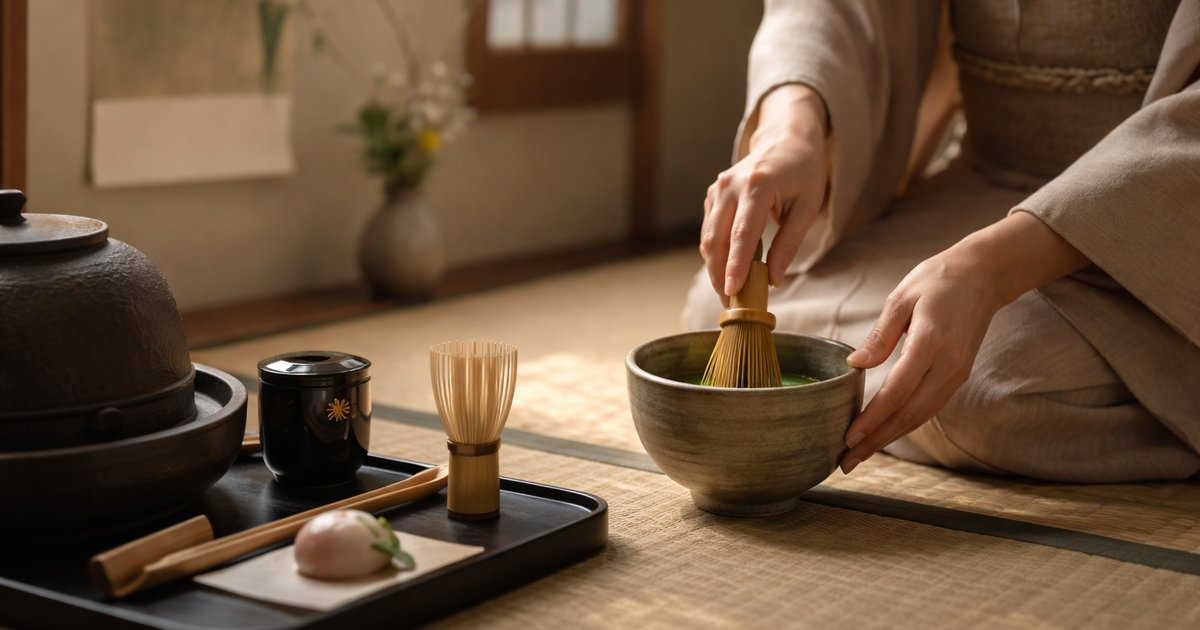
Today, October 8, is Tabi Day in Japan.
Tabi are Japan’s split-toe socks: the big toe sits in its own pocket, apart from the other four. The split exists so the thong of a zori sandal or wooden geta can pass between the toes. On the tatami of a tea room, under a festival palanquin, beside a sumo ring, tabi still quietly hold up Japanese culture from the ground.
This article has one thing to say: tabi are something you change into, right before you enter a place. The tabi in a tea room are white not as a fashion choice but because guests change into a clean pair at the entrance. The rubber-soled jika-tabi worn at festivals are changed into for that day, too. In this small act of changing your socks, you can see how Japanese culture has treated a place as something worth stepping into carefully.
What you will learn
- What tabi are, and why the toes are split
- Why October 8 became Tabi Day
- Why tea-room tabi are white, and why people change into them
- From leather to cotton: how tabi took their present form
- Gyoda, the town of tabi, and how tabi led to rubber boots and then to tires
What tabi are: a “bag” for the foot with a split toe
The two characters of the word mean “foot” and “bag,” and that is what tabi are: a cloth cover for the foot. They are close to socks, but the big toe is separated from the other four, and the back of the ankle closes with kohaze, small flat metal tabs shaped a little like fingernails that hook into loops of thread.
The toes are split so the thong of a sandal, the cord that runs over the top of the foot, can sit between the big toe and the second toe. Tabi took shape together with Japanese footwear.
They come in a few colors. For formal dress, white. For everyday wear by men, navy and black were long the standard (Sekai Daihyakka Jiten encyclopedia). In a tea room, nearly everything you see is white.
Why October 8 is Tabi Day
Tabi Day is said to have been established in 1988 by the Japan Tabi Manufacturers’ Association. October was chosen because it comes just before the season when kimono are worn more often, with the Shichi-go-san children’s festival in November and New Year ahead, and the 8th because the character for eight (八) widens toward the bottom, a shape traditionally read as a sign of good fortune.
As we noted in our article on what to wear, tea gathering guides often list “white socks or tabi” as basic etiquette, and the autumn tea season overlaps with the season of tabi. See our guide to tea ceremony clothing for the details.
Tea-room tabi are white, and you change into them
This is the heart of the article.
The etiquette guide of Ibasen, a long-established Japanese accessories shop, states that in the tea ceremony, guests wear white tabi or white socks to keep the tea room clean and pure. It adds that people sometimes bring a clean pair of white tabi or white socks and change into them just before entering the tea room.
A beginner’s guide on the culture site Waraku Web says the same thing with a little more explanation. You do not wear the white socks from home; you change into them after arriving, before the gathering begins. Bare feet would damage the tatami, and stepping into the tea room in clean socks, not the ones you walked through the streets in, is a matter of attitude.
So the whiteness of tea-room tabi is not only because white is the formal color. You walk through the outside world, reset your feet at the entrance, and step onto the tatami in something clean. White is the color in which that “just changed” state is visible, to you and to everyone else.
Even if you own no kimono, you can do this at your first tea gathering simply by putting a pair of white socks in your bag. The participation guide for the Tokyo Grand Tea Ceremony, a large public event, mentions white socks or tabi as etiquette, and in the same breath says you may come with nothing prepared at all. Do what you can; that is enough. The flow of a gathering is in our article on your first tea gathering.
There is also an old tie between tea and cotton tabi. According to the Sekai Daihyakka Jiten encyclopedia, cotton tabi are said to have begun when the mother of Hosokawa (Nagaoka) Sansai, a warlord known as a disciple of the tea master Sen no Rikyu, wore them each time she attended a tea gathering. In the tea world, cotton tabi were called sukiya-tabi, “tea-house tabi,” and leather ones were not used. The tea room turns out to be connected even to the history of what tabi are made of.
From leather to cotton: how tabi took shape
The tabi we see today did not start out this way.
According to Japanese reference works, tabi were originally made of leather. They already appear in a dictionary compiled around the 10th century, and an old spelling of the word, meaning roughly “single hide,” is said to come from a half-boot of deerskin. Another view traces them to the shitouzu, a foot covering of the Heian period (Sekai Daihyakka Jiten).
Sources differ slightly on when the split toe appeared. The Nihon Daihyakka Zensho encyclopedia says that a tabi with a divided toe, convenient for sandals and straw footwear, appeared at the end of the Kamakura period (early 14th century), while other accounts place the settled form in the Muromachi period that followed. It is safest to remember it as “somewhere between the late Kamakura and Muromachi periods.”
The great turning point came in the Edo period. According to the Nihon Daihyakka Zensho, after the Great Fire of Meireki in 1657 burned much of Edo, leather ran short and its price shot up, so cotton came to replace it. Soft, washable cotton tabi spread among ordinary people. And according to the Sekai Daihyakka Jiten, in the Hoei era (1704 to 1711) a short-ankled tabi fastened with kohaze tabs came into fashion. A fire and a leather shortage, two entirely uncultural reasons, gave us the soft white tabi of today.
Gyoda, the town of tabi
The best-known tabi-producing town is Gyoda, in Saitama Prefecture north of Tokyo. According to a city profile in Finance, the public-relations magazine of Japan’s Ministry of Finance, tabi making in Gyoda began in the mid-Edo period as side work for samurai households, and by the Tenpo era (1830 to 1844) there were 27 tabi shops, enough to count as a production center. Factories and sewing machines arrived in the Meiji era, output soared, and in 1938 Gyoda reached a peak of 84 million pairs a year. Several accounts put its share at roughly 80 percent of national production.
About 80 tabi-gura, the storehouses where tabi were kept, still stand in the town. In April 2017 they were recognized by the Agency for Cultural Affairs as Japan Heritage under the title “Gyoda, the Town of Tabi Storehouses That Has Long Supported Japanese Dress from the Ground Up”, the first such designation in Saitama. One storehouse is now the Tabi and Life Museum, where you can see what an old tabi workshop looked like.
Festival feet: jika-tabi, and then tires
Tabi have another face. With a rubber sole glued on, they can be worn straight outdoors: these are jika-tabi, literally “ground tabi.” They are still worn by the people who shoulder festival palanquins, pull drum floats, and work on construction scaffolding. The reasons given for liking them are that you feel the ground through the thin sole and can grip with your toes.
Jika-tabi were born in Kurume, in Fukuoka Prefecture on the island of Kyushu. According to a timeline compiled by Kurume City’s cultural properties office, the city had two tabi companies, Tsuchiya Tabi and Shimaya (later Nippon Tabi). Tsuchiya Tabi succeeded in making a prototype with a glued rubber sole in 1922 and began production; Nippon Tabi began making jika-tabi in 1923. In 1924 the two companies fell into a patent dispute, settled the following year. Naming a single inventor is, historically, a little difficult.
And the story has a famous sequel. The brothers Ishibashi Tokujiro and Shojiro, who ran Nippon Tabi, turned the rubber know-how they had built up with jika-tabi toward tires. In 1931, Nippon Tabi’s tire division was spun off as Bridgestone Tire Co., today’s Bridgestone Corporation. The name is “Ishibashi,” which means “stone bridge,” turned around into English. Tsuchiya Tabi lives on as the shoemaker Moonstar, and Nippon Tabi as Asahi Shoes.
White tabi in a tea room and car tires running on roads around the world: two things that look far apart came out of the same “bag for the foot.” Knowing that makes Tabi Day feel a little wider.
In closing
Tabi are something you change into. Before the tea room, before the festival, you change what is on your feet for the sake of the place. The whiteness of white tabi is also a sign to the people around you: “I just changed, for this.”
If you are going to your first tea gathering, try putting one pair of white socks in your bag. The few seconds spent changing at the entrance will shift your mood, just a little, toward the room you are about to enter.
Sources
- Kotobank, “Tabi” (Japanese) — entries from Nihon Kokugo Daijiten, Sekai Daihyakka Jiten and Nihon Daihyakka Zensho: listed in the 10th-century Wamyosho dictionary, originally leather; “single hide” spelling from a deerskin half-boot, shitouzu theory; split-toe tabi at the end of the Kamakura period; cotton after the Meireki fire; kohaze-fastened tabi in fashion in the Hoei era; cotton tabi said to begin with Nagaoka Sansai’s mother, sukiya-tabi; white for formal wear, navy or black for men’s everyday wear
https://kotobank.jp/word/足袋-94080 - Ibasen, “What to bring to a tea ceremony” (Japanese) — white tabi or white socks to keep the tea room clean; sometimes brought along and changed into just before entering
https://www.ibasen.co.jp/pages/2305_sado_bring - Waraku Web, “What you need for your first tea gathering” (Japanese) — change into white socks after arriving; bare feet damage tatami; the attitude of entering in clean socks
https://intojapanwaraku.com/rock/gourmet-rock/2552/ - Tokyo Grand Tea Ceremony, “How to participate” (Japanese) — white socks or tabi as etiquette; you may come with nothing prepared; remove watches and rings
https://tokyo-grand-tea-ceremony.jp/join.html - Best Calendar, “Tabi Day (October 8)” (Japanese) — established in 1988 by the Japan Tabi Manufacturers’ Association; October before the kimono season, eight as a lucky widening shape
https://bestcalendar.jp/dates/kinenbi/4114 - Ministry of Finance, Finance, April 2025, “No. 62: Gyoda City, Saitama” (Japanese) — began in mid-Edo as samurai side work; 27 shops in the Tenpo era; peak of 84 million pairs in 1938; about 80 tabi storehouses; Japan Heritage in fiscal 2017 with 45 component properties
https://www.mof.go.jp/public_relations/finance/202504/202504m.html - Travel Voice, “Agency for Cultural Affairs announces 2017 Japan Heritage,” April 28, 2017 (Japanese) — the Gyoda tabi storehouses title
https://www.travelvoice.jp/20170428-87981/ - Kurume City Cultural Properties Division, “Story Sheet 9: Timeline of Modern Kurume and the Rubber Industry,” March 2023 (Japanese PDF) — Tsuchiya Tabi: research from 1920, prototype and production in 1922; Nippon Tabi: jika-tabi production from 1923; patent dispute 1924, settled 1925; Bridgestone Tire spun off from Nippon Tabi’s tire division in 1931; now Moonstar and Asahi Shoes
https://www.city.kurume.fukuoka.jp/1080kankou/2015bunkazai/3050kurumeshishi/files/storysheet9-1.pdf - Bridgestone Corporation, “History” (Japanese) — first tire made in 1930 by Nippon Tabi’s tire division; Bridgestone Tire Co. founded in Kurume in 1931
https://www.bridgestone.co.jp/corporate/history/
The founding body and year of Tabi Day come from a Japanese anniversary-listing site; we could not confirm a primary document from the association itself. The story of cotton tabi and Hosokawa Sansai’s mother is given by the Sekai Daihyakka Jiten as something “said to be” the case, and we treat it as tradition. Sources differ on when split-toe tabi appeared (late Kamakura in one encyclopedia, Muromachi in other accounts), so we give a range. The “about 80 percent of national production” figure for Gyoda appears in several articles, but the Ministry of Finance piece gives only annual output and no national share, so we attribute it to “several accounts.” We avoid naming a single inventor of jika-tabi because the Kurume timeline places the two companies’ developments almost side by side.