September 8, 2026
What’s the Difference Between Taiko Drums? | Chodo, Shime and Okedo — the Sound Is Decided by the Body and the Fastening
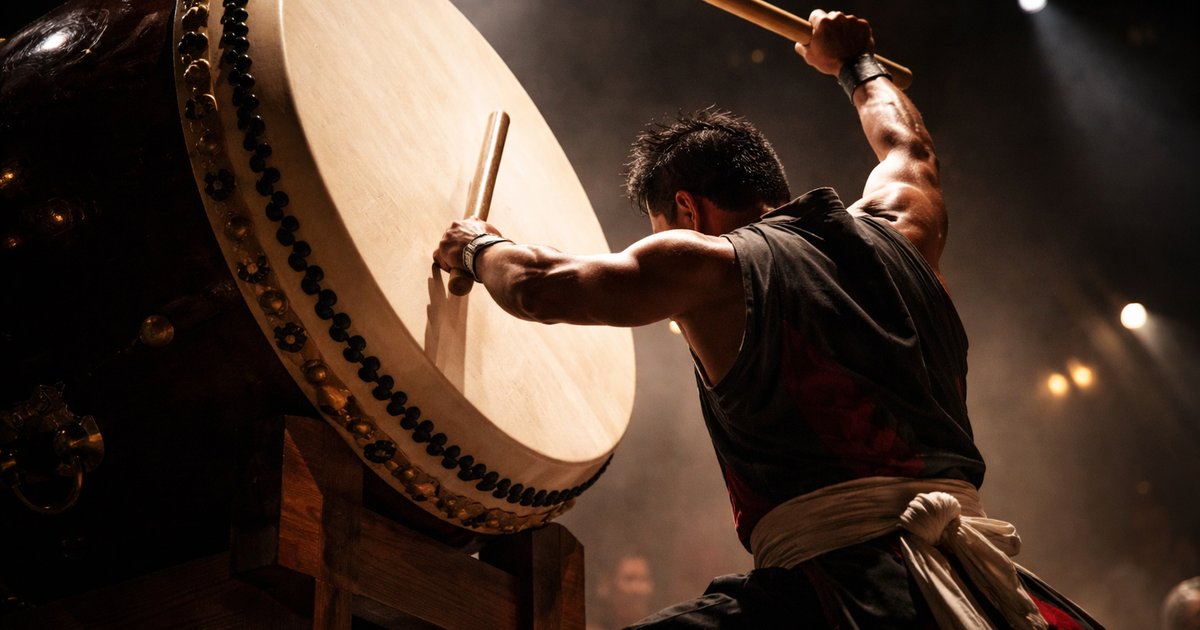
Have you ever listened to festival drums with your eyes closed?
A heavy doon arrives somewhere below your ribs. Over the top of it, something light and sharp runs past — ka, ka. And every so often, a drum moves. Someone is carrying it through the crowd.
All of that is taiko. But it is not all the same drum.
That’s what this article is about. The short version first: the difference in a taiko’s sound is decided by how the body was built and how the skin was fastened — long before anyone picks up a stick.
Which means the sound was half-settled years before the performance, at the moment someone chose a tree. That kind of instrument.
In this article
- The only two questions that separate one taiko from another
- Chodo-daiko (miya-daiko) — the sound you cannot change
- Shime-daiko — a drum tuned by how hard you pull the rope
- Okedo-daiko — the drum you can carry and walk with
- Hirado-daiko and uchiwa-daiko — what changes when the shape changes
- The skin (a cow’s back and a cow’s belly do not sound the same)
- How many years it takes to make one body
- What to look for the next time you’re at a festival
Two questions, and that’s it
Taiko come with a long list of names: chodo-daiko, shime-daiko, okedo-daiko, hirado-daiko, uchiwa-daiko, o-daiko.
Trying to memorise the list is a reliable way to lose interest. So don’t learn the names — learn the questions. There are only two.
- How was the body made? Hollowed out of a single log — or built up from staves, like a barrel or a bucket?
- How was the skin fastened? Nailed down permanently with tacks — or tensioned with rope or bolts?
Every named type of taiko is one combination of those two answers. And so is every difference in sound.
Here they are in turn.
Chodo-daiko — the sound you cannot change
This is the most representative Japanese drum. Because it so often sits in a shrine or a temple, it’s also called miya-daiko, the shrine drum. It is the shape most people picture when they hear the word.
How it’s made: a thick log is hollowed out to form the body. The skin is stretched hard over it and fastened down with metal tacks.
Miyamoto Unosuke Shoten, one of the long-established makers, describes it this way: a rigid hollowed-out body with skin drawn tight and held by tacks, producing a resonant sound with a clear core to it.
Here’s the part worth pausing on: once the tacks are driven, the pitch cannot be adjusted.
A guitar can be tuned. A drum kit has bolts you can turn. A chodo-daiko has neither. The craftsman who stretched the skin decided on a sound, and the drum will hold that sound for decades. Re-skinning it begins with pulling every tack out, one at a time.
Traditionally the finest body material is keyaki (Japanese zelkova) — beautifully grained, hard, and stable.
Sizes run wide: from around one shaku (about 30 cm) for festival ensemble playing, up to the enormous drums known as o-daiko. The measurement is the diameter of the striking face. Which means an o-daiko isn’t a different instrument at all — it’s a very large chodo-daiko.
Shime-daiko — tuned by how hard you pull
This is the bright, cutting sound in festival music.
It is built on an entirely different principle. The skin is stretched over a metal hoop and sewn. That hooped skin is placed on either end of the body and tightened with rope or bolts.
Miyamoto’s description turns on a single sentence: the sound is decided by how tightly it is drawn.
Tighter means higher and sharper. So a shime-daiko is a drum you tune on the day, in the room, minutes before you play — the exact opposite of the chodo-daiko.
The skins come in graded thicknesses, from thin to thick: namizuke, nichogake, sanchogake, yonchogake, gochogake. Thicker skin takes more tension, so it can reach a tauter, brighter high note. Combine that thickness with the height of the body and you get a very fine range of possible voices.
In an ensemble, this is usually the drum that keeps the beat and leads.
Okedo-daiko — the drum you can walk with
The two drums above are played standing still. This one you can carry.
The reason is in the body. Rather than hollowing a single log, the body is built from staves, like a wooden bucket. So it’s light. Light enough to hang from a shoulder strap and play while moving.
The skin, as with the shime-daiko, is hooped and rope-tensioned — so the pitch is adjustable. Depending on the rope, it will give you anything from a low, sunken tone to a high note that seems to pop right off the surface.
The shoulder-carried version is called katsugi okedo-daiko. If you’ve watched a performer moving around a stage while playing, that was almost certainly this. Dance can be part of the playing only because the drum is this light.
Some carried okedo drums use horse skin instead, for lightness or for a particular tone — though as we’ll see, taiko skin is usually cowhide.
Hirado-daiko and uchiwa-daiko — what shape does
Two more, both useful because the relationship between shape and sound is so easy to hear.
Hirado-daiko (also hira-daiko) looks like a chodo-daiko that has been pressed flat. The body is still hollowed from a log, so the sound keeps its core — but because the distance from one head to the other is short, it takes less force to make the sound spread. You don’t have to hit it hard for it to speak.
Uchiwa-daiko goes further: it has no body at all. It’s a fan-shaped frame with skin on one side only. It’s used in Buddhist observances and in nenbutsu odori dances, and is considered essential to Oeshiki, a Nichiren Buddhist ceremony.
No body means no cavity to hold the sound. So the tone is short and dry. More recently, players have started combining several uchiwa-daiko of different pitches in newly composed pieces.
By now you can see the two questions doing all the work. Hollowed, staved, or no body at all. Tacked down, or rope-tensioned. Almost the whole character of the sound follows from that.
The skin — a cow’s back and a cow’s belly
A little more detail, because this part is genuinely surprising.
Taiko heads are mostly cowhide. Chodo-daiko are almost always cowhide. According to Miyamoto, cow (female) hide has long been preferred: it stretches well, its fibres are dense, and it is considered especially durable.
And then this.
Even within a single animal, the sound depends on where the skin came from.
- The thicker hide from the back → a low, heavy sound
- The thinner hide from the belly → a high, springing sound
Craftsmen cut the hide with these differences in mind, judging by sound. Which means every drum ends up with its own face. Mass-producing identical instruments was never really on the table.
The hide is handled unusually too. It isn’t softened the way leather for shoes or bags is. The tension and strength of the rawhide are kept as they are. Sometimes it is rested for several years before being stretched — “seasoned” — which is said to make it stronger.
And skin stretches a little every time it is struck. When the tension goes out of the sound, it’s time to re-skin. There is no fixed number of years for this. It depends entirely on how the drum is used.
How many years a body takes
One last set of numbers — the ones most worth carrying away.
The tree that becomes a chodo-daiko body is over a hundred years old. It is air-dried as a whole log, roughed out into a shape called arado, and then dried further — slowly, for three to five years.
A century to grow. Several more years between felling and becoming a drum body. Only then is the surface finished by hand plane, read against the grain and shaved back along the rings.
Then the skin goes on. A wooden mallet called a kakeya is used to stretch it, alternating with another operation called en-otoshi, over and over — while the sound is checked, again and again.
The drum sounding across a festival for one night has all of that folded inside it.
And that thing you see on stage
Everything above is about single drums.
But what most people outside Japan know as “taiko” is probably the other thing: a large group playing several different types of drum together. Chodo-daiko holding the ground, shime-daiko cutting the beat, katsugi okedo-daiko moving around the stage.
That format is called kumi-daiko. And it may be surprising to learn that it is not very old.
The account you’ll find most often is that around 1951, Oguchi Daihachi — who revived the Osuwa Daiko tradition in Nagano Prefecture — used the fact that bodies of different lengths and diameters give different pitches, and combined drums into a single piece of music, creating this style. We were not able to confirm a primary source for that, so we present it as the explanation that is widely given, and no more.
Either way: the drums themselves are old, and have long been part of rituals and festivals. The idea of assembling them into music on a stage is comparatively recent. Holding both of those in mind will not lead you far wrong.
What to look for at your next festival
Three things you can check with your own eyes, no expertise required.
- Look at the rim of the skin. A ring of metal tacks means a chodo-daiko or a hirado-daiko. That drum’s pitch can no longer be changed
- If you can see rope, it’s a shime-daiko or an okedo-daiko. The rope isn’t decoration — it is deciding the note you are hearing right now
- If it’s being carried, it’s a katsugi okedo-daiko. Staves instead of a hollowed log; that’s where the lightness comes from
And the one thing worth trying above all: close your eyes and listen to the low sounds and the high sounds as separate instruments.
Once you can hear it that way, festival drumming stops being “loud banging.” It turns into a conversation between several voices.
A low voice holds the ground. A high voice marks the beat. A moving voice slips between the people.
And each of those voices is made from one tree, and one skin, chosen by someone decades ago.
Sources
- Miyamoto Unosuke Shoten, official site, “Chodo-daiko” (also called miya-daiko, the most representative Japanese drum; a rigid hollowed body with skin drawn tight and held by tacks, giving a resonant sound with a clear core; keyaki traditionally regarded as the finest material for its grain and hardness; sizes from about 1 to 1.3 shaku for festival ensembles up to the giant drums called o-daiko)
https://www.miyamoto-unosuke.co.jp/collections/longtrunkdrum - Miyamoto Unosuke Shoten, official site, “Shime-daiko” (a piercing high tone that leads the playing; skin stretched over a metal hoop and sewn, held between the body halves and tightened with rope or bolts — the tightness decides the sound; thickness grades namizuke to gochogake combined with body height)
https://www.miyamoto-unosuke.co.jp/collections/shimedaiko - Miyamoto Unosuke Shoten, official site, “Okedo-daiko” (a rope-tensioned drum combining a light staved body with hooped skin; adjusting the rope produces anything from low tones to a bright high note; includes the shoulder-carried katsugi okedo-daiko)
https://www.miyamoto-unosuke.co.jp/collections/barreltrunkdrum - Miyamoto Unosuke Shoten, official site, “Hirado-daiko” (flatter than the chodo-daiko; the short distance between the two heads means the sound spreads with less force)
https://www.miyamoto-unosuke.co.jp/collections/flattrunkdrum - Miyamoto Unosuke Shoten, official site, “Uchiwa-daiko” (a single-headed fan-shaped drum; used in Buddhist observances and nenbutsu odori, and indispensable to the Nichiren ceremony Oeshiki; recently combined in differing pitches for newly composed pieces)
https://www.miyamoto-unosuke.co.jp/collections/uchiwadrum - Miyamoto Unosuke Shoten, official site, “What skin is a taiko made of? Types, cuts, sound and when to re-skin” (mostly cowhide; hide from female cattle long preferred for stretch, dense fibre and durability; thicker back hide gives a low heavy sound and thinner belly hide a high springing one; horse skin sometimes used for carried okedo drums; rawhide tension retained rather than softened, sometimes rested for years to “season”; re-skinning a tacked drum begins with removing the tacks, while rope- and bolt-tensioned drums are easier to adjust)
https://www.miyamoto-unosuke.co.jp/pages/wadaiko-kawa - Miyamoto Unosuke Shoten, official site, “Taiko craftsmanship” (trees over 100 years old; air-dried as whole logs, roughed into the arado form, then dried for three to five years; surface finished with a hand plane, read against the grain; skin stretched with a kakeya mallet alternating with en-otoshi while the sound is checked)
https://www.miyamoto-unosuke.co.jp/pages/taiko
We could not verify a primary source for the origin of kumi-daiko (c. 1951, Oguchi Daihachi, Osuwa Daiko) at the time of writing. It is presented here as a widely circulated account, not as established fact. Some accounts trace Osuwa Daiko itself back to the Sengoku period and the “twenty-one drummers of Osuwa” under Takeda Shingen; that claim is not covered in this article. There is no fixed interval for re-skinning — it depends heavily on use. Naming conventions for sizes and grades can vary between makers.