2026年8月18日
Why Japanese Tea Bowls Change Shape with the Season | The Summer Hira-jawan and Winter Tsutsu-jawan, Explained Gently for Beginners
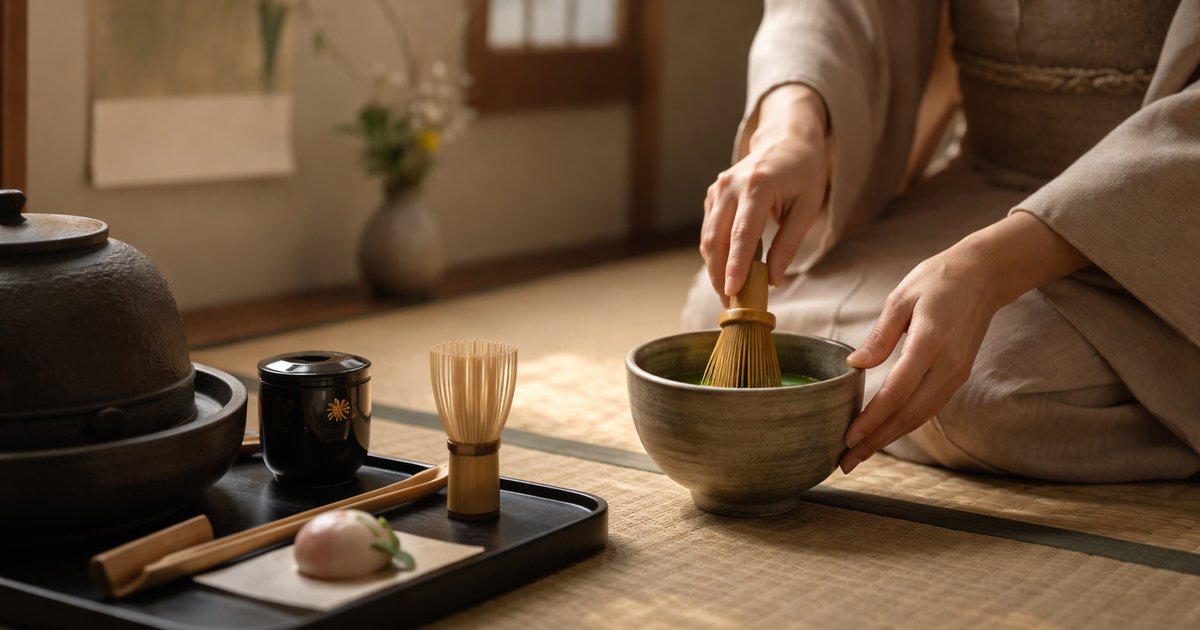
When someone hands you a cup of tea, do you ever look at the shape of the cup?
In the Japanese tea ceremony, that shape changes with the season. In summer, the bowl is shallow and wide. In winter, it is narrow and deep. The tea inside is the same matcha — only the vessel is swapped out.
In a few days comes Shosho, the calendar point named for heat beginning to withdraw (23 August in 2026). It is still hot, and in tea rooms right now the bowls being carried out are the shallowest they will be all year. Here is why.
What this article covers
- The shallow summer hira-jawan and the deep winter tsutsu-jawan
- Why the difference comes down to the temperature of the tea
- Rikyu’s teaching “cool in summer, warm in winter” — and an honest note about where it comes from
- Arai-chakin, a summer procedure that makes coolness out of nothing but the sound of water
- Why some tea bowls have proper names
- Why rankings and prestige can wait
- Something you can test tonight with cups you already own
The summer bowl is shallow
The hot-weather bowl is the hira-jawan — literally “flat bowl.” It is plate-like, low, and opens wide at the mouth.
The reason is plain: a wide mouth lets tea cool faster. It is a way of not handing someone something scalding on a scalding day, built directly into the shape.
It belongs to the season of the furo, the portable brazier that sits on the tatami — roughly May through October — and it appears most often in the fiercest heat of July and August.
Being shallow, it lets you see the whole floor of the bowl as you drink. It looks cool, and it shows off its own painting. All upside, you might think — except for the person making the tea. A shallow bowl spills. Whisking in one takes real care.
So that the guest can be cool, the host accepts a little awkwardness. That is the trade the summer bowl is built on.
The winter bowl is tall
In cold weather the tsutsu-jawan appears — the “cylinder bowl,” deep-bottomed and narrow at the mouth.
Same logic, reversed: a narrow mouth holds heat in. Cupped in both hands, it passes its warmth along. It is used in winter, most often in the deep cold of January and February.
Change the shape and you change the hands. With a cylinder bowl, the host tilts it slightly to whisk, because a straight-on whisk cannot reach the bottom. Even the chakin — the small linen cloth used for wiping — is held differently, pinched between index and middle finger and hooked over the rim.
One change to a vessel, and the entire choreography is rebuilt around it. When people say the tea ceremony has a lot of rules, this is what the rules are made of.
“Cool in summer, warm in winter”
Underneath all of this sits a set of seven teachings handed down from Sen no Rikyu, known as the Rikyu Shichisoku. The Urasenke school records them like this:
Make the tea so it suits the drinker / lay the charcoal so the water boils / cool in summer, warm in winter / arrange the flowers as they grow in the field / be early / be ready for rain even when none is falling / hold your fellow guests in mind.
The third one is the bowl, exactly. Cool in summer. Warm in winter. Nothing more.
A story travels with it. Someone once asked Rikyu what the way of tea was. “These seven are all of it,” he said. “A three-year-old could understand that,” the man replied. Rikyu answered: “Understanding it and doing it are not the same, are they? If you can truly do it, I will become your student.”
One honest note. The tea text that carries these teachings, the Nanporoku, was copied out by Tachibana Jitsuzan in 1690 — the hundredth anniversary of Rikyu’s death — and most researchers today read it as a later fabrication. Words like chado, roji and kaiseki were not in common use in Rikyu’s own time, and people who were already dead turn up in its pages.
Whether Rikyu ever said this, we do not know. What we do know is that someone more than three hundred years ago believed the way of tea was this, wrote it down, and the sentence has been carried ever since. Every seasonal tea bowl is still keeping that promise.
Coolness made of sound
There is one procedure performed only in summer, and only with a flat bowl. It is called arai-chakin, “the washed cloth.”
It goes like this. Fill the flat bowl generously with water, leave the linen cloth soaking in it, and carry the whole thing out to the guests. In front of them, lift the cloth, wring it, fold it. Then pour the water from the bowl into the waste vessel.
The point of the whole thing is letting the guest hear water. The cloth being lifted is a clear stream. The water being poured away is a waterfall. Coolness taken in through the ears rather than the eyes.
It is done in July and August, at the peak of the heat. It is a record of where people found relief when there was no such thing as air conditioning.
Bowls have names
The finest tea utensils are often given a mei — a proper name of their own. Some liken the object’s appearance to something else, some carry a story or an origin, some are simply witty. Like a person’s name, it makes that one object unmistakably itself.
These names have seasons too. Among those listed for August: banryo, the cool of evening. Higurashi, the cicada that sings at the end of summer. Shosho — the very solar term arriving this week. Kiri-hitoha, a single paulownia leaf coming down.
What is lovely is the habit of running slightly ahead of the season. While it is still hot, an autumn name is brought out. A quiet notice that the next season is on its way. The name of a bowl doubles as a weather forecast.
You can ignore the rankings for now
Tea bowls do come with a hierarchy by kiln. There is a well-known phrase — “first Raku, second Hagi, third Karatsu” — and the Ido bowl is usually added to that top group.
But this matters mainly for koicha, the thick, kneaded tea served at formal gatherings. For usucha, the thin tea most of us are actually served, prestige is generally said not to matter.
So the first time you look at a tea bowl, you do not need to guess at its value. Shallow or deep. Hot day or cold day. That is enough to be going on with.
Touching this gently, today
You can test all of it without buying anything.
Take the widest, shallowest cup in your kitchen and the deepest, narrowest one. Pour the same drink at the same temperature into both, the same amount. Wait a while. Then taste each.
They are different. Unmistakably.
Centuries of tea practice went into dividing bowls by shape for the sake of exactly that one mouthful of difference. Next time you set a drink in front of someone and find yourself hesitating — the shallow cup, or the deep one? — the question has already become yours.
In closing
Step into a tea room and the sheer number of objects can be daunting. So many rules. So much to remember.
But nearly all of it branches from a single question. What would make the person in front of me comfortable, right now?
Shallow in summer. Deep in winter. One of the answers turns out to be that simple a shape.
The heat is not over yet. If you pour something for someone today, take one look at the cup first. That alone makes you, briefly, a person of tea.