August 21, 2026
What Is Chabana? | The Single Flower in the Tea Room, Explained Gently for Beginners
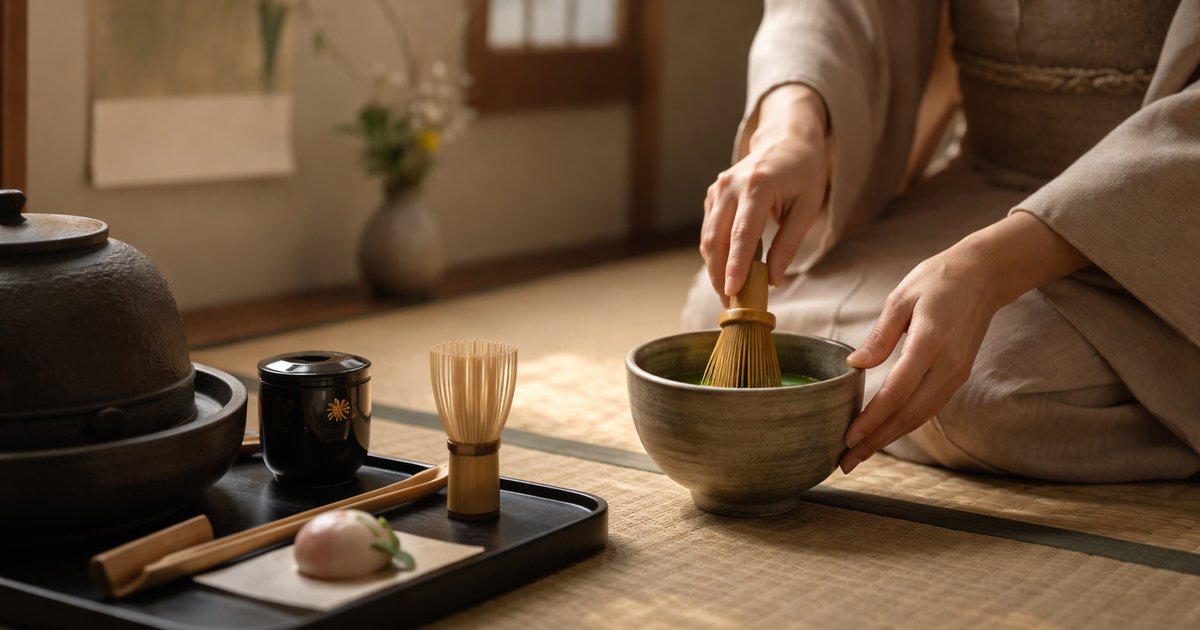
When you are shown into a tea room, there is a flower waiting in the tokonoma — the shallow alcove where a hanging scroll and a flower are placed. Usually just one stem. Sometimes two. Never a bouquet.
The first time you see it, it may look a little bare. But that flower was chosen for this day, and this hour, and nothing else.
This is chabana, the flower of the tea room. Here we look gently at why there is so little of it, and what it is quietly doing there.
What you’ll find here
- What chabana is — the one living thing in the tea room
- “Flowers as they are in the field” — a saying handed down from Rikyū
- How chabana differs from ikebana
- The vessel, and why baskets belong to summer
- The flowers that are kept out of the tea room
- This season’s stem — mukuge, which opens at dawn and closes by dusk
- A first step you can take today
Chabana — the one living thing in the room
Chabana means the flower displayed at a tea gathering, and also the plants chosen for that purpose.
Everything else in a tea room holds still. The utensils, the scroll, the tatami. Only the flower drinks water, opens a little further, and eventually fades. The Enshū school puts it simply: the flower is the single thing in the tea room that carries life.
So the flower carries the season to the guest. Whether today is the end of summer or the beginning of autumn — told not in words, but in one stem.
“Flowers as they are in the field”
One phrase comes up whenever chabana is discussed: hana wa no ni aru yō ni — flowers as they are in the field.
It belongs to the seven rules of Rikyū, handed down as the words of Sen no Rikyū (1522–1591). The Urasenke school gives them as follows:
Make the tea so it sits well with the drinker. Lay the charcoal so the water boils. Cool in summer, warm in winter. Flowers as they are in the field. Be early rather than on time. Prepare an umbrella even when no rain is falling. Hold your fellow guests in your thoughts.
All of them sound obvious, Urasenke adds, and all of them are remarkably hard to actually do.
“Flowers as they are in the field” does not mean simply carrying a wild plant indoors. It means that even a single stem, seen by a guest, should call up the image of that flower standing in an open field. Strip away what is unnecessary, and what remains shows life more clearly — including how briefly it lasts.
How chabana differs from ikebana
Japan also has ikebana, the way of arranging flowers. Chabana is sometimes counted as one branch of it, but it grew its own sense of beauty.
Roughly, the difference is this:
- Ikebana: the flowers are composed as a work. Angles and empty space are shaped with intention
- Chabana: nothing is composed. The flower is left standing as it naturally would, and it brings the season into the room
Neither ranks above the other; they are simply doing different things. If ikebana is a flower made to be seen, chabana is a flower that happens to be there, for this day and this guest.
That is why chabana uses so few stems — one kind, perhaps two. The fewer the flowers, the more clearly each one shows its face.
The vessel has a rank of its own
The container is called a hanaire. Its material places it on a scale of formality:
- Shin (formal): bronze, and celadon brought from China. The highest rank
- Gyō (semi-formal): glazed Japanese ceramics
- Sō (informal): bamboo, woven baskets, gourds, unglazed ware
There are also three ways to place it: standing on the alcove floor, hung from a nail on the alcove pillar, or suspended from the ceiling. The same flower reads differently depending on which you choose.
In hot weather, the woven basket is a favourite. You can see through the gaps in the weave, and that alone makes a guest feel cooler. “Cool in summer” is not only about the tea — it reaches as far as the choice of vessel.
Some flowers are kept out
Certain flowers are traditionally not brought into the tea room. They are called kinka, the forbidden flowers.
Nanpōroku, an Edo-period tea text said to preserve Rikyū’s teachings, hands down a verse listing them: winter daphne, Japanese skimmia, cockscomb, golden lace, pomegranate, spatterdock, pot marigold, and one further bloom whose identity is no longer certain.
The reasons given vary. Winter daphne’s scent is strong enough to clash with the incense burned at a gathering. Skimmia is poisonous. Others are said to be unwelcome for the sound of their names, or for a form that sits badly in the room. Not all of these explanations are settled — several are later readings rather than recorded fact.
It is worth adding that Nanpōroku was compiled in 1690, roughly a century after Rikyū died, and scholars do not regard it as his own writing. It has nonetheless been read for centuries as a carrier of tea’s thinking.
The list is best received less as a rule to memorise than as a feeling: a flower, too, has a place where it belongs.
This season’s stem — mukuge
From late summer into early autumn, one flower appears again and again in the tea room: mukuge, the rose of Sharon.
Mukuge is a one-day flower. It opens in the morning and has closed by that same evening. Japanese has a phrase for it — kinka ichijitsu no ei, “the glory of the mukuge lasts a day” — long used for anything whose height is brief.
And yet the shrub blooms for months. As each branch grows it sets the next bud, and the flowering runs from the end of the rainy season into September. The single bloom ends today; the tree keeps blooming.
A single-petalled white variety with a deep crimson throat is called Sōtan mukuge — named, it is said, for Sen no Sōtan, Rikyū’s grandson and the ancestor of the three Sen houses, who favoured it. It often stands in the alcove for asa-chaji, the tea gathering held at first light in summer.
The flower that opened at dawn, in the gathering held at dawn. By evening it is gone. Ichigo ichie — this meeting will never come again — placed in the alcove without a word.
Touching chabana today
You do not need a tea room for this.
Buy one flower. Not a bunch — one. A drinking glass or an empty bottle is perfectly fine.
Then choose where to put it. Somewhere you will see it, but where it is not in the way. Not the centre of the table; an edge is good. Leave the space around it clear, and the stem will seem to stand taller.
On your next walk, look at the plants along the path. Chabana often uses small wild grasses whose names most people never learn. The test is not how showy it is, but whether the season is written in it.
And if you are ever invited into a tea room, look at the alcove first, before anything else. How many stems. What vessel. That much alone begins to tell you what the day is trying to say.
In closing
Chabana is not decoration. It is one stem, showing that today is here, now.
The mukuge will close by evening. Tomorrow’s gathering will hold a different flower. That exchange has been repeating for centuries.
The flower near you has already changed a little since yesterday. If you can meet that not as a loss but as today’s shape of it — you have touched the heart of chabana already.