August 19, 2026
Sweets at a Japanese Tea Gathering | How a Confection Carries the Season in Its Name
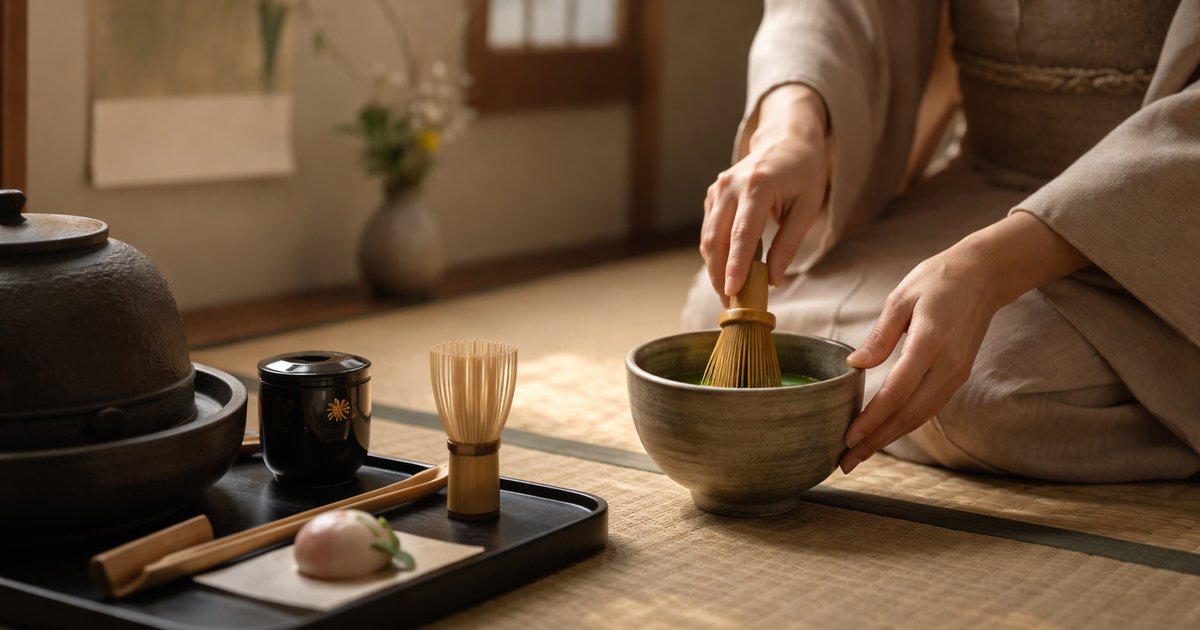
Once the Obon holidays are over, the display cases in Japanese confectionery shops quietly begin to change.
Where translucent sweets of kudzu starch and agar sat only a week ago, you start to see the colour of chestnuts, and shapes shaped like the moon. The afternoons are still hot — but inside the glass case, autumn has already arrived early.
In the Japanese tea ceremony, the sweet comes before the tea. And each sweet carries a name of its own, a name that quietly carries the season with it. Today, let’s gently follow the story of the sweets served at a tea gathering.
What this article covers
- Tea sweets fall into two families: omogashi and higashi
- The basic pairing — thick tea with moist sweets, thin tea with dry ones
- Why the sweet is eaten before the tea arrives
- How even the serving vessels change between summer and winter
- How sweets are given names drawn from poems and famous places
- Why a confectioner’s window runs slightly ahead of the calendar
- Something you can try today, without buying any tea
Two families of sweets
Sweets used in the tea ceremony divide broadly into two kinds: omogashi (main sweets) and higashi (dry sweets).
Omogashi are soft and moist. The best known is nerikiri — a dough based on white bean paste, shaped by hand into flowers, fruits and small landscapes. In Kyoto a similar sweet is called konashi. Steamed buns and steamed cakes also appear, but whatever is chosen carries a shape and a name suited to the season or the occasion.
Higashi are small and dry. Two types are common: pressed or moulded sweets such as rakugan, made by packing sugar and rice flour into a wooden mould, and sugar-worked sweets such as aruheito, made by boiling sugar and pulling it into shape. Each is small enough to sit in your palm, and dissolves almost as soon as it meets your tongue.
Japanese sweets are also often sorted by moisture content — fresh, semi-dry, dry. But the National Association of Japanese Confectionery Industry notes that while this division is “scientifically correct,” it does not quite match reality: the very same yōkan jelly counts as semi-dry when firmly cooked down and as fresh when left soft. Sweets, it seems, are not fond of being filed neatly.
Thick tea, moist sweet. Thin tea, dry sweet.
There are two ways matcha is served in the tea ceremony: koicha, kneaded thick and almost paint-like, and usucha, whisked light and frothy.
According to Omotesenke Fushin’an, one of the main schools of tea, the basic form at a full tea gathering is omogashi with koicha, higashi with usucha. A dense tea meets a substantial sweet; a light tea meets a light one. It is a question of balance.
But it is not an unbreakable rule. The same source notes that at a gathering serving only thin tea, both kinds of sweets are sometimes offered together. The etiquette bends more than people expect.
Why the sweet comes first
At a tea gathering, the sweet arrives first — and you are meant to finish it before the tea comes. For most first-time guests, this is the moment of hesitation. The tea isn’t here yet. Am I really allowed to eat?
You are. That is exactly what the sweet is for.
The usual explanation is that when a faint sweetness is still in your mouth, the bitterness of matcha meets it and settles into balance, leaving a cleaner finish. There is also a practical reason: koicha is very concentrated, and drinking it on a completely empty stomach can be heavy going. The sweet acts as a small cushion beforehand.
Taste the sweet as a sweet. Taste the tea as tea. One thing at a time. Most of the tea ceremony’s many small rules branch out from a single question: how do I make this one bowl of tea good for the person in front of me? The sweet arriving first is one of those branches.
The vessels change with the season too
It is not only the sweets. The dishes they are served on have seasons as well.
At a formal gathering, sweets are presented in fuchidaka — a set of five stacked lacquer boxes. Each guest receives one box, with the sweet placed in the centre. One person, one box.
For thin tea, a lidded container called a jikirō is used, and here a custom applies: lacquerware in winter, ceramic in summer.
Warm lacquer under the fingers in the cold months; cool clay in the heat. The sweet inside may be the same, but the surface you touch is not. It is the same thinking that makes tea bowls change shape between summer and winter.
Every sweet has a name
This may be the loveliest part of it all.
Beyond the name of its type — monaka, yōkan — a Japanese sweet often carries a name of its own, called a kamei. The National Association of Japanese Confectionery Industry explains that these names come from tanka and haiku poems, from images of nature, and from historic places.
A few examples:
Hatsu-chigiri — given to an autumn nerikiri shaped like a persimmon. It comes from a haiku by Kaga no Chiyojo, a poet of the mid-Edo period: “Is it bitter? I do not know — the first persimmon.” You cannot tell by looking; you only know once you taste it. The poem is said to carry the unease felt before a marriage. All of that, folded into one small sweet.
Tatsuta — a nerikiri shaped as autumn maple leaves. The Tatsuta River in the north-west of Nara Prefecture has been celebrated for its autumn colours in countless poems, and the sweet borrows its name. Eating it, you find yourself picturing a river you have never visited.
Kochi — “east wind,” a plum-blossom nerikiri, named from a poem by Sugawara no Michizane: “When the east wind blows, send me your fragrance, blossoms of the plum.”
A sweet disappears when you eat it. Only the name stays behind. That, more or less, is what a kamei is for.
The shop window runs ahead of the calendar
All summer, the shelves were transparent. Kuzu-manjū, kuzu-mochi, kingyokukan — agar dissolved and set into something like glass, with the bean paste showing faintly through.
This is less about flavour than about taking coolness through the eyes. In the centuries before air conditioning, Japanese summers were cooled by the sound of water, by wind chimes, and by sweets you could see straight through.
Then, from the second half of August, the shelves begin to turn over. September brings steamed chestnut yōkan; around the harvest moon, moon-viewing dumplings appear. You are still in short sleeves, and the shop window has already put on its autumn face.
The tea ceremony has a habit of reaching slightly ahead of the season — offering an autumn name while the heat still lingers, as a quiet notice that change is coming. A confectioner’s glass case is probably the most honest seasonal forecast in Japan.
Something to try today
You don’t need a tea room for this.
Buy one Japanese sweet — from a proper shop, or from the corner of a supermarket, it doesn’t matter. Then read its name first, before you eat it.
“First wild geese.” “Young rice shoots.” “Mountain path.” It’s fine if the meaning escapes you. Simply imagine something for a moment, not knowing, and then take a bite. The taste enters differently.
One more, even simpler. The next time you have something sweet and then something bitter — tea, coffee — pay attention to the order. Sweet, then bitter. Compare it with the other way around, and notice what happens to the aftertaste. That difference is the reason the tea ceremony has protected this sequence for centuries.
In closing
A tea sweet is not simply something sugary. It is preparation, so that the tea tastes as it should — and it is a letter telling you what season you are in.
Still, there is no need to make it complicated. Read the name. Look at the shape. Eat it. Enjoy it. That is already receiving everything it offers.
The heat will linger a while yet. If you pass a confectionery shop on your way home, look into the glass case just once. What’s waiting there is most likely a season slightly ahead of today.
Sources
- Omotesenke Fushin’an, “Sweets of Tea” https://www.omotesenke.jp/list5/list5-3/list5-3-7/
- National Association of Japanese Confectionery Industry, “What is a kamei” https://www.wagashi.or.jp/monogatari/ajiwai/meika/
- National Association of Japanese Confectionery Industry, “Types of wagashi” https://www.wagashi.or.jp/monogatari/shiru/syurui/
- Ministry of Agriculture, Forestry and Fisheries, aff magazine, “Feeling the mood of wagashi through their names” https://www.maff.go.jp/j/pr/aff/2002/spe2_02.html
- All About, “Why sweets are eaten before tea in the tea ceremony” https://allabout.co.jp/gm/gc/459244/