August 27, 2026
What Do You Wear to a Japanese Tea Ceremony? | Why Ordinary Clothes Are Fine, and Why You Bring White Socks
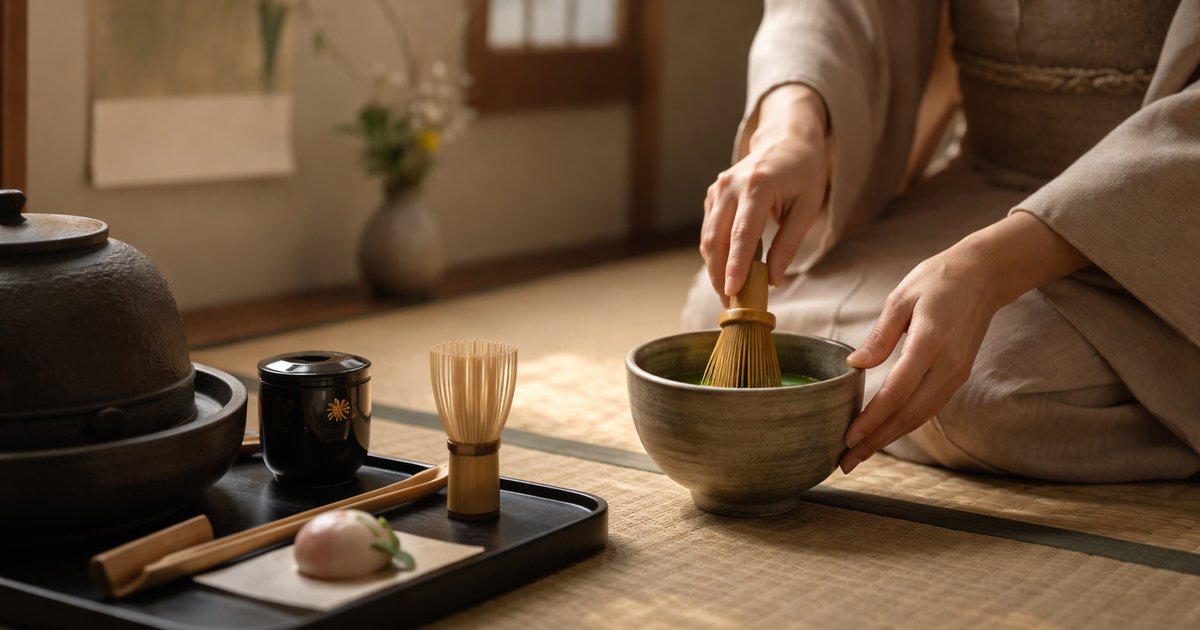
When someone invites you to a Japanese tea ceremony, the first worry is almost always the same one.
“What on earth do I wear?”
You don’t own a kimono. Buying one is out of the question. Renting one costs money. And so the reply sits unsent.
Let’s settle it right away: for a beginner-friendly tea gathering, ordinary clothes are fine. There are a few things worth knowing beyond that, so let’s walk through them gently.
What this article covers
- The short answer: can you wear Western clothes?
- Whether there are any “official” dress rules at all
- What to aim for in ordinary clothes
- Why you bring white socks rather than wear them
- What to take off — watch, rings, fragrance
- If you do wear a kimono
- The idea underneath all of it
First — there is no official dress code
This is worth saying before anything else.
Urasenke, one of the major schools of tea, publishes a beginner’s guide on its official site. It explains how to drink the tea and how to eat the sweet — but it says nothing about clothing.
So everything below is not a rule handed down by a school. It is custom, widely passed along and widely repeated. And in practice, the guidance that matters most comes from the gathering itself. Asking your host “would ordinary clothes be all right?” is more reliable than any article, including this one. It is not a rude question. It is a considerate one.
One more piece of context. Tea gatherings range from the relaxed ōyose chakai — a large open gathering where guests come and go for a single bowl of tea — all the way to a formal chaji, a full ceremony that includes a meal. This article assumes the first kind. That is almost certainly where you are going.
The short answer — yes, ordinary clothes
There is no rule saying you must wear kimono, and these days many gatherings say so outright. In fact, the official site for the Tokyo Grand Tea Ceremony, a large annual event, puts it plainly:
Because the Tokyo Grand Tea Ceremony is an event for beginners, you may join a tea seat without preparing anything at all.
Without preparing anything. That is exactly why a gathering like this is the best place to start.
What to aim for
The usual guidance runs something like this.
Men
- A plain dark suit, or business-casual with a collared shirt
- White socks (more on those below)
Women
- A dress, a blouse, or trousers
- If a skirt, long enough to cover the knees when kneeling. Hems ride up further than you expect once you sit down
- Nothing that opens too far at the neckline when you bow
- White socks
Best avoided
- Anything very casual, or very revealing
- Jeans — and not only for how they look. Denim doesn’t stretch, so it grips your legs in the kneeling position and your feet go numb far sooner. That one is purely practical
- Loud patterns and bright colors. In a tea room, the things meant to be looked at are the utensils, the hanging scroll, and the flower. The idea is simply not to pull attention away from them
White socks are something you bring, not something you wear
If you prepare one thing, make it a pair of white socks. They stand in for the white tabi worn with kimono.
And here is the lovely part of it: you don’t wear them from home. You change into them after you arrive, before entering the tea room.
Socks you have walked the street in carry the street indoors with you. So you swap them for clean ones. Bare feet are avoided too — they mark the tatami.
That small act of changing into something clean is sometimes explained as belonging to wa-kei-sei-jaku, the four principles of tea — harmony, respect, purity, tranquility — and specifically to sei, purity. Urasenke describes it this way:
Sei means purity — but not only the kind you can see. It means the heart is clear as well.
A pair of socks becomes the switch between outside and inside. Put like that, it stops being a chore.
What to take off
Watch and rings
The reason here is concrete: they scratch the bowls. The Tokyo Grand Tea Ceremony site says it directly:
Before entering the tea seat, remove your watch and accessories such as rings, so as not to damage the tea utensils.
A bowl passed down for four hundred years may well be the one placed in front of you. One knock of metal and that is that. This isn’t about formality. It’s about not breaking something irreplaceable.
Perfume
Fragrance is widely discouraged, and the reason is that it competes with the scents already in the room. You are there partly for the smell of the matcha itself, and often for incense burned alongside the charcoal. A strong perfume rewrites that experience for everyone present, not just for you.
The same logic covers scented fabric softener and hairspray. On the day, reach for the unscented ones.
Heavy lipstick
Practical again: it transfers onto the rim of the bowl. There is a step in the etiquette where you wipe the spot you drank from with your fingertips — and heavy lipstick doesn’t come away cleanly.
If you do wear kimono
You are of course welcome to. For those who can, here is the customary guidance — though this describes formal occasions, and at a beginner’s open gathering you needn’t worry about this level of detail.
Men
- A crested hakama (pleated trousers worn over the kimono)
- Restrained colors for the kimono — grey, navy, or rikyū green, a muted grey-green named after the tea master Sen no Rikyū
- Umanori-bakama, divided like trousers, is the common choice; andon-bakama, undivided like a skirt, is another
- No haori jacket. The haori exists to keep off cold and dust outdoors, so it comes off before the tea room
Women
- Semi-formal: a crested iromuji (a single-color kimono) or a hōmongi (a visiting kimono), with a fukuro obi
- For a relaxed gathering, a tasteful komon (small repeating pattern) with a Nagoya obi also works
The idea underneath — you are not the main event
Everything above leans one direction: understated, restrained, quiet. Here is why, in one line.
As a guest at a tea gathering, you are not the one being looked at.
When choosing a kimono, the customary advice is to make sure your outfit is never more formal than the host’s. You dress a step below the person who invited you, so that they are the one honored. The same care extends to the shōkyaku, the principal guest seated closest to the host — you don’t outrank them either.
It looks like a clothing rule. It is really the philosophy of tea, wearing clothes. The seven rules of Rikyū end on this line:
Aikyaku ni kokoro seyo — be mindful of your fellow guests.
Urasenke explains that aikyaku means the people sharing the room with you. Whether you sit in the principal guest’s place or the last guest’s, respect one another and pass a good hour together — that is what Rikyū was asking for.
Skipping the perfume, avoiding the loud pattern, slipping off the watch — all of it comes back here. You look at the room and the people in it, rather than at yourself. Dress etiquette is just that feeling, given a shape.
Before you go
So, for a first tea gathering, this is genuinely the whole list.
- Something reasonably tidy that you already own
- White socks, changed into on arrival
- Watch and rings off
- No perfume
- If you can, kaishi paper and a sweet pick — though many gatherings provide them
Kaishi paper, a sweet pick and a folding fan cost only a few hundred yen together, and sometimes turn up in hundred-yen shops.
And when in doubt, ask. “Would ordinary clothes be all right?” That single question dissolves most of the worry.
Because the real shame would be this: standing still over what to wear, and missing the tea altogether.
Sources
- Urasenke official site, “Tea for Beginners” / “The Heart of Tea” (wa-kei-sei-jaku, the seven rules of Rikyū)
https://www.urasenke.or.jp/textb/shiru/beginer/ - Tokyo Grand Tea Ceremony official site, “Before You Join” (watch and rings; white socks or tabi; beginners may come unprepared)
https://tokyo-grand-tea-ceremony.jp/join.html - Ibasen, “Etiquette of the Way of Tea” (specific guidance for kimono and Western dress)
https://www.ibasen.co.jp/pages/2305_sado_manners - All About, “Five points on dress, etiquette and what to bring to a tea gathering” (Western clothes permitted; perfume; lipstick; what to carry)
https://allabout.co.jp/gm/gc/454888/ - Waraku Web, “Does it have to be a kimono? A Q&A on what to bring and wear to a Japanese tea gathering” (changing socks on arrival; jeans)
https://intojapanwaraku.com/gourmet/2552/ - Kimono Rentalier, “Choosing a kimono for a tea gathering, and the basic rules to keep in mind” (not outranking the host or principal guest)
https://kimono-rentalier.jp/column/special/ocyakai-kimono/
Dress customs vary by school, by the nature of the gathering, by season and by region. This article describes general expectations at a beginner-friendly open gathering. If your host provides guidance, follow theirs.