October 1, 2026
What Was the Kitano Ōchanoyu? | “No Tea? Bring Roasted Grain Powder” — Hideyoshi’s Grand Tea Gathering Behind Japanese Tea Day (October 1)
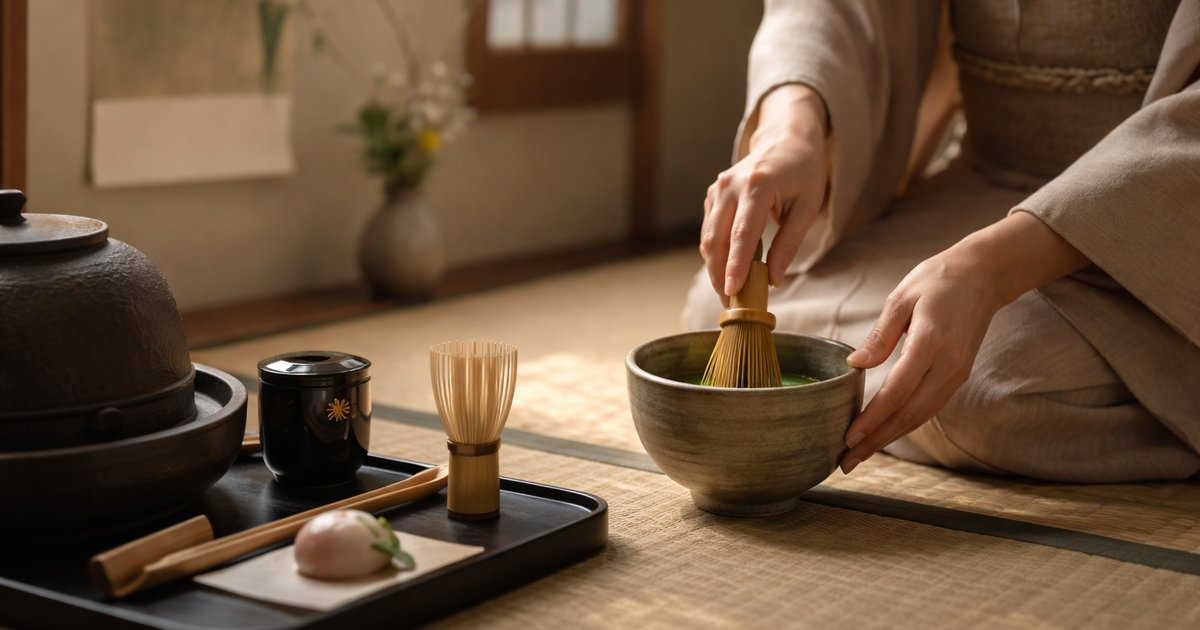
Today, October 1, is “Japanese Tea Day” in Japan.
Why this date? Follow the thread back and you arrive in Kyoto, 439 years ago, at a single tea gathering. It is called the Kitano Ōchanoyu — the Grand Kitano Tea Gathering — hosted by Toyotomi Hideyoshi, the ruler who had just unified most of Japan, in the grounds of Kitano Tenmangū shrine.
This article has one message: the invitation to this gathering said, in effect, “If you have no tea, bring kogashi instead.” You did not need a full set of utensils. You did not even need tea. This is the story of a day when the door to the world of tea swung wide open — told gently, for first-timers.
What this article covers
- What the Kitano Ōchanoyu was
- The “what to bring” list written on the public notice boards
- The day itself — a golden tea room, and tea huts under the pines
- Why a ten-day event ended after one day (there are several theories)
- How it connects to the large tea gatherings you can join today
What was the Kitano Ōchanoyu?
In the words of a standard Japanese encyclopedia (Nihon Daihyakka Zensho), it was a grand tea gathering held by Toyotomi Hideyoshi at Kitano Tenmangū in Kyoto on the 1st day of the 10th month of Tenshō 15 (1587). Another encyclopedia, the Sekai Daihyakka Jiten, calls it especially lavish among Hideyoshi’s many tea events, and “the most famous tea gathering in history.”
Four people served as hosts: Hideyoshi himself, Sen no Rikyū, Tsuda Sōgyū and Imai Sōkyū — the leading tea masters of the age.
One small note on the date. “The 1st of the 10th month” is a date in the old lunar calendar. Converted to the modern calendar it falls around November 1, so the real event took place a little deeper into autumn than today’s October 1.
The “what to bring” list on the notice boards
What makes this gathering so interesting happened before the day itself: the way it was announced.
That summer, Hideyoshi had kōsatsu — public notice boards set up where many people passed — posted in Kyoto, Nara, Sakai and elsewhere, calling on people to come. According to the Nihon Daihyakka Zensho, the seven-article notice said, roughly:
- Hideyoshi’s own collection of famous tea utensils will be put on view
- Anyone devoted to tea may come, whatever their rank
- Bring one kettle, a well-bucket for water, and one tea bowl
- Those who have no tea may bring kogashi instead
- The place is the pine grove at Kitano; set up your own little tea hut and enjoy tea together
In other words: something to boil water in, something to hold water, something to drink from. Three things were enough.
And kogashi? It is rice or barley, roasted and ground into powder, which you stir into hot water and drink. The line seems to have been written with people in mind who could not get powdered tea. If you have no tea, roasted grain powder will do. That is what the notice said.
The Sekai Daihyakka Jiten sums up the call as open to all “without distinction of city or countryside, high or low, rich or poor.”
The day at Kitano — a golden tea room and huts under the pines
On the day, Hideyoshi’s prized tea utensils were displayed in the shrine’s worship hall. At the center stood his famous golden tea room. In front of it were four tea rooms, hosted by Hideyoshi, Rikyū, Sōgyū and Sōkyū.
Meanwhile, in the pine grove, the small huts of everyone who had answered the call stood in rows. Their number is given as about 800, or as many as 1,500 to 1,600 (Nihon Daihyakka Zensho). The number of guests also differs from dictionary to dictionary — “803 people,” “more than 800,” “over a thousand.” It was more than four centuries ago, so it is best to hold the figures loosely.
The Japanese Wikipedia entry notes that guests were assigned to the four hosts’ rooms by drawing lots. Whether you were served by Hideyoshi or by Rikyū was a matter of luck.
The big red umbrella that made Hideyoshi stop
A golden tea room and rows of treasures: so far, it sounds like an event designed to show off. But the records of that day preserve another face as well.
According to the Nihon Daihyakka Zensho, Hideyoshi walked around the grounds that day and praised the tea huts of wabi tea lovers — people who favored plain, simple tea — such as Ikka from Mino (today’s Gifu) and Hechikan from Yamashina in Kyoto.
Hechikan is remembered as a tea man who lived in a small hut and, it is said, cooked his rice and made his tea in the same single kettle. On this day he is said to have put up a large red-lacquered umbrella as his tea space, to Hideyoshi’s great delight. (The biographical dictionary that records this tells it as “it is said” — it is an anecdote, not a documented fact.)
The owner of a room made of gold, stopping in front of a tea space made of one umbrella. For one day, lavish tea and simple tea shared the same shrine grounds.
Planned for ten days, over in one
The gathering was actually planned to last ten days. It ended after the first.
Nobody knows exactly why.
- The most often repeated explanation is that news arrived of an uprising in Higo (today’s Kumamoto, in Kyushu). But even the dictionaries hedge: “it is said to be because an uprising broke out” (Nihon Daihyakka Zensho); “perhaps because of the outbreak of the Higo uprising” (Yamakawa’s dictionary of Japanese history).
- The Nihon Daihyakka Zensho adds that some link it to the wider political situation of the time.
- Other theories: Hideyoshi was satisfied after one day; he was tired from making so much tea; the plan had already been changed to one day shortly beforehand.
So it is enough to remember this: there are several theories, and none is settled.
It was not only a gentle story
One thing should be said honestly.
“Anyone may come, whatever their rank” sounds very kind to modern ears. But the Nihon Daihyakka Zensho describes the notice as a “strict order” to tea lovers across the country. The notice is also reported to have included an article saying that anyone who still did not attend, after all these allowances, must never practice tea again.
The same encyclopedia explains that the gathering was, from the start, meant to display Hideyoshi’s power to the whole country, a celebration right after his conquest of Kyushu.
It was an open tea gathering, and at the same time a stage for power. It seems to have been both, not just one or the other.
Today’s large tea gatherings began here
Even so, what this single day left behind is not small.
In Rikyū’s time, a tea gathering usually had one to a few guests. Today there is the ōyose chakai — a large gathering with several tea rooms, serving hundreds of guests in a day. It is also the kind of gathering that is easiest for a first-timer to join. The Sekai Daihyakka Jiten says that the prototype of this format is the Kitano Ōchanoyu.
For what to do at such a gathering, see our guide to your first tea gathering.
At Kitano Tenmangū today
Traces of that day remain at the shrine.
A stone marker and a well. A stone monument reading “Site of the Kitano Ōchanoyu” stands in the grounds, and beside it is the Taikō Well, associated with Hideyoshi.
The tea offering ceremony. According to the shrine’s official website, in honor of the Kitano Ōchanoyu a kencha-sai — a ceremony in which tea is offered to the deity — is held every year on December 1, with Kyoto’s tea schools taking turns.
An anniversary gathering. On October 1 and 2, 1936, the 350th year, a commemorative grand tea gathering was held at the shrine, known as the “Shōwa Kitano Ōchanoyu.”
And Japanese Tea Day. The tea company Ito En states that it established October 1 as “Japanese Tea Day” in 2002, after the date of the Kitano Ōchanoyu.
In closing
What do you need to begin with tea?
The answer on a notice board 439 years ago was: something to boil water in, something to hold water, something to drink from. And if you have no tea, kogashi will do.
If you have been waiting until you have the right utensils, or until you have learned the etiquette — today, a teapot or even a mug is fine. Make yourself one cup of tea. October 1 is that kind of day.
Sources
- Kotobank, “Kitano Ōchanoyu” (Japanese; Nihon Daihyakka Zensho: held by Toyotomi Hideyoshi at Kitano Tenmangū on Tenshō 15 (1587).10.1 / seven-article advance notice / anyone devoted to tea regardless of rank; one kettle, a well-bucket water jar, one tea bowl; those without tea may bring kogashi / attendance strictly ordered / golden tea room at the center of the worship hall / four rooms hosted by Hideyoshi, Rikyū, Sōgyū and Imai Sōkyū / praised the wabi tea spaces of Ikka of Mino and Hechikan of Yamashina / about 800, or 1,500–1,600 enclosures / said to have ended because of an uprising in Higo, though some link it to politics / meant to display Hideyoshi’s power / 350th-anniversary “Shōwa Kitano Ōchanoyu” on October 1–2, 1936)
https://kotobank.jp/word/北野大茶湯-828424 - Same page (Sekai Daihyakka Jiten: the most famous tea gathering in history / notice boards in Kyoto, Nara and Sakai from the 8th month; open to all regardless of city or country, rank or wealth; kogashi acceptable for those without tea / more than 800 people said to have gathered / 1,500 tea huts. Entry “Chakai”: the prototype of today’s large ōyose gatherings is the Kitano Ōchanoyu)
- Same page (Yamakawa Nihonshi Shōjiten: tea served to 803 people in all / planned for ten days but ended in one, perhaps because of the Higo uprising. Nihon Kokugo Daijiten: over a thousand people gathered)
- Kotobank, “Hechikan” (Japanese; Kodansha Nihon Jinmei Daijiten: lived in a hut in Yamashina, said to have cooked rice and made tea in a single kettle / said to have put up a large red-lacquered umbrella at the Kitano gathering, delighting Hideyoshi)
https://kotobank.jp/word/丿貫-1107270 - Kotobank, “Kogashi” (Japanese; Digital Daijisen and others: rice or barley roasted and ground to powder, also called kōsen; dissolved in hot water to drink)
https://kotobank.jp/word/焦がし-499088 - Japanese Wikipedia, “Kitano Ōchanoyu” (Tenshō 15.10.1 = November 1, 1587 in the Gregorian calendar / contents of the notice, including the ten-day plan and the article barring non-attendees from tea / guests admitted to each room by lot / theories on the cancellation. Reference cited there: a 2009 study published by Tankōsha)
https://ja.wikipedia.org/wiki/北野大茶湯 - Kitano Tenmangū official website, “Tsukigama” page (Japanese; in honor of the Kitano Ōchanoyu, a kencha-sai is held every December 1 by Kyoto’s tea schools in rotation)
https://kitanotenmangu.or.jp/related-organizations/tsukigama/ - Chanoyu Map, “Kitano Tenmangū” (Japanese; stone monument “Kitano Ōchanoyu no ato” in the grounds / the Taikō Well beside it)
https://chanoyumap.jp/place/kitanotenmangu/ - Ito En news release, October 6, 2022 (Japanese; October 1 “Japanese Tea Day” was established by the company in 2002 after the date of the Kitano Ōchanoyu)
https://www.itoen.co.jp/news/article/44001/
The number of tea huts and of participants differs between dictionaries and sources. Sources also differ on when the notice boards went up (“end of the 7th month” or “from the 8th month”), so this article simply says “that summer.” There are several theories about why the gathering ended after one day, and no settled answer. The story of Hechikan’s umbrella is recorded as hearsay (“it is said”) even in the dictionary. The drawing of lots and the article barring non-attendees from tea follow the Japanese Wikipedia entry, which cites a study published by Tankōsha.