2026年8月12日
What Is the Japanese Tea Ceremony? | A Gentle Beginner’s Guide, Starting with Keeping You Cool
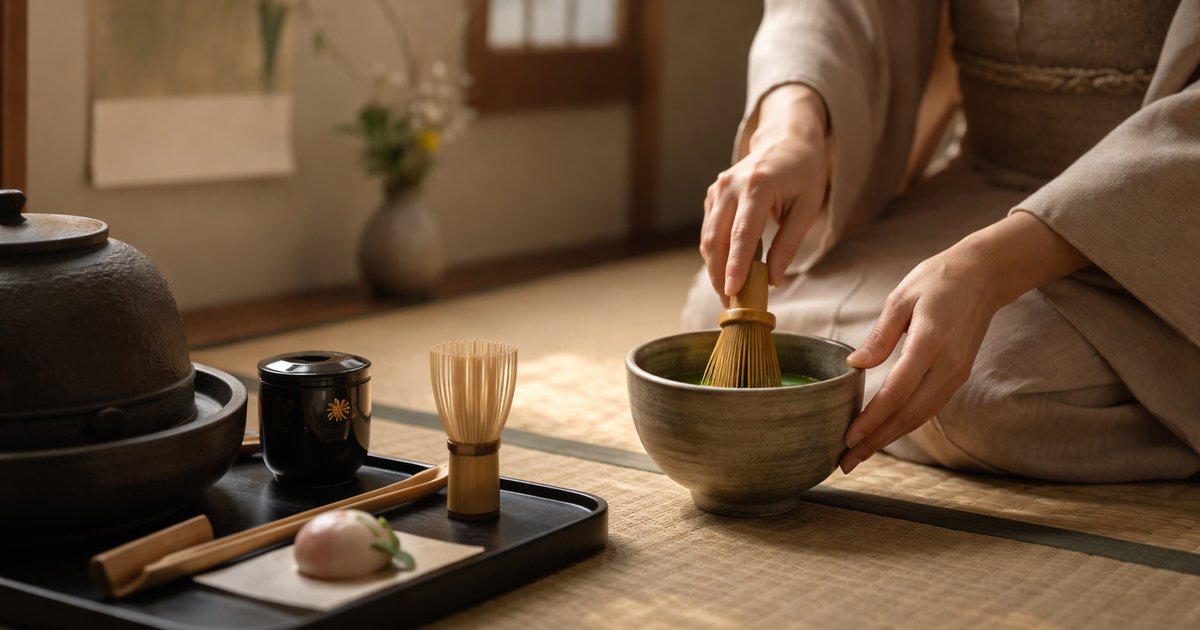
Say “tea ceremony” and most people picture kneeling on tatami, a long list of rules, and a great deal to memorize. It can feel like a door that is hard to open.
But look inside, and what you find is surprisingly plain. A wish that the person sitting in front of you enjoys their bowl of tea. That is really all of it.
In this article, we use the hottest time of year as our way in, and trace what kind of time the tea ceremony actually is — written for those meeting it for the first time.
What you’ll learn here
- What kind of time the tea ceremony is
- Why a summer tea room is built around keeping you cool
- The summer-only gathering called asa-chaji, the morning tea
- Wa-kei-sei-jaku, the four words said to hold the spirit of tea
- How wabi-cha was born and passed down
Tea ceremony is time spent welcoming someone with tea
Sadō — also called chanoyu, “the way of hot water for tea” — centers on matcha, green tea leaves ground into a fine powder on a stone mill. The host whisks a bowl of it for a guest. That whole stretch of time, not just the drinking, is the tea ceremony.
Yes, there are many forms to follow. But most of them are what remained after wasted movement was stripped away, in a long search for the shape that reaches the other person most gently. The rules did not come first. Small acts of care piled up until they became rules. Seen that way, the door opens a little more easily.
A summer tea room is built out of coolness
Every tea room has a fire for heating water. Where that fire sits changes with the season.
From May through October comes the season of the furo — a portable brazier that rests on top of the tatami. From November through April comes the season of the ro, a hearth sunk into the floor, closer to an old open fireplace.
The reason for the switch is the most tea-ceremony thing about it. In the warm months the furo is placed a little further from the guest, so the heat does not reach them. In the cold months the ro sits closer, so the warmth does.
A summer tea room, in other words, is arranged around a single question: how can this person stay cool? Where a single object is placed is already hospitality.
Asa-chaji, the tea gathering only summer has
Summer brings one more thing of its own: asa-chaji, the morning tea gathering.
Through the fierce heat of July and August, inviting guests at midday would only make them suffer. So instead — let’s meet at the coolest hour there is. Asa-chaji begins at five or six in the morning and closes by nine or ten.
Everything about it is made lighter for the heat. The meal is kept simple, one soup and two dishes, with the grilled course left out. The whole gathering moves briskly and ends before the day turns hot. It opens with fresh morning water being poured into the kettle: a few hours that exist purely to taste the cool.
Not enduring the heat, but finding the gap where coolness still lives and inviting someone into it. That instinct says a great deal about what tea ceremony is.
Wa-kei-sei-jaku, the spirit of tea
The phrase most often given for the spirit of tea is wa-kei-sei-jaku, treasured in the Senke schools as the “four principles.”
- Wa — harmony: letting hearts soften toward one another
- Kei — respect: holding the other person in regard
- Sei — purity: keeping both the utensils and the space clean
- Jaku — tranquility: a quiet mind that nothing disturbs
These words are widely told as Sen no Rikyū’s own. Yet they appear in no reliable source from his lifetime, and scholars do not accept them as his. Recent research suggests they may have been shaped instead by Daishin Gitō (1657–1730), a Zen priest of the Edo period.
Whose words they are remains unsettled. And still, for centuries, they have guided everyone who turns toward tea — which may say more about the weight of these four characters than any attribution could.
How wabi-cha came to be
Tea shifted from a display of lavish imported utensils toward wabi-cha, finding beauty in what is plain. Three names sit at that turn.
First Murata Jukō (1423–1502), regarded as the founder of wabi-cha, who left writings framing tea as a path for growing as a person. Then Takeno Jōō (1502–1555), who refined that thinking further. And then Sen no Rikyū (1522–1591), who brought wabi-cha to completion as a culture of its own.
From the sons of Rikyū’s grandson, Sen no Sōtan, came the three Senke schools — Omotesenke, Urasenke, and Mushanokōjisenke — carried on to this day.
Before you go
The tea ceremony is not a rulebook for behaving correctly. It moves the fire, moves the hour, lightens the meal — all so the person in front of you can be comfortable. The forms are what that care hardened into.
Setting out a cold drink for someone on a hot day. Opening a window to let the air move through. That is already the same thread of thought.
The forms can wait. Start with a single bowl of tea, and touch it gently from there.