2026年8月26日
Your First Japanese Tea Ceremony | From Entering the Room to Returning the Bowl, Explained Gently for Beginners
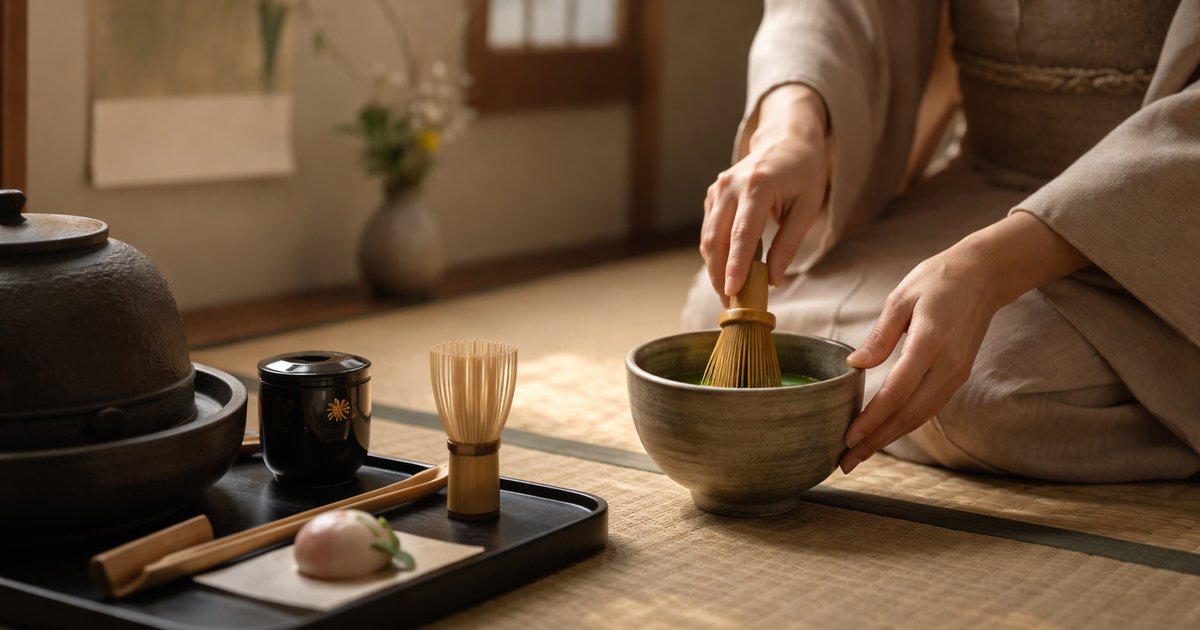
You’ve been invited to a tea ceremony. You want to go. But —
What do you bring? Where do you sit? Do you really turn the bowl? How many times, and which way? When do you eat the sweet? What if you get it wrong and offend someone?
It would be a shame to stay home over that. So here is the whole thing in order: from entering the tea room to drinking the tea and returning the bowl. You don’t need to memorize any of it. Just knowing roughly how it goes changes the day completely.
What this article covers
- The most important point first: the etiquette is not one fixed thing
- What to bring — kaishi paper, a sweet pick, white socks
- Entering and taking a seat. What “first guest” and “last guest” mean
- How to eat the sweet (the moist kind and the dry kind)
- How to drink thin tea — why the bowl is turned, and which way
- What the phrase otemae chōdai itashimasu actually means
- The thing Rikyū said matters more than any of the procedure
First: there is no single correct etiquette
This has to come first, or everything below is misleading.
Tea has many schools. Even among the three best-known ones — Omotesenke, Urasenke, and Mushakōjisenke, collectively the San-Senke — the etiquette differs noticeably. How many steps you take to cross one tatami mat, how far apart your knees go when kneeling, the angle of the bow, and even whether the tea is whisked to a foam (Omotesenke and Mushakōjisenke keep it fairly flat; Urasenke whisks it frothy).
So there is no universal “correct” version. What follows is one example, based on the beginner’s guide Urasenke publishes on its official site. At a gathering held by another school, some details will differ.
And one more thing. Large public tea events aimed at newcomers — the Tokyo Grand Tea Ceremony, for instance — state plainly that you may join a tea seating without preparing anything at all. If nerves are what’s stopping you, start with an event like that.
What to bring
The customary items are these:
- Kaishi — a folded stack of Japanese paper. It serves as your plate for the sweet, and as something to wipe your fingers on. Used sheets are folded up and taken home with you
- Kashikiri / kuromoji — a small pick for cutting the sweet. The name kuromoji comes from the spicebush tree whose branches are shaved to make them
- A folding fan — not for cooling yourself. It is placed in front of you when you greet someone
- White socks or tabi — changed into before you enter the tea room. It keeps dirt out, and is also linked to sei, “purity,” one of the four characters of the tea spirit
Also: take off your watch and rings. This is to avoid scratching the bowls and utensils — a very practical rule in a world where a bowl on the tray may be several centuries old.
Entering and sitting down
When you enter, do not step on the border strips of the tatami, or on the threshold of the sliding door. That’s the basic rule. Simply trying to avoid them will slow your steps down on its own, which is the point.
Seating has an order. The seat nearest the host is the shōkyaku — the first guest. The seat furthest away is the makkyaku — the last guest.
The first guest converses with the host and asks about the utensils; the last guest helps with the closing. Both roles are taken by experienced people. If it is your first time, the usual advice is to avoid both ends and sit somewhere in the middle — that way you can watch the person ahead of you and do as they do.
Eating the sweet
The sweet comes before the tea. That may sound backwards, but the sweetness is what makes the matcha taste right afterwards.
There are two kinds:
- Omogashi — moist sweets: yam-flour buns, kinton, rice-cake sweets, and seasonal ones such as chimaki in early summer or minazuki in June
- Higashi — dry sweets: rakugan pressed sugar, thin crackers, aruheitō hard candy
Moist sweets may arrive in a fuchidaka, a stacked lacquer box, with one kuromoji pick per guest resting on the lid — you take one. Dry sweets come on a higashiki tray, two or three varieties piled a little more generously than the number of guests, and you pick yours up by hand onto your own kaishi paper.
The sequence:
- Say osaki ni (“please excuse me for going first”) to the person beside you
- Move your sweet onto your kaishi paper
- For a moist sweet, cut it into bite-sized pieces with the pick
- Fold up the used paper and take it home
The vessel is then passed along. Aim to finish the sweet before the tea arrives.
How to drink thin tea
This is the part everyone worries about. Here is the sequence as Urasenke publishes it:
- When the bowl is set before you, place it between yourself and the next guest and bow, saying “osaki ni“
- Place the bowl in front of your knees, inside the tatami border, and bow to the host, saying “otemae chōdai itashimasu“
- Rest the bowl on your left hand, steady it with your right, and raise it slightly in a gesture of thanks
- Turn it twice toward yourself with your right hand. Then drink quietly, tasting it
- When finished, wipe the rim where you drank with your index finger and thumb, then wipe those fingertips on your kaishi paper
- Turn the bowl twice the other way, from near to far, returning it to its original orientation
- Set the bowl outside the tatami border, place both hands down, and look at its form. Then turn it twice toward yourself once more and return it to where it was served
You’ll often be told to finish it in three or four sips. That figure doesn’t appear in Urasenke’s own guide, so treat it as common advice rather than a rule. Drawing up the last of it with a slight sound is widely done as a signal that you’ve finished — the slurp is not rude here.
Why turn the bowl?
The most-asked question, and the answer is simple: to avoid drinking from the front of the bowl.
A tea bowl has a front — its most beautiful face — and the host sets it down with that face turned toward you. Having received that gesture, the guest thinks: it would be presumptuous to put my mouth on the finest part. So you shift it aside and drink from elsewhere. When you’re done, you turn the front back toward the host.
The turning isn’t the point; moving the front out of the way is the point. Which is why the number of turns and the direction vary by school. Once you know the reason, you can watch the person ahead of you and match them on the spot.
What otemae chōdai itashimasu means
The phrase you say over the bowl means, roughly: “I gratefully receive the tea you have made.” Otemae is the whole sequence of movements by which the host prepares the tea. So you are not only thanking them for the cup in front of you — you are thanking them for everything their hands did to get there.
And osaki ni, said to your neighbor a moment earlier, is short for “excuse me for going ahead of you.” One word to the host, one word to the person beside you, and then you drink. Learn those two phrases and the rest of it carries you along.
What Rikyū said matters more
Having listed all that procedure, one last thing.
Asked by a student what tea ceremony really is, Sen no Rikyū is said to have given seven short instructions, the Rikyū Shichisoku. The last of them is not about utensils or movement at all:
“Have care for your fellow guests.”
Whoever is sitting in the first guest’s place and whoever is in the last guest’s place should respect one another and enjoy the time together — that is how it is explained. And when the student replied, “well, I knew that much already,” Rikyū is said to have answered: “If you can actually do it, I will become your student.”
The spirit of tea is often summed up in four characters: wa-kei-sei-jaku. Wa, opening your heart to one another; kei, mutual respect; sei, purity not only visible but inward; jaku, a mind that stays steady in any situation. Two of the four are about the person sitting next to you.
Getting the number of turns wrong matters less than forgetting to say osaki ni. That is the order of priorities.
How to touch it today
Even with no tea gathering on your calendar, there is something you can try.
Pick up whatever cup you have and look for its front — the patterned side, the face it was made to show. If that face is turned toward you, shift it a little before you drink.
It’s a tiny movement, but it means holding the cup on the assumption that somebody thought about which way to place it. Turning the tea bowl is, in the end, a way of learning that assumption with your hands.
And if you do get to a tea gathering: watch the person ahead of you and you’ll be fine. Everyone there knows you’re nervous.
In closing
Tea etiquette is not a set of rules for getting scolded over. It is a form for returning, with your body, the fact that you noticed someone’s care.
Move the front aside. Say a word before you drink. Take your used paper home. Every one of these has a consideration for someone attached to it. Noticing the consideration may be a shorter route than memorizing the order.
Otemae chōdai itashimasu. Start with that one phrase.