2026年9月2日
What Is Matcha, Exactly? | From the Shaded Field to the Stone Mill, Explained Gently for Beginners
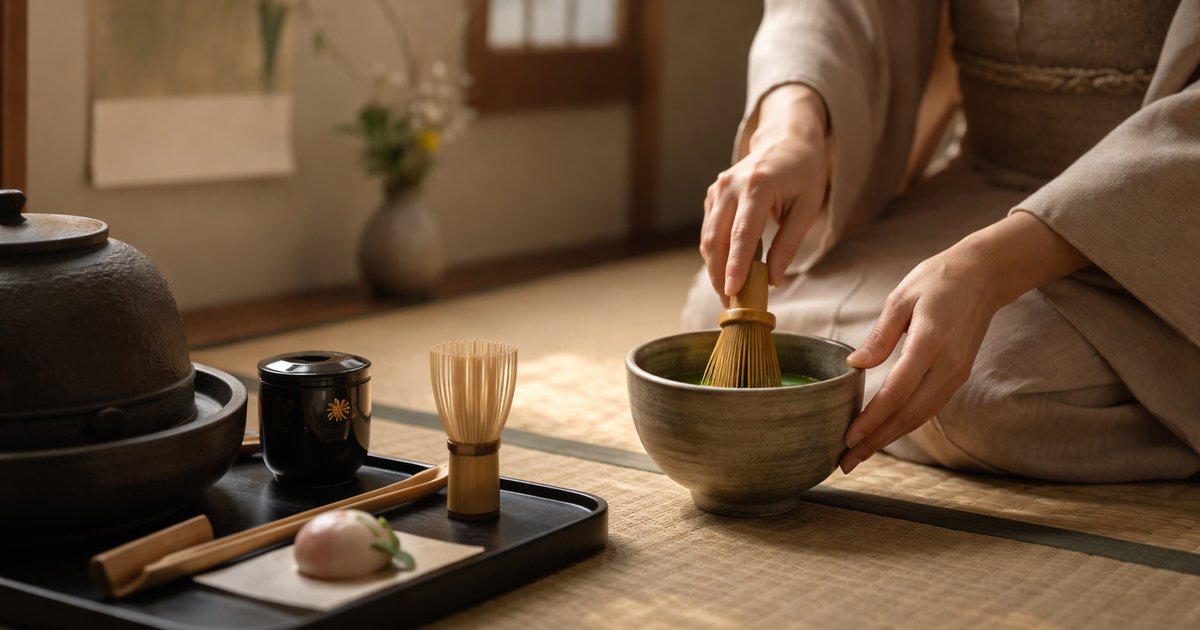
Matcha is everywhere now. In lattes, in ice cream, in chocolate, in the KitKat aisle.
And yet one question tends to stop people:
What actually is matcha?
“Green tea, ground into powder.” Half right. Only half — because green tea ground into powder already has its own, different name.
What makes matcha matcha isn’t the taste, and isn’t the colour. It’s how it is made. So let’s walk through that, from the field to the bowl.
In this article
- What matcha is, defined in one line
- Why the tea field is covered up, and what shade does to the leaf
- The fork in the road: rolled, or not rolled
- Tencha — the step just before matcha
- The stone mill, and the forty grams an hour
- Thick tea and thin tea are the same powder
- Not everything labelled “matcha flavour” is matcha
- In 2022, the world finally agreed on a definition
First, the short answer
The Japan Tea Association’s labelling standard for green tea defines matcha like this:
Tencha, ground into a fine powder with a tea mill or similar.
Which raises the next question: what is tencha? The same standard says:
Leaves picked from a shaded tea garden — one covered for roughly two to three weeks before harvest with reed screens, straw mats, or shade cloth on a frame — then steamed and dried without rolling, in a tencha oven or similar.
Wonderfully specific. And that specificity is the answer. Matcha is not a flavour or a colour. It is the name of a procedure: grown this way, made that way.
Put more gently:
Leaves grown in shade, steamed, dried without rolling, and ground on a stone mill.
Now, one step at a time.
1. The field is covered
Matcha begins weeks before anyone drinks it — out in the field.
Two or three weeks before picking, a frame goes up over the tea bushes, and over that go reed screens, straw, or these days a fine black cloth called kanreisha. The point is to block the sun. A field grown this way is an ōishita chaen — a shaded tea garden.
Why deliberately withhold sunlight?
Here is the loveliest piece of chemistry in tea. The Kyoto Prefectural Tea Research Institute explains it this way:
Theanine is synthesised in the roots of the tea plant and accumulates in the leaves. When exposed to sunlight, theanine converts into catechins, the compounds responsible for astringency.
Theanine is an amino acid, and it is where the savoury sweetness of good tea comes from. The roots make it; it travels up into the leaf. But once the leaf sits in the sun, that theanine starts turning into catechins — which is where bitterness comes from.
So: cover the field. The same institute continues:
Shading suppresses the conversion into catechins, producing a fine tea rich in savouriness and low in astringency.
Covering a tea field, in other words, is stopping sweetness from turning into bitterness, partway through. That dense, almost sweet weight you get when matcha sits on your tongue — that was decided out in the field, under a screen.
Shade does one more thing: a leaf grown without sun grows darker. That deep green is made there too.
How old is this practice?
Honestly — nobody is quite sure.
The Portuguese missionary João Rodrigues, in his História da Igreja do Japão, described covered tea gardens in Uji in the late sixteenth century. But a study of soil from an old tea garden in Uji has estimated that shading was already being practised there in the early fifteenth century.
There is also a suggestion that the covers were not originally about flavour at all, but about protecting the young shoots from spring frost, with the effect on taste discovered along the way.
All of this is contested. What is certain is only that the screens have been going up for several hundred years.
2. Steaming
Picked leaves are steamed almost immediately. As Urasenke’s guide puts it:
The picked leaves are steamed evenly.
This step is shared by all Japanese green tea. Steam halts oxidation, and the green stays green. Left alone, a picked leaf keeps oxidising and drifts off toward oolong, and then toward black tea. Green tea is green because of this one move.
(Chinese green teas usually stop oxidation by pan-firing rather than steaming. Same goal, different hand.)
3. Not rolled — this is the fork in the road
This is the part that matters most.
Ordinary Japanese green tea — sencha — is rolled for hours after steaming. Rolling breaks down the structure of the leaf and works it into those thin needles, so that when hot water arrives, the flavour comes out quickly. Rolling is the heart of making sencha.
Tencha skips it entirely. From Urasenke’s guide:
The leaves are dried at once, without being rolled.
Unrolled, the leaves dry flat, more or less the shape they grew in — big, brittle, papery leaves. That is what tencha looks like.
Why not roll? Because it is going to be ground anyway. You are not going to steep it and pour off the liquid; you are going to powder the whole leaf and drink it. Rolling would serve no purpose.
And there is the whole difference in one line. With sencha you drink what comes out of the leaf, and throw the leaf away. With matcha you drink the leaf.
4. Stems and veins removed
Next, the stems and leaf veins are picked out of the dried leaf:
Stems, veins and the like are removed, leaving only the tender leaf.
What remains is called shiage-tencha, finished tencha.
Leave the tough parts in and the grind comes out coarse — you feel it on your tongue. The famous smoothness of matcha rests on this rather unglamorous sorting.
5. The stone mill
Finally, the tencha is ground.
The finished tencha is ground on a stone mill, and becomes matcha.
Only here does the word “matcha” apply. Everything before this is tencha.
And the mill is slow. Gion Tsujiri, a tea house in Uji, describes its own stone-milled matcha as “a mere forty grams an hour.”
Forty grams is about twenty bowls of thin tea. An hour of turning, for that.
Why not hurry? Because speed means friction, friction means heat, and heat drives off the aroma. That fresh green smell when you open a tin of good matcha is exactly what the slow turning is protecting.
A footnote on the words themselves: the ma of matcha (抹) means to grind or rub to powder, and the ten of tencha (碾) also means to mill. Both names simply say: this is tea that gets ground.
Thick tea and thin tea are the same powder
In the tea room, matcha comes two ways: koicha, thick tea, and usucha, thin tea.
Koicha is dense and almost syrupy, and it is the centrepiece of a formal tea gathering. Usucha is the light, frothy bowl most people picture when they hear “matcha.”
You might assume they come from different products. They don’t. Urasenke’s guide is direct about it:
There is no difference in how they are made; both are ground on the stone mill in the same way.
The difference is quantity:
- Koicha — about one monme (roughly 3.75 g) of matcha per person, with hot water in the right amount and at the right temperature
- Usucha — about gobu (roughly 1.8 g) in the bowl, with hot water
Twice the powder. And koicha isn’t whisked into foam — it is kneaded, worked slowly with a little water into something closer to a thick liquid. Usucha is whisked briskly with a bamboo whisk until it froths.
The same powder, in two amounts, becomes two entirely different drinks. That is one of the quiet pleasures of matcha.
(In practice, koicha is usually made from higher grades — younger leaves, longer shading. The point is that the process is identical.)
Not everything labelled “matcha” is matcha
By now you can probably guess where this goes.
There is another green powder on the market, called funmatsu ryokucha — powdered green tea. It’s sencha, ground. Leaves grown in full sun, rolled, dried, then powdered.
This is not a criticism of it. It’s high in catechins, dissolves easily, and is perfectly good for everyday drinking. It is simply a different thing, different from the field onwards.
Products labelled “matcha flavour” may contain real matcha, or powdered green tea, or colouring. The ingredients list usually settles it: whether it says matcha or simply green tea.
This isn’t about catching anyone out. It’s just that the particular density of real matcha comes at the end of several weeks under a screen and an hour of stone-milling for forty grams — and knowing that tends to change the next cup a little.
In 2022, the world agreed on a definition
One recent development, to close on.
As matcha grew popular abroad, a problem grew with it. There was no international agreement on what matcha actually was, so wildly different products were all being sold as “Matcha.”
Japan’s National Agriculture and Food Research Organization (NARO) and others pushed for a standard, and in April 2022 the International Organization for Standardization published a technical report:
ISO/TR 21380:2022 Matcha tea — Definition and characteristics
It covers the history of matcha, the cultivation and processing of tencha, how tencha becomes matcha, and the markers of quality. Grown under shade. Processed on dedicated tencha equipment. Ground fine on a stone mill. The steps in this article, written down as an international document.
It doesn’t legislate taste. It simply records that the route from the shaded field to the stone mill is what makes matcha matcha. There is something satisfying about a few hundred years of practised hands being written down that way.
To finish
From the top, once more:
- Two to three weeks before harvest, cover the field (stopping sweetness from turning to bitterness)
- Steam the picked leaves (oxidation halts; the green stays)
- Dry them without rolling (they’re going to be ground anyway)
- Remove stems and veins (this much is tencha)
- Grind slowly on a stone mill — forty grams an hour (now it’s matcha)
What sits in the bowl is 1.8 grams of powder. Behind it: weeks of shade, a decision not to roll, and a stone wheel turning slowly.
Next time, before the water goes in, take a look at the powder itself. That deep green is the colour of sunlight withheld.
Knowing just that much tends to change the bowl.
Sources
- Urasenke official site, “Tea for Beginners” / “How Matcha Is Made” (shaded gardens; steaming; drying without rolling; tencha; stone mill; koicha approx. 3.75 g, usucha approx. 1.8 g, identical process)
https://www.urasenke.or.jp/textb/shiru/beginer/ - Kyoto Prefectural Tea Research Institute, “On Theanine” (synthesised in the roots; converts to catechins in sunlight; shading suppresses the conversion)
https://www.pref.kyoto.jp/chaken/teanin.html - Japan Tea Association, labelling standard for green tea — definitions of tencha and matcha (consulted via Ise Matcha Co.’s explanatory page)
https://isematcha.co.jp/tentya/ - NARO press release, “A technical report on the definition of matcha is published by ISO” (11 April 2022; ISO/TR 21380:2022; the absence of an international standard as background)
https://www.naro.go.jp/publicity_report/press/laboratory/nifts/152224.html - ISO/TR 21380:2022 Matcha tea — Definition and characteristics (published 2022)
https://www.iso.org/standard/80777.html - Gion Tsujiri, “Uji Matcha” (stone milling; “a mere forty grams an hour”)
https://www.giontsujiri.co.jp/ujicha/matcha/ - Ocha.tv (Ito En), “Matcha and Tencha” (matcha as tencha ground on a stone mill or fine grinder; shaded cultivation)
https://www.ocha.tv/varieties/nihoncha_varieties/maccha/ - History of shaded cultivation (the late-16th-century account in História da Igreja do Japão; the early-15th-century estimate from soil study of an Uji tea garden; the frost-protection hypothesis)
https://ja.wikipedia.org/wiki/覆下栽培
Details of production vary by region and by maker. The origins of shaded cultivation are disputed, and this article does not present any one account as settled.