October 3, 2026
Gintsugi: Silver Repairs That Slowly Turn Dark | Kintsugi Finishes Beyond Gold — Silver, Platinum, Tin and Lacquer
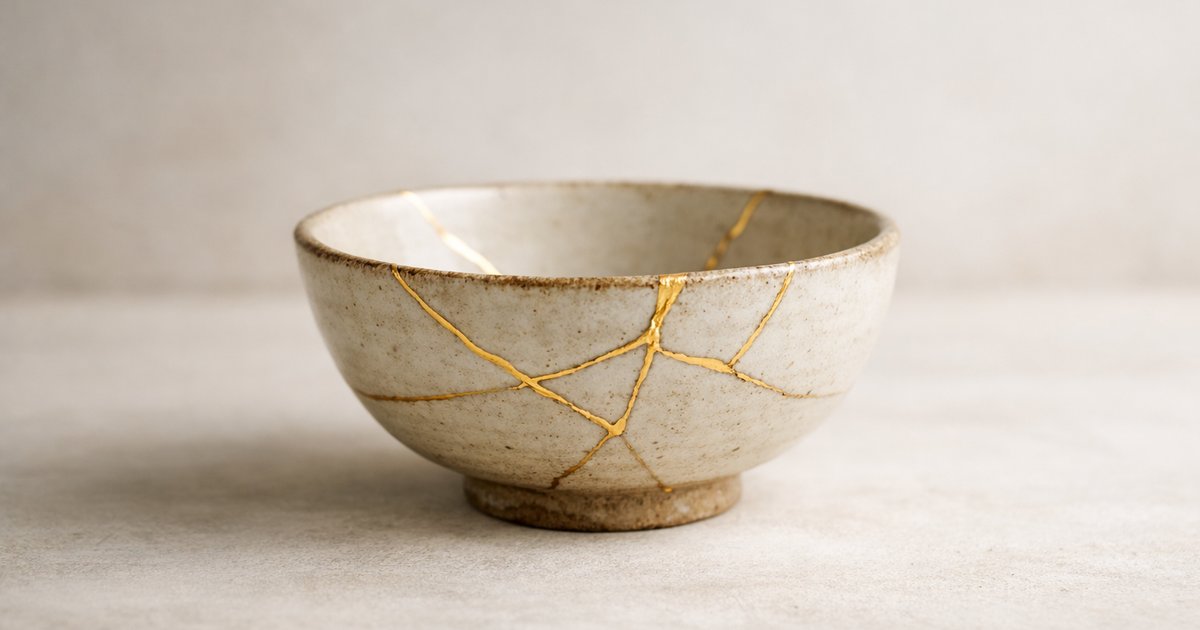
When you hear “kintsugi,” you probably picture a golden line running through a broken bowl.
But that line doesn’t have to be gold. Finish it with silver and it becomes gintsugi — “silver joinery.” Some repairers use tin or platinum. Others use no metal at all, only black or vermilion lacquer.
And among all of these, one finish keeps changing color long after the repair is done. The silver in a gintsugi repair slowly turns dark.
This is a gentle guide to the finishes beyond gold, and to the idea of enjoying silver as it darkens.
What you’ll learn
- Why the finish of a kintsugi repair can be chosen
- The different looks of gold, silver, platinum, tin and brass
- Finishing with lacquer alone, without any metal
- Why silver repairs darken over time
- The idea of enjoying that darkness on purpose
Gold is only the very last layer
First, one thing to know. In kintsugi, what holds the broken pieces together is not gold. It’s urushi, Japanese lacquer — a natural tree sap. Lacquer glues the pieces, fills the chips and smooths the surface. That’s nearly all of the work. Gold appears only in the last and thinnest layer.
While the final coat of lacquer is still slightly tacky, metal powder is dusted onto it, and the lacquer holds it in place. So if you change the powder, you change the color of the finished line. The structure underneath stays the same; only the “makeup” on top is a choice.
We walked through the full process in our article on how kintsugi repairs are made.
Finishing with metal: five looks
Kintsugi studios and classes in Japan commonly offer finishes like these:
- Gold — the best-known finish. Its color doesn’t change over time.
- Silver — bright and whitish when new, then gradually darkening.
- Platinum — a cool, grayish shine. Unlike silver, it doesn’t tarnish.
- Tin — its powder is coarser than the others, giving a slightly grainy, soft glow. It’s said to suit rustic, earthy stoneware.
- Brass — close to gold in color, but it can darken with time.
Even with the same metal, there are two ways to finish: keshi, a soft matte surface, and migaki, polished to a shine. One studio describes matte gold as the most common choice, and polished gold as the one that really says, “This has been mended with gold.”
No metal at all: finishing with lacquer
Some repairs skip the metal powder and let the color of the lacquer itself be the finish — usually black or vermilion. This is sometimes called urushi-tsugi, “lacquer joinery.”
A metal line announces, “I was repaired.” A lacquer line speaks more quietly. Matched to the colors and patterns of a bowl, it can look almost like part of the original design. Some people even choose lacquer close to the color of the bowl, so the repair barely shows.
Show the mend, or let it blend in? Kintsugi is often introduced as “the art of showing your scars,” but in real studios, even how much to show is decided bowl by bowl.
Silver repairs turn dark
Now, back to silver.
Silver reacts with tiny amounts of sulfur in the air and forms a thin black film on its surface — silver sulfide. It’s the same reason a silver ring turns dark if you wear it into a hot spring.
A paper from the Tokyo National Research Institute for Cultural Properties explains that silver is generally less reactive than copper, with one exception: it blackens quickly when exposed to sulfur. It also notes that once relative humidity rises above about 60%, this dark film grows much faster.
So a gintsugi bowl, as it’s used, slowly shifts from white to gray, and from gray toward black — quietly, in the ordinary air of a kitchen.
If you ever want the shine back, the silver can be polished again, and some studios say the silver layer alone can be reapplied. Darkening isn’t a failure. It’s simply what silver does.
Enjoying the darkness on purpose
Here’s the interesting part. Japanese metalwork has a technique for making this change happen deliberately, in advance.
Craftspeople use chemicals to give brand-new silver an aged color. This is called furubi — roughly, “giving it age.” According to the same research paper, the original purpose of furubi was to color the silver surface on purpose and bring it to a stable state. Taking bright, new silver and settling it into a calmer tone is a long-standing craft.
Japanese even has a word for this kind of beauty: ibushi-gin, “smoked silver.” Originally it meant silver darkened to gray with sulfur smoke. Today it’s also used to praise a person or thing that isn’t flashy but has real depth and quiet skill — something like “understated but masterful.”
When a silver repair darkens, you can see it as dirt, or as depth. If kintsugi is a way of accepting a break as part of an object’s history, then gintsugi may go one step further: it records, in the color of the line, the time the bowl has spent with you since it was mended.
How to choose
There’s no right answer, but here are a few things to think about:
- The color of the piece. Gold and silver both shine on white porcelain; a gold line stands out sharply on a dark bowl.
- The texture of the piece. On rough, earthy stoneware, tin or a matte finish is said to sit more naturally.
- Whether you’d enjoy change. For a shine that stays the same, choose gold or platinum. To watch the color grow, choose silver.
- Cost. Gold — especially polished gold — tends to be the most expensive, and some studios note that platinum costs less than gold.
If you’re unsure, ask the studio or class to show you finished samples. The same bowl can feel completely different just by changing the color of the line.
A gentle first step
Next time you see photos of kintsugi, look closely at the color of the lines. Alongside gold, you’ll find silver lines, black lines, even vermilion ones.
And when you spot a silver line, imagine where that bowl is on its journey — still bright, or already grown dark. If you’d like to know more about the lacquer underneath, see our article on urushi.
In closing
A gold line keeps the shine it had on the day of the repair.
A silver line starts darkening from that very day, and the days the bowl is used settle into it, little by little.
Neither is better. But when you mend something broken, it’s rather lovely to be able to choose what kind of time you’d like to spend with it.
Sources
- Kato Hiroshi, Sano Chie, Saito Shiomi and Uchibori Go, “Traditional Coloring of Metals (I): Antique Finishing of Silver and Its Color Change,” Science for Conservation No. 43, Tokyo National Research Institute for Cultural Properties, 2004 (in Japanese; silver is less reactive than copper but blackens rapidly with sulfur and hydrogen sulfide / black silver sulfide Ag2S / the sulfide film grows rapidly above 60% relative humidity / coloring of silver is called furubi, originally meant to color the surface artificially and stabilize it)
https://www.tobunken.go.jp/ccr/pdf/43/04301.pdf - Kintsugi Kobo Yagi, “Silver, tin, platinum and other finishes” (in Japanese; matte gold is the most common / matte silver mellows over time / tin powder is the coarsest and suits earthenware / platinum is grayish, cheaper than gold and does not tarnish / polished gold is the most expensive / darkened silver can be repolished / lacquer finish)
https://www.kintunagi.com/その他の仕上げ方/ - URUSHI VILLAGE, “Not just gold: different kintsugi finishes” (in Japanese; gold does not change color / silver darkens over time / platinum keeps its color / tin has a subdued tone / brass resembles gold but may darken / lacquer finishes in black or vermilion)
https://urushivillage.com/finish-type/ - Watsukuri, “Four kintsugi finishes: gold, silver, platinum and colored lacquer” (in Japanese; silver goes from white to gray to black, can be repolished, and the silver alone can be reapplied / tin suits rough stoneware)
https://www.wacrafts.com/lacquer/kintsugi-finish-types
Names for finishes, the finishes on offer and prices vary from studio to studio. How quickly silver darkens depends on the humidity and air where the piece is kept.