September 4, 2026
What Is a Japanese Tea Room? | Why the Most Famous One Is Only Two Mats — Explained Gently for Beginners
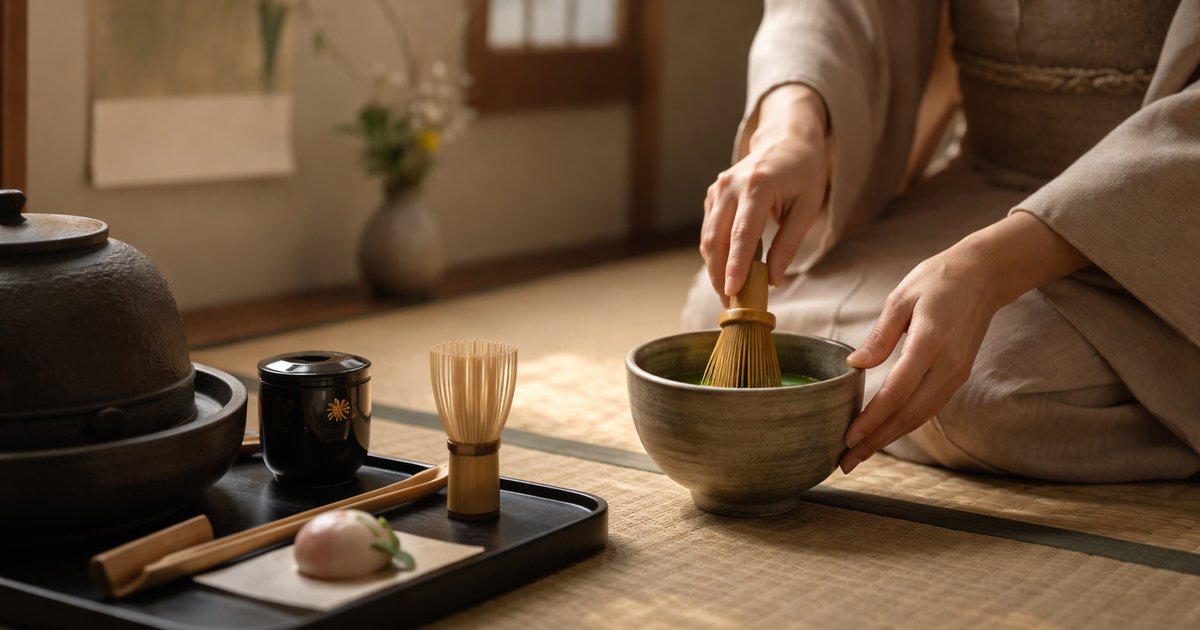
When you hear the words “tea room,” how big is the room you picture?
Most people imagine something like a modest living room — tatami mats, an alcove, a hanging scroll on the wall.
Japan’s most famous tea room is two mats. Two pieces of tatami. Roughly 3.3 square metres. Two adults sitting in it are almost knee to knee.
It is called Taian, it stands in the town of Ōyamazaki just south of Kyoto, and it is a designated National Treasure.
Which raises the obvious question. Why would anyone build it that small on purpose?
That is what this article is about. The smallness of a tea room is not thrift and it is not hardship. The smallness was the point. Once you see it that way, the whole room reads differently.
What you’ll find here
- What a tea room is actually for
- Why “four and a half mats” became the standard — and why its origin is genuinely unsettled
- From four and a half mats down to two: why tea rooms kept shrinking
- The nijiriguchi, the crawl-in door, and how much of the famous story about it we can actually verify
- The alcove and the windows — a space kept empty, and light kept scarce
- What is inside Taian, the National Treasure
- How a beginner can actually get into a tea room
What a tea room is for
Start with the plainest possible definition.
A tea room is a room built only so that a host can invite guests and serve them tea.
That word “only” is doing a lot of work. It is not a bedroom, not a dining room, not a parlour where you also happen to receive visitors. An entire structure is given over to a single activity. Even within Japanese architecture, that is unusual behaviour.
So a tea room contains almost nothing you would need to live. No storage, no display shelving, no chairs. There are tatami mats, walls, a few small windows, an alcove, and a sunken hearth for boiling water. That is the inventory.
And that is where the story starts. If you keep removing what isn’t needed, how small can a room get?
The four-and-a-half-mat standard
Tea rooms have a loose reference size: four and a half tatami mats.
Anything smaller is called a koma (small room). Anything larger is a hiroma (large room). A two-mat or three-mat tea room is a koma; an eight-mat one is a hiroma.
Why four and a half? The explanation usually given points to the Zen Buddhist term hōjō.
Hōjō literally means “one jō square” — about three metres on a side, which comes out close to four and a half mats. The term traces back to the Vimalakīrti Sutra and its story of the layman Vimalakīrti, whose room measured one jō square. When Mañjuśrī and his entire retinue came to visit, the story goes, all of them fitted inside it.
A small room holding something much larger than itself. That idea has been attached to the four-and-a-half-mat size for a long time.
But here is the honest part. There is no settled account of how the four-and-a-half-mat tea room actually came about.
- One explanation derives it from Vimalakīrti’s room.
- Another says an eighteen-mat room in a Muromachi-period residence was simply quartered.
- The Dōjinsai room at Ginkaku-ji’s Tōgu-dō in Kyoto used to be called the oldest tea room; that claim is now treated much more cautiously.
Several explanations sit side by side, and none of them has won. “Four and a half mats became the standard, more or less” is about as much precision as the evidence supports.
From four and a half mats down to two
Told broadly, the history of the tea room is a history of getting smaller.
Through the late fifteenth and sixteenth centuries, tea changed direction. Before, there was shoin no cha — tea in the formal reception room, where expensive Chinese imports were displayed around a spacious hall and admired while you drank.
Out of that grew sōan no cha, tea of the grass hut, later known as wabi-cha. Its guiding idea was shichū no sankyo: building a mountain retreat in the middle of town.
Murata Jukō (15th century), Takeno Jōō (early 16th century), and then Sen no Rikyū (late 16th century). Across those three, the room kept being cut down.
In Jōō’s day, four and a half mats was the norm. Rikyū took it to two.
Two mats means exactly this:
One mat for the host. One mat for the guest.
There is no further cut available. It is the minimum floor area on which two people can sit facing each other. The shrinking of the tea room hits bedrock here.
And at that size, what is in the room becomes very short: the other person’s face, the sound of the water, the bowl, and whatever single thing is in the alcove.
It was made small in order to remove everything else. Put that way, the number two stops being austerity and starts being a design decision.
Nijiriguchi — the door you crawl through
The single best-known feature of a tea room is the nijiriguchi.
It is the guests’ entrance to a small tea room, and it is roughly two shaku — about 60 centimetres — in both height and width. You cannot walk through it. You duck, kneel, and shuffle in. Nijiru is the verb for moving forward on your knees.
Where did such a strange door come from? An old record called the Matsuya Nikki notes that Rikyū saw a low crawl-through hatch at a boat landing in Hirakata, near Osaka, found it interesting, and tried the idea in a tea room.
From that line grew the familiar anecdote: Rikyū watched fishermen ducking into their boat sheds on the Yodo River and borrowed the shape.
It is worth saying plainly that this has come down to us as a legend, and that scholars note it cannot be called Rikyū’s invention outright. We cannot trace with certainty who did it first, or when.
About “leaving your sword and your rank outside”
The nijiriguchi almost always arrives with this explanation attached:
A samurai could not fit through wearing his swords, so a sword rack stood beside the door. Everyone had to bow their head to enter. Inside, rank did not apply. The tea room was a place without social hierarchy.
This account is told very widely, and sword racks do exist at real tea rooms.
Even so: primary sources confirming that Rikyū designed the door with that intention are thin. This article treats it as an explanation handed down afterwards rather than an established fact.
One thing is not in doubt, though. You cannot get through that opening without bending. Whoever you are, your head goes down before you go in. What the body does there is the same regardless of which theory is right.
The alcove — space reserved for keeping empty
Most tea rooms have a tokonoma, an alcove recessed into the wall with a slightly raised floor.
What goes in it is, as a rule, a hanging scroll or a flower. Usually just one of the two.
In a room this small, the alcove is the most extravagant thing in it — floor area set aside so that nothing will be put there.
Alcoves come in several forms. Taian’s is an unusual one: the plaster is carried up over the corner post and around to the ceiling, so no corner shows. With the edges gone, light slides around the surface and the depth becomes hard to read. Erase the boundaries and the smallness stops registering. That is the trick.
Windows — less for letting light in than for rationing it
Tea room windows are not there for the view. They are there to decide how much light there is.
Two types do most of the work:
- Shitaji-mado — a window made by leaving a patch of wall unplastered, so the bamboo and reed lattice beneath shows through. The light comes in soft.
- Renji-mado — thin bars set at even intervals. The light falls in stripes.
There is also the tsukiage-mado, cut into the ceiling to drop light from above.
Rather than one big opening, a tea room gets several small ones, each placed where it is needed. The room stays dark overall and only certain places are bright. The rim of the bowl catches light; the characters on the scroll lift out of the shadow. The room is kept dim precisely so that the few things worth looking at can be lit.
What is inside Taian
Everything above comes together in Taian, the room we started with.
It stands at a temple called Myōkian in Ōyamazaki, Kyoto Prefecture. It was designated a National Treasure on 9 June 1951, and is thought to have been built around the Tenshō era (1573–1592).
Japan’s Agency for Cultural Affairs describes it this way:
Taian is a tea room built around the Tenshō era (1573–92) to Rikyū’s taste, famous enough that copies of it were made repeatedly in later ages. […] The handling of the ceiling and windows is ingenious, managing the cramped interior skilfully, and it is valuable as a surviving example of an early tea room.
“Managing the cramped interior skilfully.” In other words, the smallness was treated as a problem to be solved — after having been chosen deliberately. Make it small, then make it not feel small. As design briefs go, that is a hard one.
The official description of the structure runs: a two-mat tea room, a one-mat anteroom with a board section, and a preparation room. That is the entire building.
Taian is also described as the only surviving tea room that can credibly be attributed to Sen no Rikyū himself. Rooms bearing his name exist all over Japan; almost none of them can be traced back to the man with any confidence.
Together with Jo-an in Inuyama, Aichi Prefecture, and Mittan at Ryōkō-in in Kyoto’s Daitoku-ji, it forms what are called the three National Treasure tea rooms.
How a beginner actually gets into a tea room
Taian can be visited. It is not, however, a place you wander into.
According to Myōkian’s own guidance:
- Applications are accepted by return-paid postcard only
- Viewing is Sunday mornings only (slots at 10:30 and 11:30)
- Apply from about a month before your preferred date; listing a first, second and third choice is recommended
- ¥1,000 per person, up to five people per booking
- Visitors of high-school age and under are generally not admitted
- No photography or video anywhere on the premises
You write a letter, wait for a reply, and go out on a Sunday morning. And since you cannot photograph it, you have to look at it and carry it home in your head.
That may sound like a lot of friction. But a two-mat room cannot hold a crowd. A room like that gets a way of entering like that; it follows from the thing itself. And all that preparation is what makes that particular Sunday different from other Sundays.
※ Conditions can change. Please check Myōkian’s official website before making plans.
If you’d like to start somewhere gentler
You do not have to begin with a National Treasure. There are easier ways in.
- Tea houses in parks and gardens — many Japanese gardens have one, and on open days you can often see inside.
- Municipal tea rooms — cultural centres in many Japanese cities keep a tea room that anyone can book.
- Large gatherings (ōyose) — big, open tea events. Usually held in larger rooms, but you get to see how a tea space is set up.
We have written separately about going to a tea gathering. These may be useful next:
- Your First Tea Gathering — from entering the room to drinking the tea
- What Should You Wear to a Tea Gathering?
In closing
To gather it up:
- A tea room is built only for serving tea to guests.
- The reference size is four and a half mats — smaller is koma, larger is hiroma — though the origin of that size is not settled.
- As tea moved from the formal reception room toward wabi-cha, the room kept shrinking.
- Rikyū’s two mats is the limit: one for the host, one for the guest.
- The nijiriguchi is a door you enter bent over. The “leave your sword, leave your rank” reading is widely told but not backed by primary sources.
- The alcove is space kept empty; the windows ration the light.
- Taian, National Treasure since 1951, is the one surviving room credibly by Rikyū.
The smallness of a tea room is not poverty. It is the result of deciding what to keep.
Into two mats fit one other person, the sound of water, and a single bowl of tea. Which is to say: someone, more than four hundred years ago, seriously tested the proposition that this is enough. The evidence of that experiment is still standing south of Kyoto.
If you ever get the chance to enter a tea room, look first at the height of the door. The moment your body registers that you will have to bend, the tea room has already started.
Sources
- Agency for Cultural Affairs, Cultural Heritage Online — “Myōkian Shoin and Tea Room (Taian): Tea Room (Taian)” (National Treasure designation 9 June 1951; built around the Tenshō era, 1573–92; structure given as a two-mat tea room, one-mat anteroom with board section, and preparation room; “the handling of the ceiling and windows is ingenious, managing the cramped interior skilfully”)
https://online.bunka.go.jp/db/heritages/detail/200949 - Myōkian official website, “Visiting Information” (applications by return-paid postcard only; Sunday mornings only, 10:30 and 11:30 slots; ¥1,000 per person; up to five per booking; generally not open to high-school age and under; photography and video prohibited; apply from about one month before)
https://www.myokian.net/拝観案内/ - Nipponica (Encyclopedia Nipponica), “nijiriguchi” (entrance form of the grass-hut tea room, also called kuguri; roughly two shaku — about 60 cm — in both height and width; the Matsuya Nikki record of a crawl-hatch at the Hirakata boat landing near Osaka; Taian’s own nijiriguchi is notably larger than the norm)
https://kotobank.jp/word/躙口-3162303 - Wikipedia (Japanese), “Chashitsu” (four and a half mats as the standard, derived from the Zen term hōjō, “one jō square”; smaller = koma, larger = hiroma; the legend that Rikyū took the idea from fishermen’s boat sheds on the Yodo River at Hirakata, with the note that it cannot be called his invention; shitaji-mado, renji-mado, tsukiage-mado; the shift from shoin tea to the grass-hut tea of shichū no sankyo; the three National Treasure tea rooms — Taian, Jo-an, Mittan)
https://ja.wikipedia.org/wiki/茶室 - Wikipedia (Japanese), “Hōjō” (one jō square; the Vimalakīrti Sutra episode in which Mañjuśrī and his retinue all fit inside Vimalakīrti’s one-jō-square room)
https://ja.wikipedia.org/wiki/方丈 - Kyoto Prefecture Tourism Federation official site, “Myōkian (National Treasure ‘Taian’)” (a two-mat interior with a corner hearth and a murodoko alcove; Taian, Jo-an and Mittan as the three National Treasure tea rooms; said to have been built by Rikyū during his stay in Ōyamazaki)
https://www.kyoto-kankou.or.jp/info_search/3221
The origin of the four-and-a-half-mat size, the invention and derivation of the nijiriguchi, and the “leave your sword and your rank at the door” reading are all matters without settled scholarly consensus, and none is treated here as established fact. Even the name for Taian’s alcove differs between sources (murodoko in some, horadoko in others). Myōkian’s visiting conditions are subject to change; please check the official website before planning a trip.