September 16, 2026
Why Don’t Ikebana Flowers Fall Over? | Kenzan, Straw and Turtle-Shaped Holders — The Hidden Tools Beneath the Water
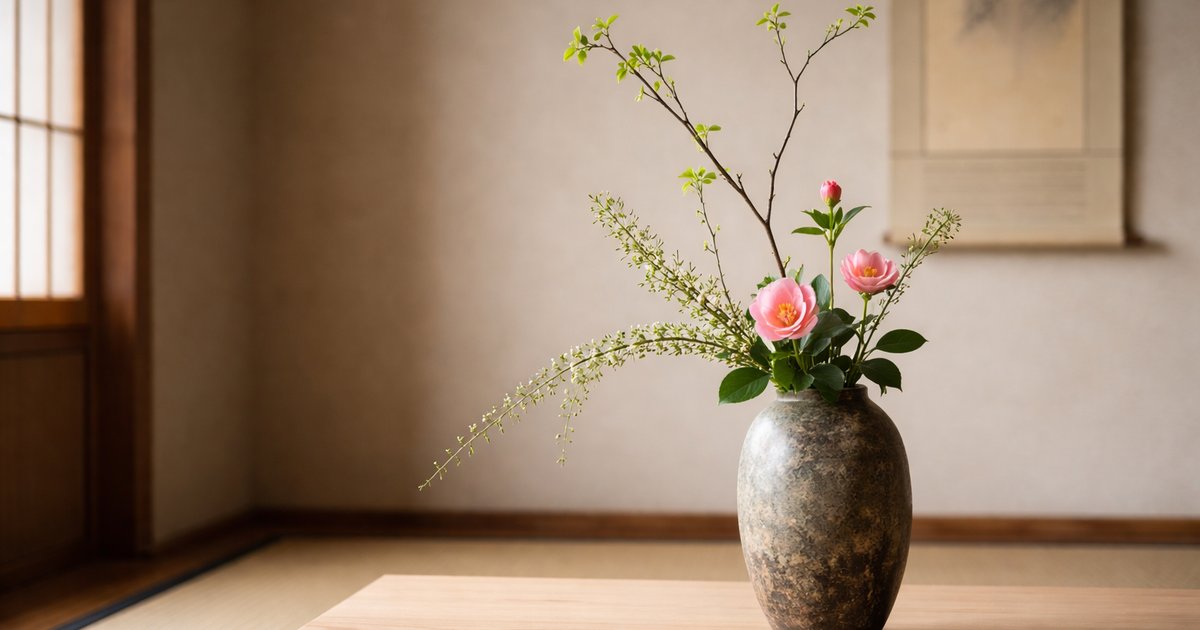
Look at a photo of ikebana and the flowers seem simply to stand there. A branch reaches out at an angle, a stem bows its head, and each one looks as if it stopped exactly where it wanted to be.
But flowers don’t stand up on their own. Put a branch in a bowl of water and it will usually just slump against the rim.
So inside every ikebana vessel, there is something you are not meant to see. A device that holds the flowers in place. In Japanese these are called hanadome — literally, “flower-stoppers.”
This article is about that hidden side. We’ll start with the one most people know, the kenzan or pin holder, and how to use it. Then we’ll go back to what came before it, and finish with flower holders shaped like turtles and crabs. By the end, you may find yourself looking below the waterline in every ikebana photo.
What this article covers
- What a flower holder is, and why ikebana needs one
- How to use a kenzan, and the one trick beginners usually miss
- Why the kenzan is actually a newcomer — only about a century old
- The straw and forked twigs people used before it
- Turtles, crabs and a horse’s bit: holders borrowed from other things
The kenzan: a bed of needles
The most familiar flower holder is the kenzan — the name means something like “sword mountain.” It’s a heavy metal base with thick needles set upright, packed close together. You place it in a shallow vessel, add water, and press the stems onto the needles.
There are more needles than you’d guess. Nihon Kadosha, the publisher and supplier connected to the Ikenobo school, lists around 370 needles for a standard kenzan and about 610 for one made for soft-stemmed flowers. There are versions for branches, for flowers, and for both — in the combined type, the needles in the centre are sturdier and the ones around them finer. What you plan to arrange decides how the needles are set.
The basics
The Ikenobo school’s official site explains how to use one:
- Add water until the kenzan disappears — just a little above the tips of the needles
- Push each stem firmly straight down onto the needles
- If you want a stem to lean, insert it upright first, then tilt it in the direction you want
- For thin stems, insert several together, or bundle them with a short piece of thicker stem
The third point is the one beginners tend to miss. A leaning branch isn’t pushed in at an angle. It’s stood up straight, and then laid over. Knowing that alone changes how a kenzan feels in your hands.
After use, rinse it under running water and pick out any trapped leaves with a bamboo skewer. If the needles bend over years of use, there’s even a small tool, the kenzan-okoshi, for straightening them again.
The kenzan is a newcomer
“A shallow dish with a pin holder” is probably the image most people have of ikebana. Yet the kenzan’s history is short compared with ikebana’s own.
Nihon Kadosha writes that the kenzan is said to have come into use “from the end of the Meiji era to the beginning of the Taisho era” — roughly the 1900s to 1910s, a little over a hundred years ago.
In the same late Meiji years, ikebana gained a new form. Ohara Unshin, who founded the Ohara school in 1895, created moribana, a style in which materials are “heaped” in a wide, flat vessel. The Ohara school’s official site puts it plainly:
The image of ikebana as a flat basin with a kenzan is well known — and it was the Ohara school that first created that form.
In a wide, flat dish, there’s no rim to lean the flowers against. You need something that makes them stand in open water. In that sense, the kenzan and moribana were made for each other.
Who actually invented the kenzan, and exactly when, is something we could not confirm from reliable sources. We’ll leave it at “said to have come into use in the late Meiji to early Taisho years.”
Before the kenzan: straw and forked twigs
So how did people make flowers stand before that?
Komiwara — stems pushed into bundled straw
One way was komiwara. Straw is bundled and packed into the mouth of the vessel, and the stems go into the gaps between the straws, which hold them from every side. Natural straw is hard to find now, so substitute products are sold as well.
Matagi and kubari — a Y-shaped twig across the mouth
The other was the matagi or kubari: a Y-shaped piece of wood set across the mouth of a tall vessel, with the branch held in its fork. Rose of Sharon wood is one of the woods used.
It’s the simplest tool imaginable — a single twig. And yet Nihon Kadosha describes it as “for intermediate to advanced” practitioners. Unlike a kenzan with hundreds of needles, it gives you only a couple of points of support. You have to read the weight and direction of the branch and balance it on almost nothing. The simpler the tool, the more it asks of your hands.
Turtles, crabs and a horse’s bit
This is where flower holders get delightful.
The Ohara school’s official site introduces the shippo, a ring-shaped flower holder used alongside the kenzan. Its form was modelled on the shippo pattern of interlocking rings found in Japanese family crests.
The same page lists some stranger ones:
- Kutsuwa-dome — a horse’s bit, the metal piece that goes in a horse’s mouth, repurposed as a flower holder. In some schools, it is said, there were forty-eight traditional ways to assemble it
- Kani-dome — a crab-shaped lid rest from the tea ceremony, turned into a flower holder. There are rules for placing them, such as setting them so they seem to “glare at each other, eye to eye”
- Kame-dome — a turtle whose tortoiseshell pattern is pierced with holes for stems. Because turtles live in water, it is mainly paired with water plants
Dragon, rabbit and even scissor-shaped holders are mentioned too.
Horse gear, tea utensils, scissors. Things never made for flowers, seen anew as something that could hold them. And then a thread of meaning drawn between holder and flower — a turtle for water plants. Even down in the water, where almost no one will look, someone was quietly playing.
Today, the Ohara school teaches that holders like the shippo should be hidden naturally with the plant material. So much care, poured into an object designed to disappear. That feels very much like ikebana.
A gentle way to try it today
The easiest start is one small kenzan and one shallow dish — a deep plate from your kitchen will do. Try the Ikenobo tip: insert straight, then tilt. Even with a single branch, the moment it stands on its own is a small pleasure.
When buying a kenzan, measure the opening of your vessel first, and mention whether you’ll mostly arrange branches or flowers.
And one more thing. Next time you see ikebana at an exhibition or in a shop, look not at the flowers but at the mouth of the vessel. Can you see a kenzan? Straw? Nothing at all? If you can’t see anything, someone has hidden it well.
For how the schools differ in what they find beautiful, see our article on ikebana schools.
In closing
Open a book on ikebana and the photos show only flowers. But those flowers can stand there only because something beneath the water, something no one looks at, is holding them steady.
A bundle of straw, a forked twig, hundreds of needles, a turtle and a crab. The less visible the place, the deeper the thought that went into it.
Next time you put a single flower in a glass, spare a thought for the bottom of it. Knowing where a flower is standing changes, a little, how you see the flower.
Sources
- Ikenobo official lesson site, “How to use a kenzan” (Japanese) — add water until the kenzan is hidden; insert firmly from top to bottom; to lean a stem, insert it vertically then tilt; bundle thin stems or add a short thick stem; rinse after use; kenzan brush; kenzan-okoshi
https://lesson.ikenobo.jp/ikenobomedia/kenzan/ - Nihon Kadosha (Ikenobo Flower Shop Karaku), “Choosing a kenzan” (Japanese) — about 370 needles for general use, about 610 for flowers; branch / flower / combined types; said to have come into use from the end of Meiji to the beginning of Taisho, improved in the Taisho era
https://www.kadosha.co.jp/view/page/kenzan.html - Nihon Kadosha (Ikenobo Flower Shop Karaku), “Flower holders in ikebana” (Japanese) — kenzan; komiwara (straw packed into the vessel mouth, stems inserted in the gaps); matagi / kubari (Y-shaped wood, e.g. rose of Sharon, intermediate to advanced); ishiana; shippo
https://www.kadosha.co.jp/blog/ikebana_hanadome/ - Ohara School of Ikebana official site, “Ikebana trivia Vol.2: Flower holders” (Japanese) — kenzan and shippo mainly used; shippo modelled on the shippo crest; kutsuwa-dome (horse’s bit, said to have 48 traditional assemblies in some schools); kani-dome (crab lid rest, placed “eye to eye”); kame-dome (turtle, paired with water plants); dragon, rabbit, scissor holders
https://www.ohararyu.or.jp/email_newsletter/mamechishiki-vol2.html - Ohara School of Ikebana official site, “About the Ohara School” (Japanese) — moribana defined; “the Ohara school first created the form of a flat basin with a kenzan”; founded 1895; Ohara Unshin born 1861 in Matsue
https://www.ohararyu.or.jp/about/
We could not confirm the inventor or exact date of the kenzan from primary sources, and have kept to Nihon Kadosha’s wording that it is “said to” date from the late Meiji to early Taisho years. The “forty-eight ways” of the kutsuwa-dome is a tradition that the Ohara school itself describes as “said to” exist. Names and uses of flower holders vary by school — if you are taking lessons, follow your teacher.