September 7, 2026
What’s the Difference Between Ikebana Schools? | Ikenobo, Ohara and Sogetsu, Explained Gently for Beginners
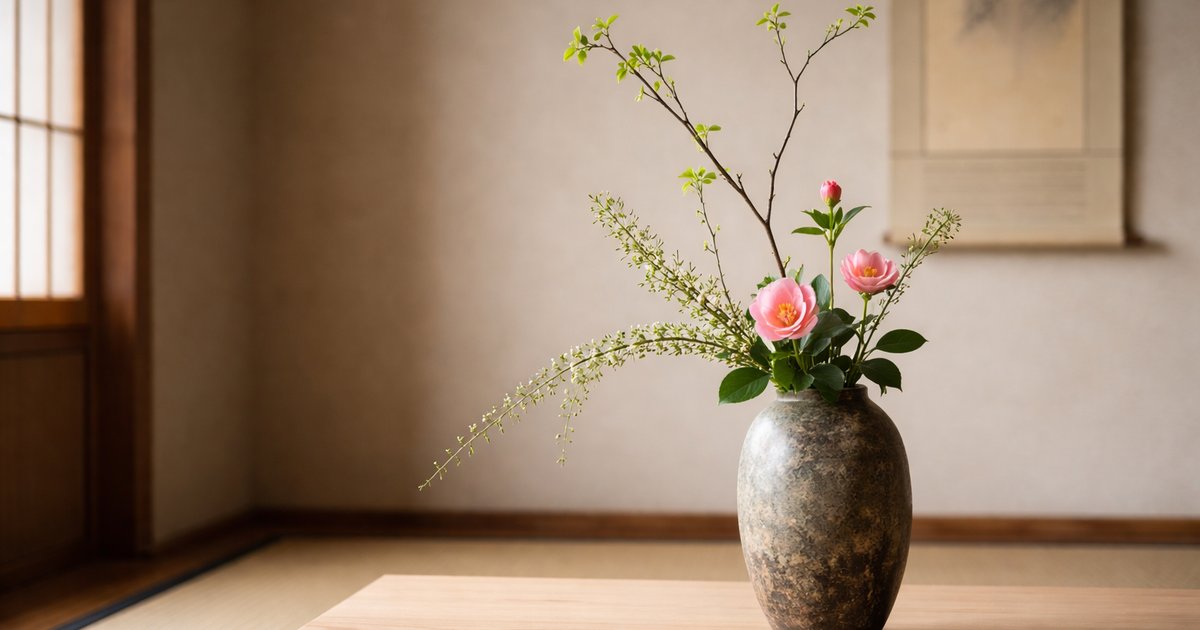
Say you decide to try ikebana. You start looking into it, and almost immediately you hit this:
Ikenobo. Ohara. Sogetsu. Ryusei-ha. Saga Goryu.
There are a lot of schools.
And it is not obvious how they differ. It is all arranging flowers, so why the split? Do you have to pick one before you can start? What happens if you pick the wrong one?
That is usually where people quietly give up.
So let’s deal with that part first. Here is the short answer: the difference between schools is a difference in what each one decided was beautiful. And picking the “wrong” one, as a beginner, is close to impossible.
What this article covers
- What an ikebana “school” actually is
- How many exist in Japan — and what the phrase “the three great schools” really means
- Ikenobo — the oldest, and the one that refuses to call itself a school
- Ohara — the one that invented the image you already have of ikebana
- Sogetsu — a school founded in order to get out of schools
- What actually separates the three
- How a beginner should choose
What a “school” is here
First, a note on the English word. These are called schools, but they are not schools in the sense of a place you enrol in and graduate from. A better way to think of it: a school is two things fused together.
- A system of form — which shapes count as beautiful. How a stem stands, where it goes, how many you use
- A structure for teaching it — a headmaster (iemoto), teachers, classrooms, and certificates awarded as you progress
So a school is an aesthetic decision plus the machinery to pass it on.
How many are there? The Japan Ikebana Art Association, a public interest foundation established in 1966, currently has 232 member schools and 3,250 individual members (as of 31 December 2025).
And that is only the schools that belong to that association. Others don’t, so the true number is higher.
Either way: this is not a choice between three or four options. There are hundreds of separate answers to the question of what a beautiful arrangement looks like.
About “the three great schools”
Despite that, three names come up together constantly: Ikenobo, Ohara, Sogetsu. In Japanese they are often called the three great schools.
Let’s be straight about this. It is not an official designation. No body has ruled that these three are the top three. It is a customary phrase, based on size and name recognition, and nothing more.
So in this article it means only “three representative schools.” Nothing here implies the others are lesser.
What these three do offer is the clearest possible view of how ikebana moved over five centuries. Taken in order, they read almost like a timeline.
Ikenobo — the oldest, and it will not call itself a school
In central Kyoto there is a temple called Rokkakudo — formally Shiunzan Chohoji. It is said to have been founded by Prince Shotoku, and it is known as the birthplace of ikebana.
Ikenobo is the family that has served as head priest of that temple, generation after generation. In the Muromachi period, Ikenobo held the post of shugyo, running the temple’s practical affairs, and it was from this line that figures like Senkei and Senno emerged during the period when ikebana was taking shape.
Now, something worth noticing.
Ikenobo does not call itself Ikenobo-ryu.
Every other school takes the suffix -ryu or -ha, roughly “school” or “branch.” Ikenobo’s official name is Kado Iemoto Ikenobo — no suffix at all. And it describes itself as the origin of ikebana.
Why no suffix? We could not find an official statement explaining the reason, so we will simply leave the fact standing on its own. Though the naming itself says a fair amount about where Ikenobo sits in this world.
Ikenobo teaches three styles.
- Rikka — established in the Muromachi period, the oldest style. Many kinds of plant material, arranged to express a whole landscape of nature
- Shoka — established in the Edo period. One to three kinds of material, expressing plants as they live with roots in the ground
- Jiyuka — no fixed form. You attend to the shape and texture of the material and arrange, literally, freely
A whole landscape; then a single plant rooted in earth; then no rule at all. Five hundred years of accumulated options, all still in use. That is what Ikenobo is.
Ohara — the school that invented the picture in your head
Now the part I most want to tell you.
Picture “ikebana” for a second. What do you see?
Probably: a wide, shallow dish holding water, with stems rising out of it, and at the bottom a small metal block bristling with pins.
The dish is a suiban. The pin holder is a kenzan.
The Ohara School’s own website puts it plainly: the image of ikebana as a shallow basin with a kenzan is well known, but it was the Ohara School that first created that form.
Which means the arrangement you picture as quintessentially Japanese, quintessentially old, is in fact one of the newest things in a five-hundred-year art.
The founder was Ohara Unshin (1861–1916). He was born in 1861, the closing years of the Edo period, into a family of potters in Matsue, Shimane. He worked as a sculptor in Osaka, then ill health turned him toward ikebana.
This was the Meiji era. Western culture was arriving, and with it Western flowers that Japan had never arranged before. The existing forms simply were not built for them.
So Unshin, drawing on his experience as a sculptor, designed new vessels — shallow basins and bowls made for Western blooms. Out of that came moribana: arrangement in a flat vessel, material “heaped” so that the composition spreads across a surface.
This was the decisive turn. Ikebana until then had been about standing things up. Rikka and shoka are compositions in line, rising. Moribana introduced the plane. Suddenly an arrangement could be wide as well as tall.
The school dates its founding to 1895. Its own account notes that finding beauty in wild grasses and foreign flowers was, at the time, a sensational move in the ikebana world.
The shallow basin you see in a classroom window or a florist’s display today is, in other words, a shape thought up about 130 years ago by a former sculptor.
Sogetsu — founded in order to leave form behind
The third is Sogetsu, founded in 1927.
Its first headmaster was Teshigahara Sofu, born in 1900 as the eldest son of an ikebana teacher. He was taught flowers from early childhood.
And he came to doubt it. Ikebana at the time had become a matter of form above all else, and Sofu wanted something that made room for the individual. He broke with his father and founded his own school.
Sogetsu’s thinking fits in one line:
Anytime, anywhere, by anyone.
Any time of year. Any place. Any person. And with any material at all — it does not have to be a flower. Branches, metal, paper: in Sogetsu these are all material.
There is a second line, from the founder:
“Once arranged, the flowers become the person.”
The mind of whoever arranged them shows in the arrangement, so the finished work becomes that person. Sogetsu treats this as its starting point.
What is interesting is the shape of the decision: in order to be free of schools, Sofu founded a school. If the goal were only to reject form, no organisation would be needed. Building one anyway suggests he believed free expression is also something that can be taught and handed on.
Sogetsu reaches its centenary in 2027.
Putting the three side by side
- Ikenobo — over five centuries. Three styles stacked up over time: rikka, shoka, jiyuka. Plants shown as they live in nature
- Ohara — founded 1895. Moribana opened up the plane alongside the line, and made room for Western flowers
- Sogetsu — founded 1927. Individuality over form. No restriction on material or setting
But there is one reading to avoid.
“Older school, stricter; newer school, freer.” That is not accurate.
The oldest of them, Ikenobo, includes jiyuka, a style with no fixed form at all. And Sogetsu, for all its freedom, has a curriculum, textbooks and graded qualifications.
The real difference is not old versus new but what each holds as most important: the life of the plant, the composition on the vessel, or the person doing the arranging. None of the three is the correct answer.
So how should a beginner choose?
You may be waiting for a recommendation. The most reliable answer comes, a little anticlimactically, from the Ohara School’s own beginner page:
Why not book a trial lesson at a classroom that is easy to get to — near home, near work?
And the things it tells you to check: the cost of lessons, which days they run, and whether you get on with the teacher.
Convenience and personal fit come before philosophy. Which, in terms of whether you actually keep going, is exactly right.
A workable order:
- See which schools have classrooms you can realistically reach. Each school runs a classroom search on its site
- Go to a trial lesson. Many classrooms let you turn up empty-handed
- Decide on the arrangement you made that day and the feel of the teacher. You do not have to choose by doctrine
And the thing most worth saying: you can change schools later. This is not a contract you cannot exit, and studying elsewhere is not a betrayal. If it does not suit you, go somewhere else. That is all it is.
In closing
- A school is a decision about what is beautiful, plus the structure that transmits it
- The Japan Ikebana Art Association has 232 member schools — and that is not the total
- Ikenobo is the oldest; it drops the “school” suffix entirely and holds three styles
- Ohara, founded 1895, created the shallow-basin-and-kenzan form you already picture
- Sogetsu, founded 1927: anytime, anywhere, by anyone, with anything
- Old does not mean strict, and new does not mean free
- Choose on reachability and the teacher, not on philosophy
232 schools means 232 versions of beautiful.
One flower, that many ways of answering it, and not one of the answers discarded along the way. That is probably the richest thing about this art.
So choosing a school is not choosing the right answer. It is choosing which voice you want to speak to flowers in.
If you pass a classroom window and see a shallow basin sitting there — that is a shape someone thought up 130 years ago, still in use. Starting from there is more than enough.
Sources
- Kado Iemoto Ikenobo, official site, “About Ikenobo” (when ikebana is treated as a “way” like tea or incense it is called kado; the name carries no -ryu or -ha suffix, only “Kado Iemoto Ikenobo”; rikka = oldest style, established in the Muromachi period, many kinds of material expressing a landscape of nature; shoka = established in the Edo period, 1–3 kinds of material expressing plants rooted in the earth; jiyuka = no fixed form)
https://www.ikenobo.jp/ikebanaikenobo/ - Kado Iemoto Ikenobo, official site, “Rokkakudo, the birthplace of ikebana, and its relationship with Ikenobo” (Rokkakudo / Chohoji, said to have been founded by Prince Shotoku, has had Ikenobo as head priest for generations and is called the birthplace of ikebana; in the Muromachi period Ikenobo served as shugyo, and Senkei and Senno established the position of iemoto)
https://www.ikenobo.jp/ikebanaikenobo/rokkakudo/ - Ohara School of Ikebana, official site, “About Ohara” (founded 1895; founder Ohara Unshin, 1861–1916, born into a potter’s family in Matsue, Shimane, worked as a sculptor in Osaka before turning to ikebana; designed basins and bowls for Western flowers and created moribana; moribana = arrangement in a flat vessel emphasising planar spread; “the image of ikebana as a shallow basin with a kenzan is well known, but it was the Ohara School that first created that form”)
https://www.ohararyu.or.jp/about/ - Ohara School of Ikebana, official site, “Start ikebana” (“why not book a trial lesson at a classroom that is easy to get to, near home or near work”; check lesson cost, days, and fit with the teacher; many classrooms allow you to attend empty-handed)
https://www.ohararyu.or.jp/beginners/ - Sogetsu School, official site, “About Sogetsu” (founded 1927; first headmaster Teshigahara Sofu doubted an ikebana centred on form and sought free expression respecting individuality; “anytime, anywhere, by anyone”; any material may be used; “once arranged, the flowers become the person”)
https://www.sogetsu.or.jp/about/ - Sogetsu School, official site, “Headmasters: Sofu” (born 1900, eldest son of ikebana teacher Teshigahara Hisaji; taught from childhood, questioned the form-centred ikebana of the day, broke with his father and founded Sogetsu in 1927)
https://www.sogetsu.or.jp/about/iemoto/sohu/ - Sogetsu School, official site, “Sogetsu marks its 100th anniversary”
https://www.sogetsu.or.jp/events/sogetsu100/ - Japan Ikebana Art Association, official site, “Overview” (established 1966; 232 member schools; 3,250 members as of 31 December 2025)
https://www.nihonikebana.or.jp/overview/ - Japan Ikebana Art Association, official site, “Member schools” (list of member schools as of 31 December 2025, published as PDF)
https://www.nihonikebana.or.jp/school_list/
“The three great schools” is a customary phrase, not an official classification. We could not find an official statement explaining why Ikenobo uses no school suffix, so this article states only the fact. For Ohara we have used the founding year given officially, 1895; some accounts instead treat 1910, when the name “Ohara-style kokufu moribana” was first used at an exhibition, as the decisive moment. We have not identified who invented the kenzan itself as a tool — what the Ohara School states is that it was the first to create the shallow-basin-and-kenzan form. Membership and member numbers are as of 31 December 2025 and will change.