September 10, 2026
What Is a Chasen? | One Piece of Bamboo, 160 Prongs — and Why “Eighty-Prong” Counts Only Half of Them
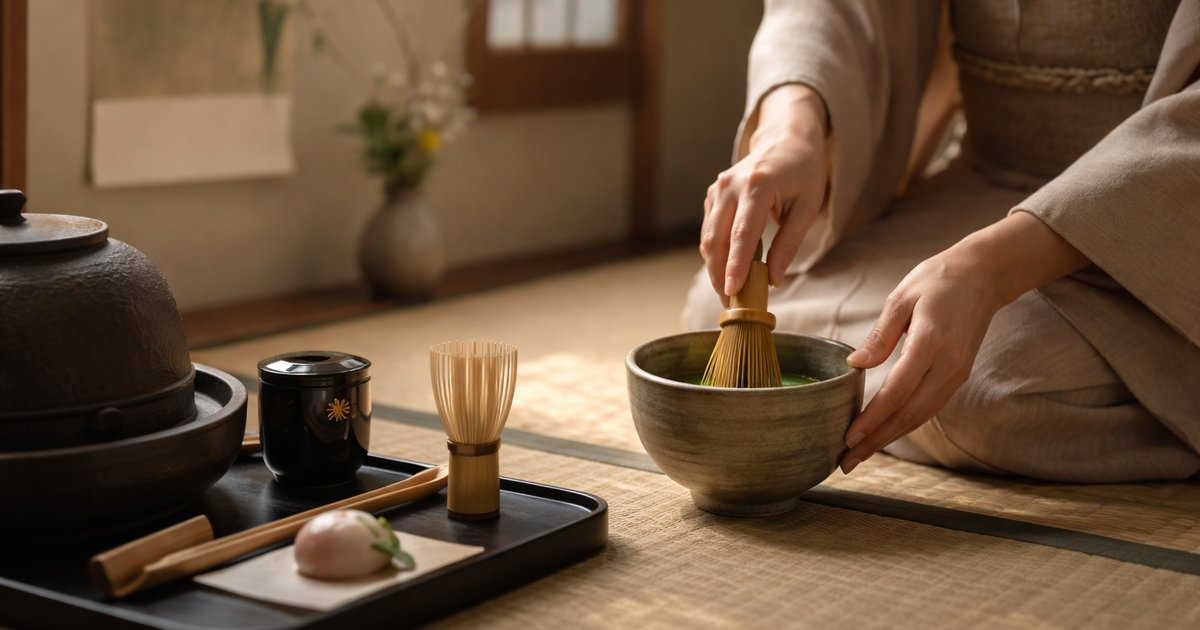
That tool you see when someone whisks matcha.
Pale, splayed at one end, a little like a shaving brush and a little like a kitchen whisk. It is called a chasen.
Most people, seeing one for the first time, assume the obvious: a bundle of thin bamboo strips, tied together at the base.
It isn’t.
A chasen is one piece of bamboo, from end to end. Nothing is bundled. Nothing is joined. It is a single tube of bamboo that has been split, and split, and split again — and what you are looking at is the result.
This is a story about splitting. By the end of it, the thing moving around inside the bowl should look a little different to you.
What this article covers
- Why a chasen is not an assembled object
- Why the “80” in “eighty-prong” is only half the real number
- Why the hardest step in making one is called “flavour shaving”
- There are 120 kinds — and why your first one is basically already chosen
- Why the bamboo is cut in winter
- Why more than 90% of Japan’s tea whisks come from one small town
- The 500 years when the method was kept secret
- What to do with it after you use it
1. The short answer: nothing was assembled
Urasenke, one of Japan’s major tea schools, describes the chasen in its beginners’ guide in a single line:
A bamboo tool for whisking matcha. The type of bamboo and the shape differ according to the school.
Two things are packed into that sentence. It is made of bamboo, and its shape depends on which school of tea you follow.
Take the first part further: it isn’t just made of bamboo, it is made of one piece of bamboo.
The prongs — the fine tines at the working end — are still attached to each other at the base. They were never separate parts gathered and tied. They are the far end of a single tube, opened up. Which means no prong can ever fall out. It also means that when one snaps, it cannot be put back.
Everything about a chasen being a consumable object follows from that.
2. How one piece of bamboo becomes 160 prongs
Chikumeidō, a maker in Nara, publishes its process step by step with photographs. Follow it in order.
The peeled bamboo is halved with a splitting blade. Then:
Half again, and half again, down to sixteen, forming what will become the prongs.
Half, half, half, half. That is 16 — still sixteen fairly chunky slats.
Then each of those sixteen is cut again:
Each of the sixteen pieces is then cut into ten, alternating thick and thin.
16 × 10 = 160. And that number connects directly to the number printed on the box when you buy one.
You may have seen a whisk sold as hachijippon-date — “eighty-prong”. So what is the 80 counting? Chikumeidō’s own caption answers it:
The thicker outer prongs number 80; together with the inner ones, 160 prongs in total are roughed out.
The 80 only counts the ones you can see from outside.
That is why the cuts alternate thick and thin. Thick prongs and thin prongs are made in turn, the thick ones bent outward, the thin ones inward. The outer eighty move the tea; the inner eighty break the foam finer. A two-layer structure, built inside a single stem.
Look down into a chasen from above and you will find a second ring of prongs facing inward. Almost nobody notices it when they first buy one. Nobody un-notices it afterwards.
3. The hardest step is called “flavour shaving”
After splitting comes shaving.
The prong ends are simmered in warm water, then shaved with great care so that they grow thinner towards the tip.
The hot water softens the bamboo so it won’t crack. Then each prong is thinned from the inside with a small blade, tapering towards the tip.
The name of this step is the good part. It is called ajikezuri — literally, flavour shaving.
The taste of the tea is said to change with this shaving. It is the most difficult step in making a chasen.
Japan’s official traditional-crafts guide, Aoyama Square, says the same thing about the designated craft:
Depending on how well the flavour-shaving step is executed, the taste of the tea differs subtly.
The thinness of a prong decides how it flexes. How it flexes decides how fine the foam is. How fine the foam is decides how the tea feels in your mouth. So the shaving step is named after flavour.
A manufacturing step named not after the object but after the sensation of the person drinking. That may be the loveliest thing about the whole craft.
After shaving, the prongs are curved inward with a spatula, their corners are pared so tea can’t lodge in them, cotton thread is woven between them, and the inner and outer rings are levelled. Aoyama Square counts eight steps in all. Every one of them by hand.
4. There are 120 kinds. Your first one is already decided.
If you are now thinking about buying one, here is the reassuring part first.
Yes, there are a lot of them. From the Aoyama Square entry:
There are as many as 120 kinds of Takayama chasen. The material, shape and number of prongs differ according to the school of tea and the use — thin tea, thick tea, ceremonial offering, outdoor tea, travelling tea set, and so on.
One hundred and twenty. Prong counts vary by source too: Aoyama Square gives 60 to 240, the City of Ikoma gives 60 to 120 — presumably a difference in how far out the specialist variants are counted.
But for a first whisk, the answer is unusually clear. Nara Prefecture’s page puts it plainly:
Broadly divided into those for thick tea and those for thin tea. […] The eighty-prong is the most widely produced.
For everyday matcha — what tea people call usucha, thin tea, more water and a lighter body — you want a white bamboo, eighty-prong. It is the most made, the easiest to find, and the easiest to raise foam with.
More prongs means water and powder mix more thoroughly and the foam comes finer. The low-count whisks exist to knead koicha, thick tea — far more powder, almost a paste. A beginner is very unlikely to meet it.
There are three bamboos: white bamboo (shiratake), smoked bamboo (susudake, darkened over decades in the roof of an old farmhouse), and black bamboo (kurochiku). As Urasenke said, which one you use depends on your school. Charts pairing specific schools with specific bamboos circulate widely, but we could not verify them against the schools’ own published material, so we are not printing them here.
If you are about to start lessons, ask your teacher before you buy. That is faster and more reliable than any chart. If you aren’t studying with anyone yet, a white bamboo eighty-prong will not let you down.
5. The bamboo is cut in winter
Nara Prefecture summarises the raw material in one line:
Uses hachiku, kurochiku and madake (three years old), cut in winter, de-oiled and sun-dried.
Four conditions in one sentence.
- Cut in winter — when the stem holds the least water and sugar. Less prone to insects, less prone to splitting
- De-oiled — heat or hot water draws out the natural oils; green bamboo turns pale and lasts longer
- Sun-dried — outdoors, slowly
- Three years old — younger is too soft, older is too hard
So the bamboo being shaved today was already growing three years ago. It was cut in winter, dried, and only then shaved. Like the making of matcha itself, everything on a tea tray started years before it reached the room.
6. Almost all of Japan’s tea whisks come from one town
This was the fact that surprised us most.
They are made in Takayama, in the city of Ikoma, Nara Prefecture. From the city’s own website:
Its share of domestic production exceeds 90% of the national total.
More than nine in ten of the whisks used in tea rooms across Japan come from this one place. They are known as Takayama chasen, and on 10 May 1975 they were designated a national traditional craft.
The same city page carries a maker’s own words:
We say that finishing seven chasen in a day makes you a full craftsman.
Seven. In a day.
On the same page: “A craftsman’s work runs from waking to sleeping — about fourteen hours a day.” Fourteen hours, seven whisks. Roughly two hours each.
If you have ever looked at the price of a good chasen and thought that much, for bamboo? — that number is probably your answer.
7. For 500 years, it was a secret
From here on, the certain and the uncertain are mixed together. Saying so up front.
Whisk-making in Takayama is said to have begun in the mid-Muromachi period, and both the prefecture and the city describe it as “500 years of history”. The origin story told locally goes like this:
It began in the mid-Muromachi period, when the son of the lord of Takayama made one at the request of Murata Jukō, the founder of the tea ceremony.
The Takayama Bamboo Garden, a municipal facility, names that son as Sōzei, names the man who commissioned it as Murata Jukō — held to be the originator of wabi tea — and adds that the emperor of the day admired the result and gave it a name.
This is an origin story handed down in local accounts, not something supported by contemporary documents. We are not going to state it as more than that.
Something else, though, is solid: the method really was kept out of public view for a very long time. The Bamboo Garden’s own account:
Holding fast to the injunction of secrecy, the craft was passed to a single heir, and no one but a son born to the family name was permitted to make chasen.
One heir per generation. Nothing leaves the household. And the reason the system finally broke is unexpectedly human: there were not enough hands. It could no longer be held, so the secret was opened.
Takayama today also makes tea scoops, ladles, flower containers and incense cases in bamboo. A good deal of the bamboo in any tea room comes from this one town.
8. What to do after you use it
Briefly, the practical part. Makers in Takayama and tea merchants say the same three things.
- No detergent, no scrubbing brush. Swish it in water or lukewarm water; coax off what remains with your fingers. A dishwasher is out of the question
- Dry it holding its shape. Left flat, the prongs draw inward, so it is set on a ceramic stand — a kusenaoshi, a “shape corrector” — and dried somewhere airy and out of direct sun
- Store it only when dry. Sealed damp in its tube, it will go mouldy
Even so, prongs eventually break. A broken prong cannot be rejoined — it was split from the same stem, so there is nothing to swap out. It is a tool that wears down as you use it.
The chasen sits oddly among tea utensils. Tea bowls last centuries. Tea scoops are named, boxed, inscribed, handed on. The chasen is used, damaged, and finished. It is made on the assumption that it will not last.
And it is still given two hours and eight handmade steps. That, quietly, is the point.
In closing
- A chasen is not assembled. It is one piece of bamboo, split, shaved and woven
- Sixteen splits, then ten each: 160 prongs. The “80” counts only the outer ring
- The hardest step is flavour shaving; the thinness of each prong decides the foam and the mouthfeel
- 120 kinds exist. For everyday thin tea, white bamboo, eighty-prong is enough
- The bamboo is three years old, cut in winter, de-oiled and sun-dried before it is touched
- Over 90% are made in Takayama, Ikoma, Nara; designated a national traditional craft in 1975
- Seven a day makes a full craftsman — about two hours each
- It is a consumable. A broken prong cannot be mended
One thing to try today.
Next time matcha is whisked in front of you — or by you — look down into the chasen from above. Inside the outer ring of prongs there is a second ring, turned inward.
That is the proof that it was once a single stem of bamboo.
Sources
- Urasenke, “Tea for Beginners” — utensils (a bamboo tool for whisking matcha; bamboo type and shape differ by school)
https://www.urasenke.or.jp/textb/shiru/beginer/dougu.html - Traditional Crafts Aoyama Square, “Takayama Chasen” (designated 10 May 1975; 120 kinds; 60–240 prongs; flavour shaving alters the taste; eight steps today; the mid-Muromachi / Murata Jukō origin account)
https://kougeihin.jp/craft/0625/ - Chikumeidō Kubo Samon, “How a Takayama chasen is made” (splitting to sixteen, then ten each; 80 outer prongs and 160 in total; flavour shaving as the hardest step; shaping, paring, weaving, levelling, finishing)
https://chikumeido.com/flow - Nara Prefecture, “Takayama Chasen” (hachiku, kurochiku and madake, three years old, cut in winter, de-oiled and sun-dried; thick-tea and thin-tea types; the eighty-prong is the most produced)
https://www.pref.nara.lg.jp/n101/1381.html - City of Ikoma, “Column: a traditional industry defended with pride — chasen making in Takayama” (over 90% of domestic production; seven a day makes a full craftsman; around fourteen hours a day; bamboo sourced in and around Takayama)
https://www.city.ikoma.lg.jp/html/keikan_masterplan/2-3-2c.html - City of Ikoma, “Traditional industries of Ikoma” (500 years of history; 60–120 prongs depending on use and school; tea scoops, ladles, flower containers and incense cases)
https://www.city.ikoma.lg.jp/0000002709.html - Takayama Bamboo Garden, “The history of Takayama” (the era of the eighth Ashikaga shogun; Sōzei, second son of the lord of Takayama; Murata Jukō; the imperial naming; secrecy and single-heir transmission; opened up for want of hands)
https://www.tikurinen.jp/history - Care instructions (swish-wash; no detergent, brush or dishwasher; dry on a shape-correcting stand out of direct sun; store only when dry) summarise guidance shared by Takayama makers and tea merchants
https://chikumeido.com/09_chadougu-maker-kokunai/ and https://www.senkien.jp/blog/chadougu_howtocare
The origin of the Takayama chasen (Sōzei, Murata Jukō, the imperial naming) is an account handed down in local sources and is not confirmed by contemporary documents; this article does not treat it as established history. Prong-count ranges also differ between sources (60–240 / 60–120). Pairings of specific tea schools with specific bamboos are omitted because we could not verify them against the schools’ own published material.