September 14, 2026
What Is a Chashaku? | Why a Bamboo Tea Scoop Gets a Name — the Node, the “Mei”, and Rikyū’s “Tears”
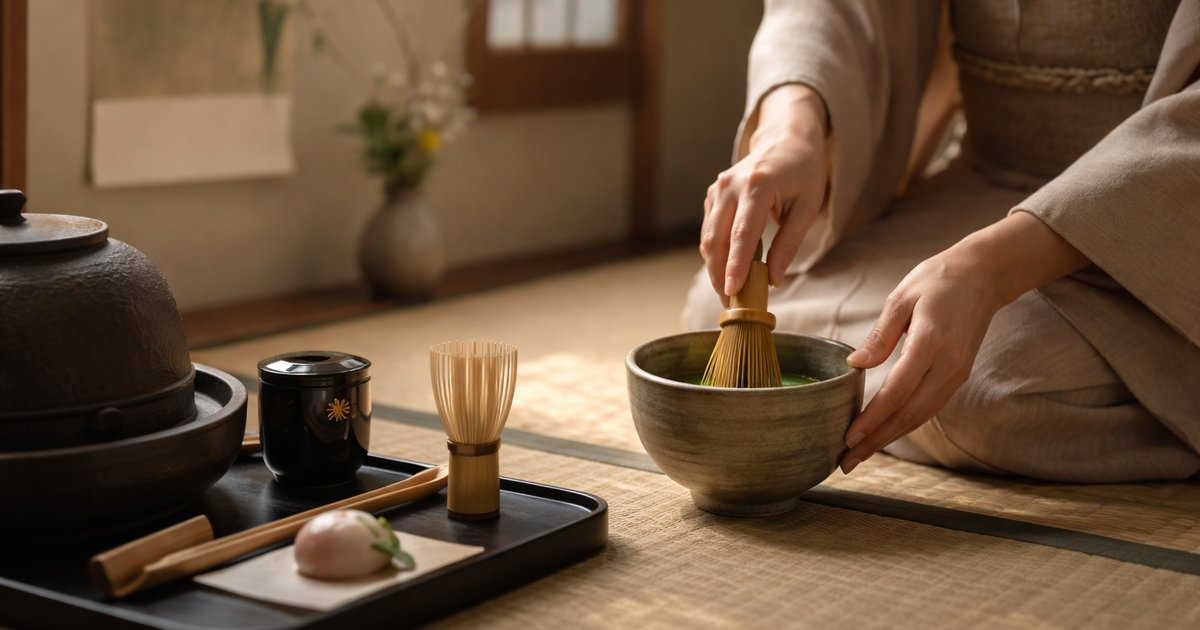
The slender bamboo spoon used to lift matcha into the bowl.
It is called a chashaku — a tea scoop. About twenty centimetres long. To look at, it is nothing more than one strip of bamboo, carved thin.
And yet this little spoon has something no kitchen utensil has: a name.
“Tears.” “Dew on the Bush Clover.” “Voices of Insects.” A chashaku can be given its own name, stored in a bamboo case with that name written on it, and kept for centuries.
In our article on the tea whisk, we said the whisk is a tool that wears out as you use it — while the tea scoop gets a name and is carefully kept. This is the other half of that story. Two tools made of the same bamboo. Why does only one of them get named?
What this article covers
- The tea scoop began as an ivory “medicine spoon”
- Where the bamboo node sits changes the scoop’s formality
- The tip is called the kaisaki — “the tip of an oar”
- What a mei, a tea scoop’s name, is
- What kind of names a scoop might carry in September
- The moment at a tea gathering when a guest asks, “And its name?”
- “Namida” (Tears), the scoop Sen no Rikyū is said to have carved for his final tea
1. The short answer: a tool that is given a name
Omotesenke, one of the main family schools of the Japanese tea ceremony, explains the naming of utensils on its official website roughly like this:
A mei is given to flower vases, tea bowls, tea scoops and the like, so that it may richly stir feeling — in the atmosphere of the tea room where a bowl is shared, and in the heart of the person of tea.
A mei is a proper name given to one particular object. In the case of a tea scoop, the scoop usually lives in a slim bamboo case, and the name is written on the case.
The tea whisk is used, worn down, and retired. The tea scoop is the opposite: a tool you name, and keep. The moment a plain carved strip of bamboo receives a name, it becomes that one. That is really all this article is about.
2. It began as an ivory medicine spoon
The first tea scoops were not bamboo.
When tea came to Japan from China, powdered tea was measured out with spoons made for medicine, usually of ivory or silver — matcha is said to have arrived first as a kind of medicine.
In Japan, the material changed to bamboo. Bamboo scoops are said to have spread from the time of Murata Jukō, regarded as the founder of the quiet, rustic style of tea known as wabi-cha. One explanation says he preferred bamboo because it makes little sound when it touches the bowl. Part of this is tradition rather than documented history, so please read it as “so it is told.”
Ivory scoops still exist. But almost every scoop you will see at a tea gathering today is bamboo.
3. Where the node sits changes the formality
Bamboo has nodes — the ring-like joints along the stalk. When people look at a tea scoop, the first thing they notice is where the node is.
Tea practice often ranks utensils in three levels borrowed from calligraphy: shin (formal, like block script), gyō (semi-formal, like running script) and sō (informal, like cursive). For the tea scoop, the level is read from the node:
- Shin — no node at all. Ivory scoops, closest to the original medicine spoon
- Gyō — the node at the very end (tomebushi)
- Sō — the node in the middle (nakabushi)
Nearly every scoop you’ll see today has the node in the middle. This form is said to have been established by Sen no Rikyū, and is sometimes called the “Rikyū shape.”
So the most informal level has become the most ordinary one. It is a small, pleasing thing: the whole drift of tea culture — from precious imported objects toward humble bamboo — seems to be recorded in the position of a single joint.
4. The tip is “the tip of an oar”
Each part of a tea scoop has a name. You don’t need them all. Just three:
- Kaisaki — the curved end that holds the tea. The characters mean “oar tip,” and it does look like the blade of a boat’s oar
- Fushi — the node. As above, its position sets the formality
- Kiridome — the cut end you hold
The underside of the tip sometimes carries a fine groove, called a hi. The way it is cut shows the hand of the person who made it.
Small differences like these are why a tea scoop, to someone who knows how to look, is not “a thin bit of bamboo” but a face you can recognise.
5. How are the names chosen?
What kinds of words become a mei? Omotesenke’s website lists them in a long, generous sentence — names taken from:
the owner of the object, the place where it is kept, its shape and colouring, the scenery of the four seasons, seasonal occasions, celebrations and mourning, and lessons or teachings — mei are of every kind.
Owner, place, shape, season, festival, celebration, a line of teaching. It is remarkably open.
In lessons and seasonal gatherings, though, the most common source is the season itself. For September, guides written for tea students give examples like Mushi no Ne (“Voices of Insects”) and Hagi no Tsuyu (“Dew on the Bush Clover”).
“Voices of Insects” means the crickets and bell insects singing on autumn nights. Japan has an old custom called mushikiki — listening to insects as music. To give a bamboo spoon that name is to hand the season to your guest: the person making tea and the person drinking it picture the same autumn.
Omotesenke’s website puts it this way:
Through the names of tea bowls and tea scoops, the meeting of hearts between host and guest becomes markedly stronger.
A name, then, is not decoration. It is a word placed between two people.
6. “And its name?”
A mei comes most alive after the tea has been drunk.
Near the end of the host’s preparation, a guest may ask to look at the utensils. This is called haiken, “respectful viewing.” At a gathering serving thin tea (usucha), the items passed out for viewing are often the tea caddy and the tea scoop.
The guests hold the scoop, look it over, and then ask the host about it. As commonly taught in lessons, the exchange goes something like this:
- Guest: “May I ask who made the tea scoop?”
- Host: “It is by (the maker’s name).”
- Guest: “And its name?”
- Host: “It is called Voices of Insects.”
The exact wording and order vary by school and by occasion. At your first gathering, the principal guest (shōkyaku, seated in the place of honour) usually handles this, and everyone else simply listens.
But do try to remember the name you hear. More often than not, the season the whole gathering was built around is folded into that single word.
7. “Tears” — the scoop Rikyū is said to have carved last
Finally, the most famous named tea scoop of all.
The Tokugawa Art Museum in Nagoya holds a bamboo tea scoop named “Namida” — Tears. Its maker is Sen no Rikyū, the tea master who shaped the tea ceremony as we know it. It is 16.8 cm long. Japan’s Agency for Cultural Affairs, on its Cultural Heritage Online database, describes it roughly as follows:
In the second month of 1591, having been ordered by Toyotomi Hideyoshi to take his own life, Sen no Rikyū carved this scoop himself, used it at his final tea gathering, and gave it to Furuta Oribe. Afterwards, it is said, Oribe made a case for it with a rectangular window, and through that window worshipped the scoop in place of a memorial tablet.
Furuta Oribe was Rikyū’s student, later a leading tea master in his own right. The case he made is lacquered black, with a horizontal window cut into its face. Cultural Heritage Online notes that when the case stands upright, it looks very much like a Buddhist memorial tablet.
What matters here is that this is a story “that is told.” The Tokugawa Art Museum itself uses the same careful phrasing — “it is said,” “it is handed down.” Whether this very scoop was used at Rikyū’s last tea, whether Oribe truly bowed before it: those things can’t be confirmed.
The scoop itself, though, is real, and its line of ownership is recorded: from Rikyū to Oribe, to Tokugawa Ieyasu, to Tokugawa Yoshinao, first lord of the Owari Tokugawa. The museum has shown it in special displays around Rikyū-ki, the memorial period for Rikyū’s death (in 2025, from February 22nd to March 2nd).
A bamboo spoon was given the name “Tears,” and for more than four hundred years it has not been just a spoon. Once a tool has a name, it begins to carry a story. That, more than anything, is what makes the tea scoop what it is.
8. Tea masters sometimes carved their own
“Tears,” it is said, was carved by Rikyū’s own hand.
Most tea utensils are made by specialists — potters for bowls, metalworkers for kettles. The tea scoop was different: it was often shaped, at least in part, by the tea person themselves. In early times, scoops are said to have been carved for each gathering and not kept, which is why very old ones are rare. Later it became common for a professional scoop maker to rough out the shape, and for the tea master to finish it and call it their own work.
You can’t fire a tea bowl at home. You can’t cast an iron kettle. But bamboo can be carved with a small knife.
A host shapes it by hand, names it in their own words, and offers it to a guest. That closeness is probably why the tea scoop, of all things, became the tool that receives a name. Like the two-mat tea room, it is small — and because it is small, feeling goes straight into it.
In closing
To sum up:
- A chashaku is the bamboo spoon for matcha. It began as an ivory medicine spoon from China
- Bamboo scoops are said to have spread from the time of Murata Jukō
- The node’s position sets the formality: no node = shin / node at the end = gyō / node in the middle = sō. Today’s standard is the middle-node “Rikyū shape”
- The tip is the kaisaki, shaped like the tip of an oar
- A scoop can have a mei, a name written on its case — very often a word for the season
- At a gathering, guests ask “Who made it?” and “And its name?”
- “Tears,” said to have been carved by Rikyū for his final tea, survives at the Tokugawa Art Museum
One small thing to try today.
Take the spoon you use for matcha, or coffee, and give it a name for today. In mid-September, it might be the insects singing outside your window, or the first slightly cooler evening breeze.
Just for today, your everyday spoon becomes that one. Which is, very likely, exactly what the tea masters were doing all along.
Sources
- Omotesenke Fushin’an official website, “Tea utensils: colour, shape and mei” (the role of names; kinds of names — owner, place, shape and colour, seasonal scenery, occasions, celebrations, teachings)
https://www.omotesenke.jp/list6/list6-1/list6-1-3/ - Omotesenke Fushin’an official website, “Tea utensils: box inscriptions” (names added by grand masters or noted tea people; names of bowls and scoops strengthening the bond between host and guest)
https://www.omotesenke.jp/list6/list6-1/list6-1-5/ - Cultural Heritage Online (Agency for Cultural Affairs), “Bamboo tea scoop, named Namida” (second month of 1591; final tea gathering; Furuta Oribe; windowed case used in place of a memorial tablet, as told; black-lacquered case; line of ownership Rikyū–Oribe–Ieyasu–Yoshinao; length 16.8 cm)
https://online.bunka.go.jp/heritages/detail/96849 - Tokugawa Art Museum, “Bamboo tea scoop by Sen no Rikyū, named Namida” (case description; single-groove tip, high node and deep underside carving typical of Rikyū’s scoops)
https://www.tokugawa-art-museum.jp/collections/%E5%8D%83%E5%88%A9%E4%BC%91%E7%AB%B9%E8%8C%B6%E6%9D%93%E3%80%80%E9%8A%98-%E6%B3%AA/ - Tokugawa Art Museum, “Special display: Sen no Rikyū’s ‘Namida’ tea scoop” (shown for Rikyū-ki; February 22nd – March 2nd, 2025)
https://www.tokugawa-art-museum.jp/news/%E7%89%B9%E5%88%A5%E5%85%AC%E9%96%8B%E6%B3%AA%E3%81%AE%E8%8C%B6%E6%9D%93/ - Chanoyu Jiten, “Shin, gyō and sō of the tea scoop” (shin = ivory, no node; gyō = end node; sō = middle node; the scoop arrived from China as a medicine spoon)
https://chanoyujiten.jp/tyasyakunosinngyousou/ - Touken World, “Chashaku” (medicine spoons of silver or ivory; Murata Jukō and bamboo scoops; the Rikyū shape; names of parts)
https://www.touken-world.jp/tips/116937/ - Wikipedia (Japanese), “Chashaku” (length about 16–21 cm; the name written on the case; early scoops made for each gathering and not kept; scoop makers’ rough carving finished by tea masters)
https://ja.wikipedia.org/wiki/茶杓 - The viewing exchange and the September name examples follow guides written for Urasenke tea students (secondary sources)
https://ocha-dangi.hatenablog.com/entry/haiken / https://ocha-dangi.hatenablog.com/entry/tyasyaku-mei
That bamboo scoops spread from Murata Jukō’s time, and that the middle-node form comes from Sen no Rikyū, are explanations widely given in reference works; they have not been confirmed here against contemporary records. That “Namida” was used at Rikyū’s final gathering, and that Furuta Oribe worshipped it through the window of its case, are traditions described as such (“it is said”) by both Cultural Heritage Online and the Tokugawa Art Museum. Quotations from Japanese sources are our own translations. The wording of the viewing exchange varies by school and occasion.