September 21, 2026
What Is a Kakemono? | In a Tea Room, the Most Important Object Is a Line of Writing — Bokuseki, a National Treasure Letter, and the Moment It Comes Down
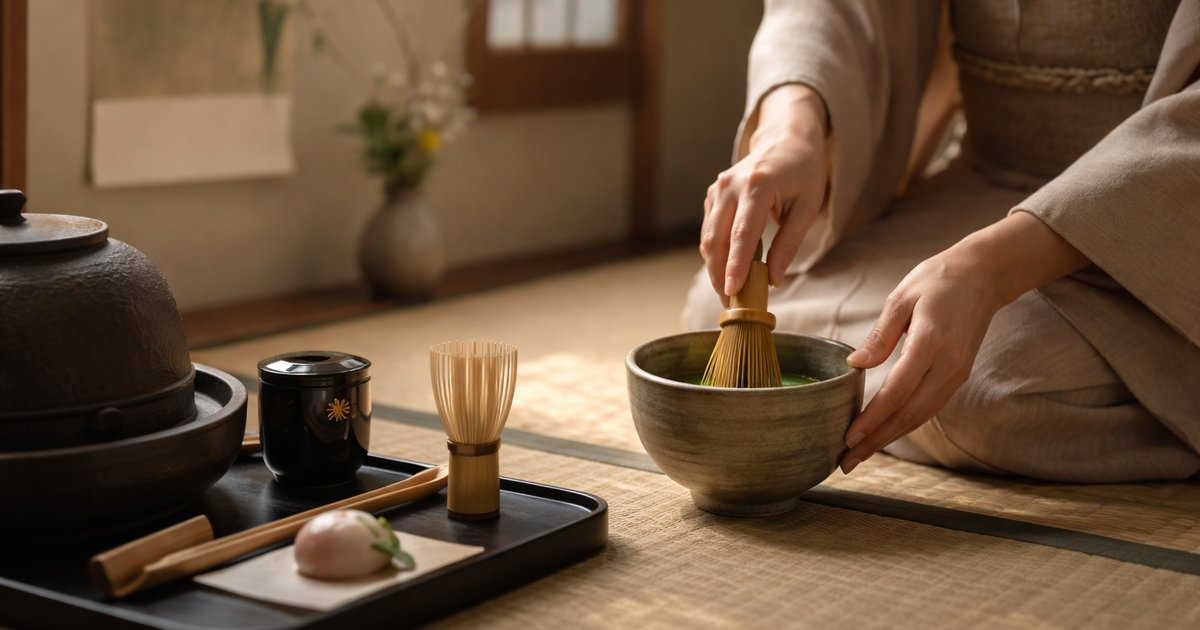
You’ve been invited to a tea gathering. You step into the tea room.
What do you look at first?
Not the tea bowl. Not the sweets. Omotesenke, one of the head schools of Japanese tea, describes the opening of a formal tea gathering this way on its official site:
On entering, the guests first view the scroll hanging in the alcove, then the hearth and kettle and any display on the shelves, after which they take their seats in order, beginning with the principal guest.
First, the kakemono — the hanging scroll in the tokonoma, the recessed alcove. You look at it before you sit down.
In our article on the tea room, we called the alcove the most luxurious space in the house: floor area kept empty on purpose. Today, we’re looking at the one thing that hangs there.
What this article covers
- Why the first thing you look at in a tea room is a scroll, not a bowl
- How the scroll announces the theme of that day’s gathering
- Bokuseki — the strange, prized genre of “handwriting by Zen monks”
- The letter that became a National Treasure
- “There is no utensil more important than the hanging scroll” — and the surprising origin of that famous line
- The phrases you’ll actually find on a scroll
- The moment, halfway through, when the scroll is taken down
- Why not being able to read it is completely fine
1. The scroll announces the theme
Urasenke, another of the head schools, explains the scroll like this in its beginner’s guide to tea utensils:
It is hung in the alcove to be viewed. It expresses the host’s feeling and the theme of the gathering, and plays the most important role of anything in the tea room.
The theme of the gathering. That is the scroll’s real job.
The bowl, the scoop, the flower, the sweet — each of them carries the season in its own way. But the reason this particular gathering is being held, what the host has in mind today: only the scroll says it in words.
There are several formats. The most common is the ichigyōmono, a single vertical line of Zen text. Written horizontally, it’s a yokomono. A scroll may also pair a painting with a line of writing, or be an old letter, hung exactly as it was sent.
Think of it as the title of a piece of music, announced before anyone plays a note — except it stays on the wall for the whole first half.
2. Bokuseki — you’re not looking at good handwriting
Among scrolls, the one most prized in tea is bokuseki.
The Kyoto National Museum defines bokuseki as “handwriting by monks, particularly Zen monks,” and notes that what survives covers a wide range:
- Inkajō — a certificate in which a master confirms that a student has understood
- Hōgo — a written teaching
- Yuige — a short verse written just before death
None of these were written to be art. They are letters, certificates, last words. That matters more than it might sound: nobody who wrote a bokuseki was composing a piece for exhibition.
The same commentary describes how they look. Unlike the elegant, delicate hands of Heian-period aristocratic calligraphy, bokuseki has “weight and sharpness.” Which is a polite way of saying: it isn’t pretty. It can be blunt, fast, and hard to read.
So why treasure it? Because Zen places its highest value on the unbroken line from teacher to student — on who understood, and from whom. The fact that a particular person wrote it is the point. You are not admiring skilled handwriting. You are looking at the life of the person who held the brush.
(If Zen itself is new to you, we have a beginner’s guide.)
3. A letter that became a National Treasure: “Nagare Engo”
One example of how far this reverence goes.
The Tokyo National Museum holds a National Treasure known as “Nagare Engo” — the Drifted Engo. According to e-Museum, run by Japan’s National Institutes for Cultural Heritage, it is an inkajō written in 1124, during China’s Northern Song dynasty, by the Chan monk Yuanwu Keqin (Engo Kokugon in Japanese) for his student Huqiu Shaolong. It is considered the oldest surviving bokuseki.
The odd name has a story behind it. The same commentary records a tradition that the scroll washed ashore on the coast of Bōnotsu in Satsuma — present-day Kagoshima — inside a paulownia-wood tube. Hence “the drifted Engo.”
Its journey afterwards is basically a history of Japanese tea. From Daisen-in at Daitoku-ji temple in Kyoto, to Tani Sōtaku, a wealthy merchant and tea practitioner in Sakai. Later, the commentary says, it is thought to have been divided into sections by Furuta Oribe at the request of the warlord Date Masamune. It then passed to Shōun-ji, and finally to Matsudaira Fumai, lord of the Matsue domain and one of the great tea figures of his age, who obtained it by giving the temple a thousand pieces of gold and thirty bales of rice a year.
All of that, for one letter. And the man who wrote it, Yuanwu Keqin, is also famous as the compiler of a Zen classic called the Blue Cliff Record. Hold onto that name — it comes back in a moment.
4. “There is no utensil more important than the scroll” — with a caveat
There is a very famous line about scrolls in the world of Japanese tea. The revised Sekai Daihyakka Jiten encyclopedia quotes it from a book called the Nanpōroku:
There is no utensil more important than the hanging scroll. Through it, guest and host alike bring their hearts as one into the way of tea. Among scrolls, bokuseki comes first.
For a long time this was passed down as the teaching of Sen no Rikyū, the sixteenth-century tea master. The Nanpōroku presents itself as notes taken by his student Nanbō Sōkei.
But here we should be honest. Scholars now largely regard the Nanpōroku as a later creation.
According to the same encyclopedia, the book surfaced in 1690, when Tachibana Jitsuzan, a senior retainer of the Fukuoka domain, assembled scrolls said to be Rikyū’s secret writings into seven volumes and, finding them untitled, named the whole the Nanpōroku. The encyclopedia states that “the compiler can only have been Tachibana Jitsuzan himself, who claimed to have discovered it,” and suggests the work was created in Rikyū’s name around the hundredth anniversary of his death.
Rikyū died in 1591. The year 1690 is, almost exactly, a century later.
So we can’t write “Rikyū said this.” What we can say is that this one sentence has shaped what hangs in tea rooms ever since. Whoever wrote it, it has been true on the alcove wall for about three hundred years. That feels like the right distance to stand at.
5. What the single line actually says
Rinnō-net, the official site of the Rinzai and Ōbaku schools of Zen, defines zengo — Zen phrases — as “words that express a Zen truth concisely.” They tend to be short, and are often drawn from Zen classics or the sayings of eminent monks. That’s almost always what’s hanging in a tea room.
Nichinichi kore kōjitsu — every day is a good day
Probably the best-known line of all. Rinnō-net gives its source as Case 6 of the Blue Cliff Record, a saying of the Tang-dynasty monk Yunmen Wenyan (864–949). The meaning: every single day is a fine day.
And there’s that name again — the Blue Cliff Record was compiled by Yuanwu Keqin, the man who wrote the letter that became a National Treasure. The scroll on the wall and the oldest scroll in Japan lead back to the same book.
The same page pairs the phrase with a poem by Yamaoka Tesshū, a swordsman of the late Edo period:
Fine when it’s clear, fine when it’s cloudy — Mount Fuji: its true form never changes.
A sunny day isn’t the good day and a grey day the disappointing one. Both are simply today.
Wa-kei-sei-jaku — harmony, respect, purity, tranquility
Four characters that hold the spirit of tea, known as the shiki, the four principles. Urasenke’s official site says all of the heart of tea is contained in them, and explains each:
- Wa — opening your heart to one another and getting along
- Kei — respecting one another
- Sei — being clean inside as well as out
- Jaku — a mind that stays steady whatever happens
Four characters, but what they amount to is: how to share one bowl of tea pleasantly with the person in front of you.
Ichigo ichie — one time, one meeting
This meeting will never come again. It hangs often. We’ve written about it at length in our article on ichigo ichie.
6. And then the scroll is taken down
This may be the most interesting thing about the kakemono.
A formal tea gathering has a first half and a second half, with an interval in between called nakadachi, when the guests leave the room and rest in the garden. Omotesenke’s official site describes what the host does during that interval:
The guests go out to the garden, beginning with the principal guest, and rest a while on the inner waiting bench. Meanwhile the host sweeps the tea room and opens the high window wider. In the room, he rolls up the scroll in the alcove, hangs a flower container on the wall facing the alcove, and arranges the flowers.
He rolls up the scroll and puts flowers where it was.
The most important utensil in the room — taken down halfway through. When the guests come back in, there is a single flower standing where the words used to be.
First half: language. Second half: a flower. Even the light has changed, because the window has been opened wider. When we wrote in our article on tea-room flowers that you should look at the alcove as soon as you enter, this second entrance is part of what we meant.
Say it in words, then take the words away. One alcove does both.
7. You really don’t need to be able to read it
If you’ve been thinking “but I can’t read cursive Japanese” — you’re in good company.
Most Japanese people can’t either. Tea scrolls are usually written in flowing cursive script, and being unable to make out what it says is the normal experience, not the exception.
There’s even a convention for it. At a gathering, guests ask the host what the scroll says. Like the exchange over the utensils described in our first-time tea gathering guide, asking isn’t rude — asking is the etiquette. For the host, it’s the moment to talk about the thing they most wanted to share that day.
Not reading it is no failure. You can simply watch the movement of the brush. If bokuseki is really about the person who wrote it, that may be closer to the original way of looking anyway.
8. Something small to try
- Look for bokuseki in a museum. Calligraphy galleries often have them. Instead of judging the handwriting, try asking “what kind of person was this?” It gets interesting fast.
- Choose your own line for today. The scroll announces the theme of the day. Write one line in a notebook or a phone memo. Suddenly the day has a title.
- Go to an autumn tea gathering. Autumn is a busy season for tea. Even just noticing what hangs in the alcove tells you something about what the host had in mind.
In closing
The most valuable object in a tea room is usually a bowl or a tea caddy. But the first thing anyone looks at is a single line of writing on the wall.
It isn’t necessarily beautiful handwriting. Often it can’t be read. And partway through the gathering it disappears, replaced by a flower.
Guests still look there first — the way you might ask, on arriving, what kind of day this is.
The next time you find yourself in a tea room, look up at the alcove before you sit. You don’t have to read it. The fact that something is written there means the gathering has already begun.
Sources
- Omotesenke Fushin’an official site, “Shoza” (on entering, guests first view the scroll in the alcove, then the hearth, kettle and shelf display, before taking their seats in order)
https://www.omotesenke.jp/list5/list5-3/list5-3-3/ - Omotesenke Fushin’an official site, “Goza / Nakadachi” (during the interval the host opens the high window wider, rolls up the scroll in the alcove, hangs a flower container on the wall facing the alcove and arranges flowers)
https://www.omotesenke.jp/list5/list5-3/list5-3-4/ - Urasenke official site, beginner’s guide to tea utensils (the scroll is hung in the alcove to be viewed; it expresses the host’s feeling and the theme of the gathering and plays the most important role in the tea room; ichigyōmono and yokomono)
https://www.urasenke.or.jp/textb/shiru/beginer/dougu.html - Urasenke official site, “The Heart of Tea” (the four principles wa-kei-sei-jaku, Rikyū’s seven rules)
https://www.urasenke.or.jp/textb/shiru/beginer/kokoro.html - Kyoto National Museum, “Bokuseki” (handwriting by monks, particularly Zen monks; inkajō, hōgo, yuige and more; weight and sharpness, unlike the elegance and delicacy of classical aristocratic calligraphy)
https://www.kyohaku.go.jp/old/jp/theme/floor1_3/f1_3_koremade/syoseki_20150102.html - e-Museum (National Institutes for Cultural Heritage), “Certificate of Enlightenment (Nagare Engo),” National Treasure, by Yuanwu Keqin, Northern Song, 1124, Tokyo National Museum (oldest surviving bokuseki; author of the Blue Cliff Record; tradition of washing ashore at Bōnotsu in a paulownia tube; Daisen-in → Tani Sōtaku → thought to have been divided by Furuta Oribe at Date Masamune’s request → Shōun-ji → Matsudaira Fumai, for a thousand pieces of gold and thirty bales of rice a year)
https://emuseum.nich.go.jp/detail?langId=ja&content_base_id=100223&content_part_id=001&content_pict_id=001 - Kotobank, “Bokuseki,” revised Sekai Daihyakka Jiten (Rikyū advocated bokuseki as first among alcove decorations; Nanbō Sōkei’s Nanpōroku insists “there is no utensil more important than the hanging scroll…”)
https://kotobank.jp/word/%E5%A2%A8%E8%B7%A1%E3%83%BB%E5%A2%A8%E8%B9%9F-383167 - Kotobank, “Nanpōroku,” revised Sekai Daihyakka Jiten and others (Tachibana Jitsuzan made a seven-volume copy in 1690 and named it; “the compiler can only have been Tachibana Jitsuzan himself”; created around Rikyū’s hundredth memorial; the forgery theory)
https://kotobank.jp/word/%E5%8D%97%E6%96%B9%E9%8C%B2-108662 - Rinnō-net (official site of the Rinzai and Ōbaku Zen schools), zengo “Nichinichi kore kōjitsu,” by Nishimura Eshin (source: Blue Cliff Record Case 6; Yunmen Wenyan, 864–949; “every single day is a fine day”; the Yamaoka Tesshū poem)
http://www.rinnou.net/cont_04/zengo/060601.html - Rinnō-net, “Zengo” (Zen phrases are words expressing a Zen truth concisely; usually short; often drawn from Zen classics or eminent monks)
https://rinnou.net/language/
Reference works differ on the origins of the Nanpōroku; some date it to around 1593. This article follows the revised Sekai Daihyakka Jiten, which attributes its compilation to Tachibana Jitsuzan in 1690, and therefore does not treat “there is no utensil more important than the hanging scroll” as Rikyū’s own words. The drifting of “Nagare Engo” is described in the museum commentary itself as a tradition, and the division by Furuta Oribe as something believed rather than documented. The flow of a tea gathering and the handling of the scroll vary by school and occasion. English translations of the quoted Japanese passages are our own.