September 27, 2026
October Is Nagori, the Month of Lingering in Tea | Nakaoki, the Worn-Out Brazier and Mended Bowls — Savoring Things That Are Almost Over
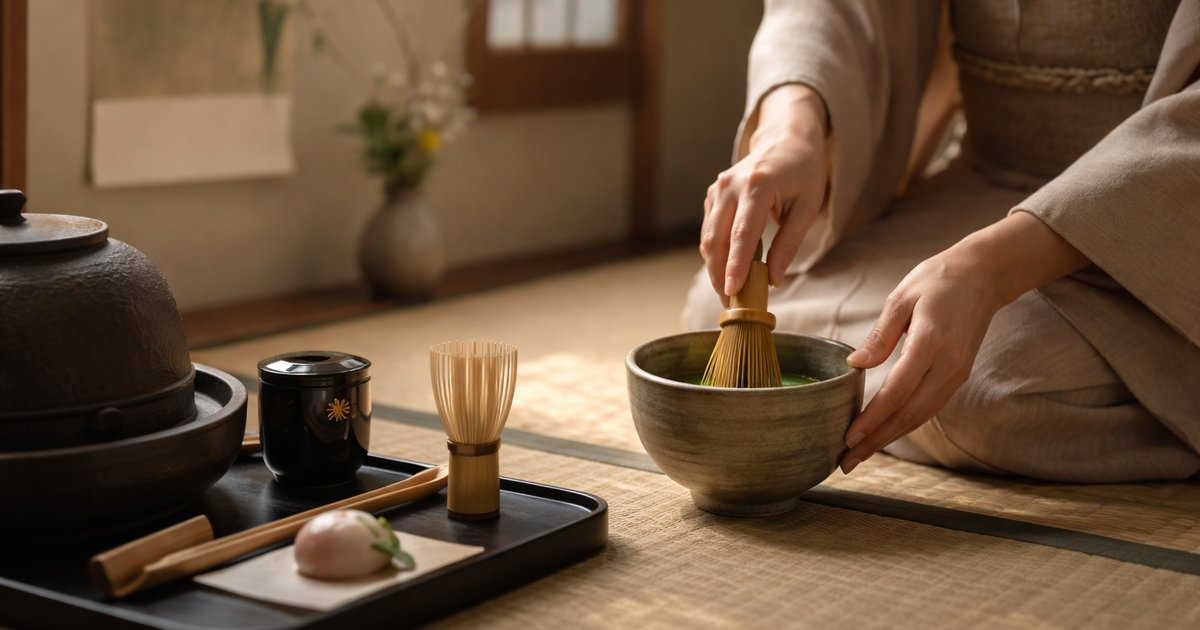
October is almost here. In the world of chanoyu — the Japanese way of tea — this month has a name of its own: nagori.
Nagori is the feeling of holding on to something as it slips away — a lingering. What tea people linger over in October is a little surprising. Not the autumn leaves, not the last warm days, but the tea itself, which they have been drinking all year, and the summer kettle stand they have been using for half a year.
This article has one message: in tea, October is the month for savoring things that are almost over. Once you know that, the slightly chipped utensils and mended bowls you may meet at an October tea gathering start to make quiet sense.
What this article covers
- Why the tea year begins in November
- Why October is called nagori, “the lingering”
- Nakaoki — when the brazier moves to the middle of the mat
- Yatsure-buro — a brazier that is broken on purpose
- What to look for at an October tea gathering
New Year for tea people is in November
Before talking about endings, it helps to know where the year actually ends.
The leaves that become matcha are picked in spring and early summer, packed into a large ceramic tea jar (chatsubo), sealed, and left to rest. Breaking that seal is called kuchikiri, “cutting the mouth.” The Japanese encyclopedia Sekai Daihyakka Jiten describes it as opening the jar of the year’s new tea in November and grinding it on a stone mill right there to serve — the most important New Year event in the tea calendar.
Around the same time, the equipment changes too. Through the warm months, water is heated in a furo — a freestanding brazier set on the mat. From November, hosts switch to the ro, a sunken hearth cut into the floor. This switch is called robiraki, “opening the hearth.” The official site of the Omotesenke school says it happens around the start of winter in early November, and quotes two old tea masters: Sen no Rikyū said to open the hearth “when the yuzu citrus turns yellow,” and his grandson Sōtan, “when your breath begins to show white.”
New tea and a new hearth, arriving together — that is why November is sometimes called “New Year for tea people.”
We follow the journey from tea jar to stone mill in more detail in our article on how matcha is made.
So October is the end of the year
If November is New Year’s Day, October is New Year’s Eve.
The tea from last November’s jar has been drunk a little at a time all year, and by now there is not much left. The Japanese dictionary Digital Daijisen defines nagori no cha as a tea gathering held to cherish the last of the previous year’s tea, and notes that today it is held from mid- to late October, as the season moves from brazier to hearth.
The other thing being let go is the brazier. According to Sekai Daihyakka Jiten, the furo is used in the warm season, May through October. After half a year together, it is about to be put away.
A tea jar that is nearly empty, and a brazier that is nearly retired. Tasting both of these “almost over” things slowly, without rushing past them — that is the nagori season.
The brazier moves to the middle — nakaoki
At an October gathering, if you look closely, you may notice the brazier is sitting somewhere new.
According to the Omotesenke school’s official site, in May, when the brazier season begins, the furo is placed toward the host’s side of the mat. As autumn deepens, it is moved to the center of the mat. This is nakaoki, “middle placement” — and the site explains it as a small kindness to bring the fire just a little closer to the guests.
As mornings and evenings turn cool, the fire moves a few dozen centimeters toward you. No announcement, no drama — just a quiet shift. That restraint is very much the spirit of tea.
The same page mentions that in October, kimono change from unlined to lined, and the summer reed screens in the doorways are swapped for paper sliding doors. The whole room starts getting ready for winter, a little at a time.
Whether nakaoki is used, and exactly how, varies by school and by gathering. Think of it as “something you might see in October” rather than a fixed rule.
Broken on purpose — yatsure-buro
One utensil belongs especially to the nagori season: the yatsure-buro, the “worn-out brazier.”
According to tea-utensil dealers’ guides, a yatsure-buro is an iron brazier whose rim or shoulder has partly broken away, or one whose cracks have been mended. It is also called kake-buro (“chipped brazier”) or yabure-buro (“broken brazier”).
Ordinarily, you would expect something like this to be thrown out as damaged. But tea people looked at crumbling, rusting iron and saw a landscape in it. The Tenpyodo tea-utensil dictionary says these braziers are used in the October nagori period, and that from the mid-Edo period onward they were often made worn-looking from the start. In other words, the broken shape itself became a form worth handing down.
At the end of the year, you bring out a utensil that is worn and chipped from long use. The end of the season and the near-end of an object, tasted together in one room.
Mended bowls, pieced-together bowls
It is not only the brazier. Writing about the nagori season, the tea practitioner Kimura Sōshin mentions tea bowls made by yobitsugi — gathering fragments of different ceramics and joining them into a single bowl.
Mending a broken vessel and going on using it connects directly to the idea behind kintsugi. For one famous bowl whose cracks were held together with metal staples, see our article on the Bakōhan tea bowl.
If you meet a mended bowl at an October gathering, it may be there not because it is old, but because it is October.
At an October tea gathering, try looking here
Look at where the brazier sits. If it is in the middle of the mat, that is nakaoki — the fire has been moved toward you.
Look at the brazier’s rim. If the edge is broken away, it may be a yatsure-buro.
Look for seams in the bowls. A line of gold, or patches of different patterns, means the bowl has been mended.
And if you are not sure, simply ask the host, “May I ask about this utensil?” Utensils chosen for the nagori season almost always come with a story the host is happy to tell.
In closing
Every culture has festivals to welcome something new. Fewer, perhaps, set aside a whole month to sit quietly with things that are ending — and to enjoy them just as they are.
The last of the year’s tea, whisked with water heated in a chipped brazier. That is the kind of bowl October holds. If you have the chance to attend a tea gathering this autumn, try looking for what is “almost over.”
Sources
- Omotesenke Fushin’an, “A Year of the Live-in Apprentice: October — Lingering of the Brazier” (Japanese; in October kimono change from unlined to lined, reed doors to fusuma / in May the furo is placed on the host’s side; as autumn deepens it is placed at the center of the mat — “nakaoki” — to bring the fire a little closer to the guests)
https://www.omotesenke.jp/chanoyu/7_10_1b.html - Omotesenke Fushin’an, “A Year of the Live-in Apprentice: November” (Japanese; robiraki around the start of winter in November; Rikyū: when the yuzu colors; Sōtan: when breath shows white)
https://www.omotesenke.jp/chanoyu/7_10_2b.html - Kotobank, “Nagori no cha” (Japanese; Digital Daijisen: a tea gathering held to cherish the last of the previous year’s tea; today held from mid- to late October as brazier gives way to hearth)
https://kotobank.jp/word/名残の茶 - Kotobank, “Nagori no chaji” (Japanese; Nihon Kokugo Daijiten: a gathering using the remaining tea of the previous year, about a year after kuchikiri; autumn seasonal word)
https://kotobank.jp/word/名残の茶事 - Kotobank, “Kuchikiri” (Japanese; Sekai Daihyakka Jiten: in November the seal of the jar holding the year’s new tea is cut and the tea ground on a stone mill; regarded as the most important New Year event in tea)
https://kotobank.jp/word/口切 - Kotobank, “Robiraki” (Japanese; Digital Daijisen: in tea, held from the end of October to early November)
https://kotobank.jp/word/炉開き - Kotobank, “Furo” (Japanese; Sekai Daihyakka Jiten: the furo is used in the warm season, May to October)
https://kotobank.jp/word/風炉 - Tenpyodo, tea utensil dictionary: “Furo” (Japanese; yatsure-buro also called kake-buro or yabure-buro; used in the October nagori period; from the mid-Edo period often made worn from the start)
https://tenpyodo.com/dictionaries/brazier/ - Kobayashi Shittō, “Yatsure-buro, iron” (Japanese; an iron brazier with part of the rim or shoulder missing, or with mended cracks; nagori chaji held from around mid-October)
https://kobayashishittou.com/item/madeinjapan-yatsurefuro-yatsureburo%E3%80%80 - Kimura Sōshin, “Sōshin’s Tea Talk No. 8: Kannazuki — Nagori” (Japanese; mid-October brings the nagori season / some schools use nakaoki / yobitsugi bowls / November called “New Year for tea people”)
https://salon-tea.jp/article/4188/
Whether nakaoki is used, how it is arranged, and when nagori gatherings are held all vary by school and by host. The description of yatsure-buro comes from tea-utensil dealers and a dealer’s dictionary; we could not confirm an official definition from a tea school. The words attributed to Rikyū and Sōtan follow the Omotesenke official site. Under the old lunar calendar, kuchikiri was held in early 10th month (Nihon Kokugo Daijiten); today it is generally held in November.