October 5, 2026
How to Look at Rikka: Start with the Shin | A Beginner’s Guide to Ikebana’s Oldest Style
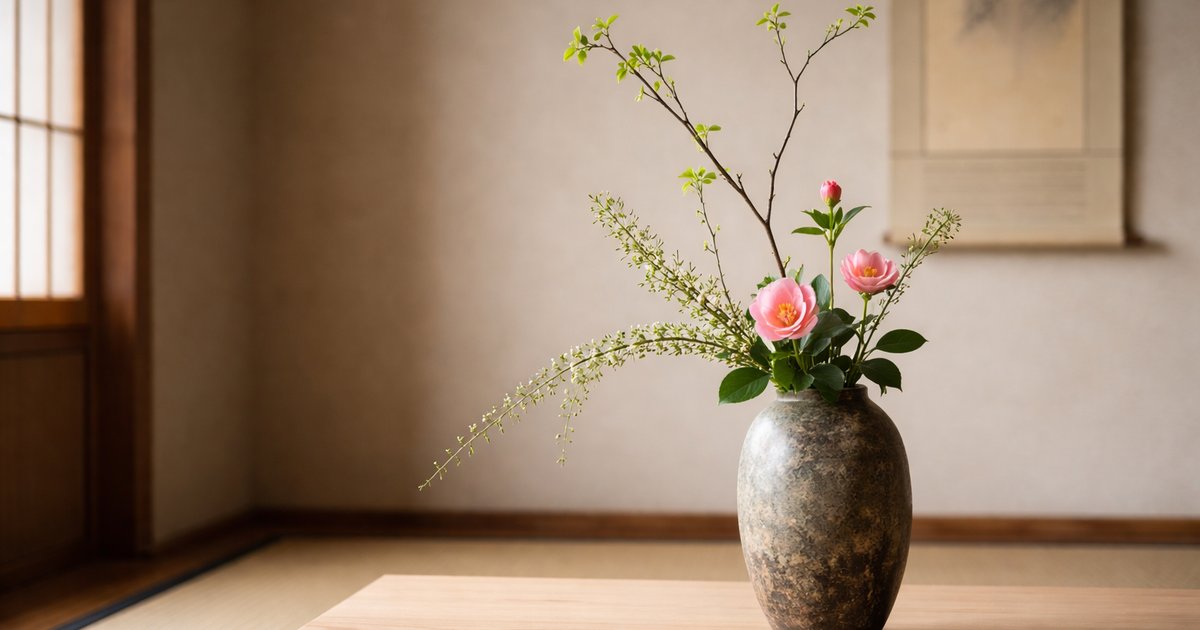
At an ikebana exhibition, you sometimes come across a piece that is bigger than the rest — branches, leaves and flowers packed tightly into one vessel. It’s hard to know where to look, so you think “wow” and walk on. Many of those pieces are rikka, “standing flowers.”
Rikka is the oldest style of ikebana. It uses many kinds of plants at once, so the first time you see one, the sheer amount of information can be overwhelming.
But you only need to start with one branch. This article has one message: to begin reading a rikka, first find a single branch called the shin.
What this article covers
- What kind of ikebana rikka is
- Why it is called “standing flowers”
- The shin — the first branch to look for
- Three things to look at in front of a rikka
- Rikka with a set form, and rikka without one
A landscape inside one vase
According to the official website of Ikenobo, the oldest school of ikebana, rikka is the oldest style of ikebana, established in the Muromachi period (roughly the 14th–16th centuries), and it uses many kinds of plants to express a whole natural landscape.
What’s interesting is how the plants are given roles. Ikenobo explains that in rikka, trees stand for mountains and grasses stand for water, so that a single vase holds the beauty of a landscape — and beyond that, everything in the world.
So a rikka is less a bouquet and more a small landscape of mountains and water. Think of the tall branches as peaks and the low grasses as the waterside, and it starts to look a little different.
It began as flowers offered to the Buddha
Why “standing” flowers?
Ikenobo explains that flowers offered to gods and buddhas since ancient times gave rise to an arrangement called tatebana, built from a central branch (the shin, or main tree) and the grasses at its feet (shitakusa). It came to be used where guests were entertained, and in the late Muromachi period it developed into rikka.
The site also mentions the mitsugusoku — a Buddhist altar set of three: a flower vase, an incense burner and a candle stand — being brought into the decoration of reception rooms. The Nihon Kokugo Daijiten, a major Japanese dictionary, likewise says the rikka style of standing a central flower or tree upright is said to come from these altar offerings.
The style was completed over the following century or so. Ikenobo describes rikka as having taken its finished form “from the late Muromachi period to the beginning of the Edo period” (around the early 1600s).
The first branch: the shin
In rikka, each branch has a fixed role and a name. These are called yakueda, “role branches.”
According to Ikenobo, when rikka was first established it was built from seven role branches. In the late Edo period, two more — dō (the body) and hikae (the reserve) — became standard, making nine. Their names include shin, soe, uke, mikoshi, nagashi and maeoki. You don’t need to memorize them.
The only one a beginner needs is the one at the center: the shin. Ikenobo quotes the saying that “the shin is the pivot of the whole vase,” and explains that it is the first branch put in place, and its shape decides the shape of the entire rikka. The other branches move in response to the shin’s line and volume.
So when you look, start with the shin too. Once you’ve found it, the other branches become readable, little by little, as “how they move in relation to the shin.”
Three things to look at
Ikenobo’s website offers a beginner’s guide to enjoying rikka. Here are three of its points.
1. Find the shin. What plant is it? What shape does it take? What was the arranger trying to do? Start by finding that one central branch. Sometimes it rises straight up from the center (sugushin); sometimes it swings out to one side in a curve (nokijin).
2. Find the mizugiwa, the “water’s edge.” This is the straight, upright section where the plants meet the vessel. It’s the reason rikka is called “standing flowers”: Ikenobo explains that it comes from standing a tree straight up as a yorishiro — a vessel for the divine to rest in — when offering to gods and buddhas. By custom, this part is set beautifully straight.
3. Look from the front, from slightly low. Ikebana grew up in the tokonoma, an alcove that can only be viewed from one direction, so every rikka has a front. The arranger built it while watching how the leaves overlap from that front, so the viewer should look from there too. Ikenobo says the best eye level is where you can just see a little space at the water’s edge.
Left and right are not matched on purpose
Once you’ve found the shin, compare the left and right sides. They almost certainly won’t be symmetrical.
According to Ikenobo, a flower manual from the Muromachi period uses the phrase uchō satan, “right long, left short.” If the right is long, the left is short; if the left is strong, the right is weak. The idea is to keep the balance while making the two sides unequal.
Another phrase, kokon enkin, “old and new, far and near,” refers to letting opposites live together in one vase — a distant view and a near one, an old branch and a new one. If you see a weathered branch next to a flower that has just opened, it’s probably not an accident.
Rikka with a form, and rikka without one
Today’s rikka falls into two broad types.
One is rikka shōfūtai, the standard form. According to Ikenobo, as students spread across Japan in the Meiji era (1868–1912), the shapes needed to be unified, so Ikenobo Senshō set down a model. That form has been carefully kept ever since.
The other is rikka shinpūtai, the new form. As the tokonoma — rikka’s traditional home — began to disappear from people’s houses, the current headmaster, Ikenobo Sen’ei, introduced it in 1999 as rikka free from a fixed pattern.
The oldest style also has one of the newest forms. If you see a rikka at an exhibition, guessing which kind it is can be part of the fun. For more on the differences between schools, see our article on ikebana schools, and for the vessels, our article on ikebana vases.
In closing
Even a rikka crowded with plants began with one branch.
If you ever find yourself in front of a rikka — at an ikebana exhibition or as an offering at a temple — look for the shin first, then bend down a little and peek at the water’s edge. Past the “wow,” you might see a small landscape of mountains and water.
Sources
- Ikenobo, “Rikka” (the oldest style, established in the Muromachi period / trees as mountains and grasses as water, expressing natural scenery and everything in the world in one vase / seven role branches at first, nine after dō and hikae became standard in the late Edo period / rikka shōfūtai set by Ikenobo Senshō in the Meiji era / rikka shinpūtai introduced by Ikenobo Sen’ei in 1999) (Japanese)
https://www.ikenobo.jp/ikebanaikenobo/ikebana/rikka/ - Ikenobo, official Ikenobo Senkō website, “Enjoying rikka, a traditional flower” (completed from the late Muromachi to the early Edo period / mitsugusoku brought into room decoration / “the shin is the pivot of the whole vase,” the first branch placed / the water’s edge comes from standing a tree straight as a yorishiro / viewing from the front at an eye level where the water’s edge shows a little / “right long, left short” and “old and new, far and near” from a Muromachi flower manual / sugushin, nokijin, sunanomono) (Japanese)
https://www.ikenobo.jp/shodai-senko/rikka/ - Kotobank, “Rikka” (Digital Daijisen: a central role branch called shin with seven, later nine, role branches around it / Nihon Kokugo Daijiten: the upright style is said to come from altar offerings / Heibonsha World Encyclopedia: the shin–shitakusa rules around 1490, rikka perfected around 1615–61) (Japanese)
https://kotobank.jp/word/立花
The names and number of role branches are written differently depending on the period and the source (even Ikenobo’s own websites list the original seven slightly differently). Dictionaries name Ikenobo Senkō II as the person who perfected rikka, while Ikenobo’s website says both the first and second Senkō contributed greatly. This article follows Ikenobo’s explanations; how to view rikka may differ between schools.