October 10, 2026
What Is Nageire? | The Ikebana Style Closest to Home — “Thrown-In” Flowers That Are Never Really Thrown
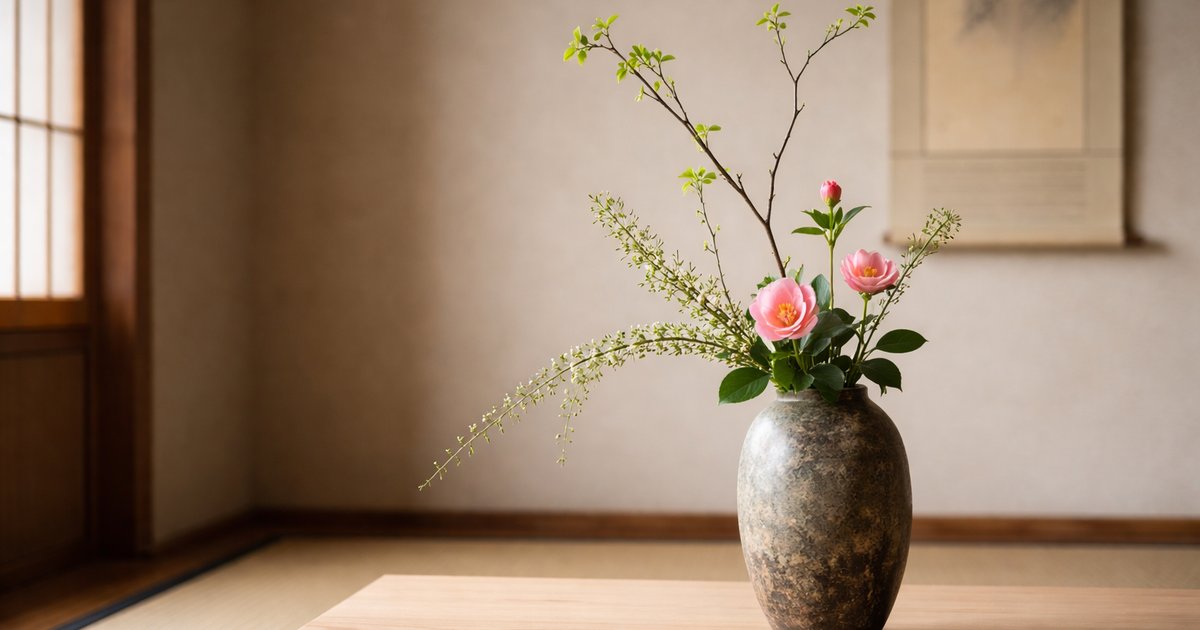
You buy a single stem at the flower shop and slip it into a slender bottle at home. Someone gives you a branch, and you stand it in a narrow-mouthed vase.
Without knowing it, you are doing something very close to an ikebana style called nageire — literally, “thrown in.”
Today, let’s take a gentle look at nageire, often described as the style of ikebana closest to everyday life at home.
What you’ll find in this article
- What nageire is
- Why “thrown-in” flowers are not actually thrown (the hidden supports)
- How nageire grew up alongside the tea ceremony
- How it differs from moribana, the “heaped” style
- How to try it at home tonight, with a single stem
Nageire: a tall vase, and flowers as they naturally are
Nageire means placing flowers and branches in a tall vase, in their natural shape. It is also written 抛入 — the first character means “to fling.”
Its key feature is that it does not use a kenzan, the needle-point holder used in shallow, flat containers. A kenzan won’t fit in a narrow-mouthed vase. Instead, the stems lean against the mouth and inner walls of the vessel.
And rather than bending stems into shape, nageire works with the direction and lean each flower already has. That is the biggest difference from carefully constructed styles such as rikka.
(For more on the kenzan itself, see “The Kenzan and Other Flower Holders.”)
“Thrown in” — but never really thrown
If you truly threw flowers into a vase, they would spin around and settle wherever they liked.
So nageire relies on small supports called tome (“stops”). Ikebana teacher Takanobu Saito describes two common ones on his blog:
- Jumonji-dome (cross support) — two twigs cut to the inner diameter of the vase, crossed just below the mouth. Flowers rest against them. It is very stable, but it only works in cylindrical vases, and it can crack a fragile one.
- Ichimonji-dome (single-bar support) — one short crosspiece fixed to the base of a stem. In a vase that narrows at the bottom, split the stem end and wedge the crosspiece in; in a jar that narrows at the top, tie them together with string. For soft-stemmed flowers, even a toothpick pushed sideways through the stem works.
None of this shows from outside. Just below the rim, something quietly holds the stem in place. To look as if it simply fell in naturally, it takes care where no one can see — that is nageire.
In English you may hear that the name comes from a bored samurai who, on a hot summer day, tossed plants into a vase across the room. Where this story comes from is unclear, so it’s best enjoyed as a legend.
Growing up with the tea ceremony
Nageire has deep roots. According to the Japanese encyclopedia Sekai Daihyakka Jiten, in the Muromachi period (14th–16th century) there was already a way of arranging flowers freely, without fixed rules, in contrast to the rule-bound rikka. In the Azuchi-Momoyama period it gained a firm place as chabana, flowers for the tea room, thanks to Sen no Rikyu.
Among the teachings handed down as Rikyu’s Seven Rules is “Arrange flowers as they are in the field.” The encyclopedia Nihon Daihyakka Zensho explains that chabana, true to these words, is fundamentally about placing flowers in the vase with their natural feeling intact. It also quotes the old tea text Nanpōroku: flowers in a small tea room are best as one kind, one or two stems, lightly arranged.
One kind. One or two stems. Lightly. Think of that as the seed of nageire, and a single stem in a bottle at home feels much closer to tradition.
(For tea-room flowers, see “What Is Chabana?“)
Spreading to townspeople in the Edo period
Japan’s Agency for Cultural Affairs explains that in the Edo period, alongside the fashion for rikka, interest grew in nageire — arranging flowers in their natural form — and it spread to merchants and other townspeople. A guidebook, Nageire Kadensho, was published in 1684, and Nageire Kishi no Nami (1750) discussed what nageire is and how to approach it.
“Free and natural,” yet people wrote books about it. Even a free style had its own path.
That article, by the way, reported that on October 18, 2024, Japan’s Council for Cultural Affairs recommended registering kadō (ikebana) as an Intangible Cultural Property — two years ago this month.
Nageire and moribana: it starts with the vessel
In many schools, beginners learn two styles side by side: moribana and nageire (some schools call it heika, “vase flowers”). The first difference is the vessel.
- Moribana — a shallow dish (suiban) with a kenzan; flowers are “heaped” to show breadth and surface
- Nageire / heika — a tall vase, no kenzan; the arrangement is shown through lines of stems and branches
Moribana is actually the newer one. The Ohara School says on its official site that it was founded in 1895, when founder Unshin Ohara introduced moribana. As Western flowers arrived, shallow dishes were designed to bring out their bright colors.
The same page describes the school’s heika as carrying on the lineage of the “nageire flowers” that existed since the Edo period. Whether a school says nageire or heika, both mean flowers arranged in a vase.
(See also “Ikebana Schools” and, for the carefully built rikka style, “How to Look at Rikka.”)
Trying nageire, gently, today
The lovely thing about nageire is that you need almost nothing.
- Find a narrow-mouthed bottle. An empty glass bottle or a sake flask is fine. The narrower the mouth, the more naturally the flower stands.
- One or two stems. Following “one kind, one or two stems,” keep it simple.
- Look at which way the flower faces. Which way does the stem lean? Where is the bloom looking? Don’t correct it — find the position where that lean comes alive.
- Add a support only if it won’t stay. A toothpick pushed sideways through the base of the stem often does the trick.
October brings slender autumn plants to flower shops — pampas grass, burnet, gentian. Thin stems, leaning plumes. It’s one of the seasons nageire suits best.
In closing
Nageire has the fewest rules of any ikebana style. But because there are so few, you end up looking very closely at the flower itself.
Which way it leans. Where it faces. Without correcting it, you search for the place where it looks most like itself.
“As they are in the field” doesn’t mean cutting a flower and dropping it in as-is. It means helping the flower remember, inside the vase, how it once stood in the field — that’s what nageire is for.
One stem in an empty bottle tonight. That is already the way in.
Sources
- Agency for Cultural Affairs, Japan, “Kadō no mukei bunkazai e no tōroku ni tsuite” (On registering kadō as an Intangible Cultural Property), Bunkaru News 016 (Nov. 21, 2024) — Council recommendation of Oct. 18, 2024; nageire spread to townspeople alongside rikka; Nageire Kadensho published 1684; Nageire Kishi no Nami (1750) discussed nageire; moribana and kakeihō formalized after Meiji
https://www.bunka.go.jp/prmagazine/rensai/news/news_016.html - Kotobank, “Chabana” (Nihon Daihyakka Zensho: chabana is based on “flowers as they are in the field” from Rikyu’s Seven Rules; has no fixed rules; quotes Nanpōroku. Sekai Daihyakka Jiten: nageire-bana, free in form as opposed to rikka in the Muromachi period, was given a firm place by Sen no Rikyu as chabana in the Azuchi-Momoyama period)
https://kotobank.jp/word/茶花-566907 - Ohara School of Ikebana, official site, “About Ohara-ryu” (founded 1895 with the introduction of moribana; moribana uses a flat container; heika continues the lineage of Edo-period nageire flowers)
https://www.ohararyu.or.jp/about/ - Takanobu Saito, “Securing material in nageire (jumonji-dome)”
https://ameblo.jp/tsaitou/entry-11998316470.html - Takanobu Saito, “Securing material in nageire (ichimonji-dome)”
https://ameblo.jp/tsaitou/entry-12002432757.html - Wikipedia, “Nageirebana” (samurai legend of the name; Mishō-ryū, Ohara-ryū and Saga Go-ryū call it heika)
https://en.wikipedia.org/wiki/Nageirebana
Rikyu’s Seven Rules are not Rikyu’s own writing; they are said to have been handed down by his students. The samurai origin story circulates in English, but its source could not be confirmed. Names and methods of supports vary by school and teacher. We use 1895 for Ohara’s founding per its official site; some reference works date it to the 1897 exhibition.