When is Hatsugama 2027? | January: The First Tea Ceremony of the New Year, Hanabira Mochi and the Knotted Willow
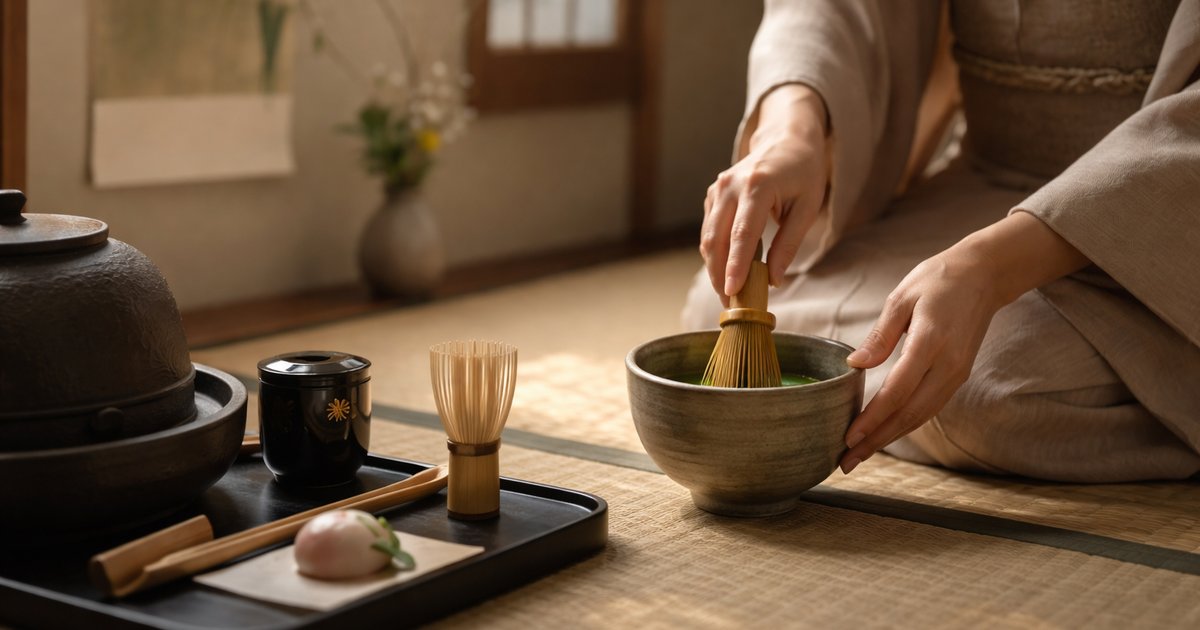
In 2027, Hatsugama, the first tea gathering of the New Year, takes place in January. There is no single fixed date: each school of tea and each teacher holds theirs on a day of their own in January. It is the moment the kettle is set over the fire for the first time in the new year.
If the Japanese tea ceremony has ever felt a little intimidating, this is a lovely place to start. Of all the gatherings in the tea year, it is the most festive, and somehow the softest.
Let’s take a slow look at what Hatsugama is.
What this article covers
- What Hatsugama is
- The surprisingly recent history of the name
- Hanabira mochi, the sweet of the first tea
- Musubi-yanagi, the knotted willow in the alcove
- Gentle tips for your first Hatsugama
The first bowl of tea in the new year
The name is written 初釜: hatsu means “first,” and kama is the iron kettle used to heat water for tea. Japanese dictionaries define Hatsugama as setting the kettle over the hearth for the first time in the new year and holding a tea gathering. In winter, the kettle sits in a ro, a small sunken hearth cut into the tatami floor.
In haiku, Hatsugama is a seasonal word for the New Year. For people who study tea, it is also the first gathering of the year with their teacher and fellow students: a way of greeting the new year together.
An old custom with a newer name
Tea gatherings at New Year go back a long way. According to a Japanese encyclopedia, the Tennōjiya Kaiki, the tea records of a merchant family in Sakai, describe a gathering for three guests on the fourth day of the New Year in 1565, called hatsuburo, and one on the same day in 1575, called hatsukai, “first gathering.”
In the Edo period, the first tea of the year came to be called chanoyu hajime or hatsu-chanoyu. The name “Hatsugama” itself is thought to have come into use only around the 1890s–1900s (the fourth decade of the Meiji era). An old custom, a fairly young name.
Hanabira mochi: a sweet with burdock inside
The sweet most associated with Hatsugama is hanabira mochi, “petal mochi”: a thin, white rice cake folded over, with a faint blush of pink showing through. Inside is sweet white miso paste and a stick of candied burdock root.
Burdock, in a sweet? According to a feature by West Japan Railway Company, the story goes back to New Year rituals at the imperial court in the Heian period. The court displayed hishi-hanabira, layered round white and diamond-shaped pink rice cakes, and held a hagatame rite, eating hard foods to wish for long life. Sweetfish (ayu) used in that rite are said to have been replaced by burdock by the early Edo period.
It was Gengensai, the 11th head of the Urasenke school of tea, who turned this into a sweet for Hatsugama. He is said to have asked Kawabata Dōki, the confectioner who had long served the imperial palace, to create a Hatsugama sweet based on the hishi-hanabira he had received from the court. The hanabira mochi found in Japanese sweet shops every January grew from there. The City of Kyoto also lists January’s hanabira mochi as part of Kyoto’s confectionery culture.
Musubi-yanagi: the knotted willow
At Urasenke Hatsugama gatherings, the alcove is decorated with musubi-yanagi, long, trailing willow branches tied into a loop.
In an interview, Nara Sōkyū, a senior instructor (gyōtai) of Urasenke, spoke of this loop: not a “line” with a beginning and an end, but a “circle” that keeps turning. One year ends, another begins. Perhaps Hatsugama is a place to feel that turning.
Decorations and sweets vary by school and by teacher. What you read here is one well-known example.
Enjoying your first Hatsugama, gently
- If you are invited, just ask: what to wear, what to bring and how the gathering flows all differ. Asking your host or teacher is always the easiest way
- Dress a little more formally than usual: kimono is not required at every gathering. See what to wear to a tea gathering
- You don’t have to be perfect: watch the guest beside you and take your time. Our guide to first-time tea gathering manners can help
- No gathering? A sweet and a bowl of tea at home: if you spot hanabira mochi at a Japanese sweet shop in January, enjoy it with tea at home. That alone feels like a small Hatsugama
You might also enjoy our articles on tea sweets and the hanging scroll in the tea room.
In closing
The sound of water coming to a boil in the kettle for the first time. Pale pink showing through white mochi. A loop of willow in the alcove.
Sometime in January 2027, in a tea room somewhere, the first bowl of the year will be whisked.